Consider the part of an eye operation that happens before the patient enters the room. Somewhere else, a technician has prepared donated tissue. Someone has checked the order, arranged transport, and matched the preparation to a surgeon’s requirements. By the time the surgeon reaches for the graft, a small production has already taken place. CorneaGen’s business lives inside that production.
- It prepares donated corneal tissue for surgeons and healthcare facilities.
- Its preloaded products move delicate preparation into specialist laboratories.
- Its CTAK service customizes tissue inlays to reshape keratoconic corneas.
This is a useful place to look if you want to understand medical innovation. The interesting improvement can be a change in where a task happens. CorneaGen supplies tissue, devices, and instruction; the surgeon brings those pieces together for a patient. The company reported that donated tissue supported more than 39,000 surgeries in 2025. That number describes a great deal of coordination.
A graft with its homework done
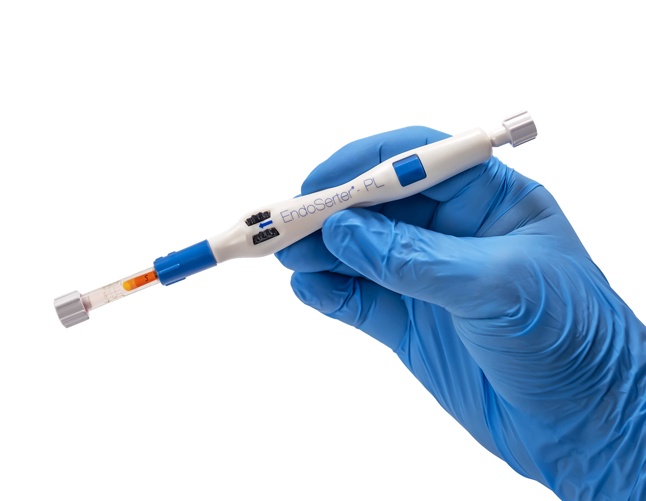
Start with the EndoSerter-PL. In a photograph, it resembles a thick pen in a blue-gloved hand. It is an FDA-cleared, single-use insertion device for DSEK surgery, supplied with a thin donor graft already loaded. CorneaGen offers it with Nano-Thin or Ultra-Thin tissue. The device carries part of the laboratory’s work into the operating room.
That detail changes the division of labor. Loading a fragile graft is a task somebody must perform. Preparing it beforehand gives that task to the tissue-processing team and reduces manipulation in the operating room. CorneaGen’s proposition is practical: let the surgeon receive more of the preparation already completed.
The same thinking appears in its Geuder preloaded glass cannula for DMEK, another form of corneal transplantation. Tissue arrives punched to a specified diameter inside a transport cartridge. These are different surgical workflows, with different tissue preparations. What they share is an attempt to make the handoff between an eye bank and an operating room more useful.
CorneaGen sells into a specialist market: ophthalmologists, hospitals, and ambulatory surgery centers. Its business combines fees for tissue services with surgical products. Competitors have learned the value of preparation, too. Eversight offers preloaded DMEK and DSAEK tissue, alongside education. Prepared grafts alone therefore do not explain CorneaGen’s position. The particular devices, processing experience, and newer custom-inlay service matter.
Add tissue. Change the shape.
CTAK gives donated tissue another assignment. Keratoconus changes the shape of the cornea. Corneal Tissue Addition Keratoplasty uses custom donor-tissue inlays to contour that shape. CorneaGen commercially launched the service in June 2024, working with CTAK LLC and Ziemer. The procedure’s co-inventors include Peter Hersh, Steven Greenstein, and John Gelles.
“We have a long history as innovators and tissue processing leaders,” president and CEO Bernie Iliakis said at launch. Here, that processing experience becomes a service built around an individual patient. Corneal scans and clinical information inform a surgical plan; tissue is laser-cut to specified dimensions and supplied ready for the procedure.
CorneaGen describes the inlays as gamma-irradiated and sterile, with a two-year shelf life. Its onboarding guide makes the surrounding requirements clear: training, suitable patients, compatible tomography and laser equipment, and a plan for billing. It asks practices to anticipate three weeks between ordering CTAK tissue and delivery. Customization has a calendar.
By September 2026, the company reported nearly 3,000 cumulative CTAK procedures. That is evidence of use, rather than a guarantee of an individual patient’s result. The scale is interesting because adopting a procedure requires more than liking an idea. A practice has to arrange equipment, select patients, learn the technique, and make the service fit its day.
The invoice belongs in the story
The least glamorous page on a medical company’s website can be the most revealing. CorneaGen’s reimbursement guidance says commercial coverage for CTAK varies; some insurers consider it investigational. It provides consultation and documentation resources. A facility’s enthusiasm still has to survive the payment process.
In its broader policy work, CorneaGen says its analysis of Medicare claims found hospital outpatient departments submitted no tissue charge 45 percent of the time. The company warns that missing those charges can make transplant procedures appear financially unattractive. The implication is uncomfortable: an accounting omission can influence whether a service looks sustainable.
The operation has a supply chain.
The supply chain has an invoice.
Delivery creates another constraint. In March 2026, CorneaGen warned that airspace restrictions and transport disruption could delay tissue shipments. Even carefully prepared tissue depends on a working route to the surgeon. The operational lesson travels beyond healthcare: prepare the product, train the customer, and examine the handoffs that can stop the product being used.
A company changes shape, too
CorneaGen grew out of SightLife in 2016, initially as SightLife Surgical. Founder Monty Montoya led the company; Iliakis, who began eye banking as a technician in 1995, later assumed its leadership. The 2018 CorneaGen rebrand accompanied a broader product portfolio. Today, its KAMRA page offers support only for existing patients and customers, a reminder that portfolios evolve.
Expansion required capital. In 2019, the company announced $37 million in Series B equity, led by Flying L Partners with Falcon Vision and Petrichor participating. Petrichor also supplied a separate $25 million credit facility. Those figures describe financing, rather than the price of developing CTAK or a current cash balance.
The corporate boundary changed afterward. Aurion Biotech’s SEC filing records the April 2022 separation that made CorneaGen’s tissue business independent. Its current story should be read with that distinction in mind. More recently, CorneaGen acquired Lions Eye Bank of Texas in late December 2025, following a processing and distribution relationship that began in 2018.
That sequence suits this company. Work together, learn the handoffs, then expand the arrangement. For anyone building a technical business, the idea is worth borrowing: study what the customer must do before your product becomes useful. CorneaGen’s place in corneal care is among those preparatory steps, where a donor’s gift becomes something a surgeon can use.