The problem with putting a lens inside an eye is that the place it must fit is partly hidden. The iris, that familiar ring of color, stands in the way. A surgeon can inspect the front of the eye and still want a better account of the space behind it. ArcScan has built a company around that awkward little fact. Its proposition begins with a practical question: before choosing the implant, how well have you measured the room?
- Robotic ultrasound captures anatomy behind the iris for surgical planning.
- The Insight 100 combines imaging, measurement tools and operator training.
- A strategic investor and China approval connect the scanner to a wider lens market.
A ruler for the hidden room
A phakic intraocular lens sits inside the eye while the natural lens remains. Planning its size involves anticipating its position and the clearance, or “vault,” above the natural lens. ArcScan’s Insight 100 supplies images and biometric measurements for that decision. The surgeon can feed the data into a sizing formula, then scan after surgery to examine the result. The useful object is a measurement that changes a decision.
That is why the company talks so much about the “Dark Zone” behind the iris. Its ultrasound can reveal the ciliary sulcus, ciliary body, masses and cysts. Optical coherence tomography, or OCT, uses light; ultrasound uses sound. Their views overlap, but their visibility through tissue differs. ArcScan occupies the part of ophthalmic imaging where those differences matter, alongside the broader market for anterior segment diagnostics.
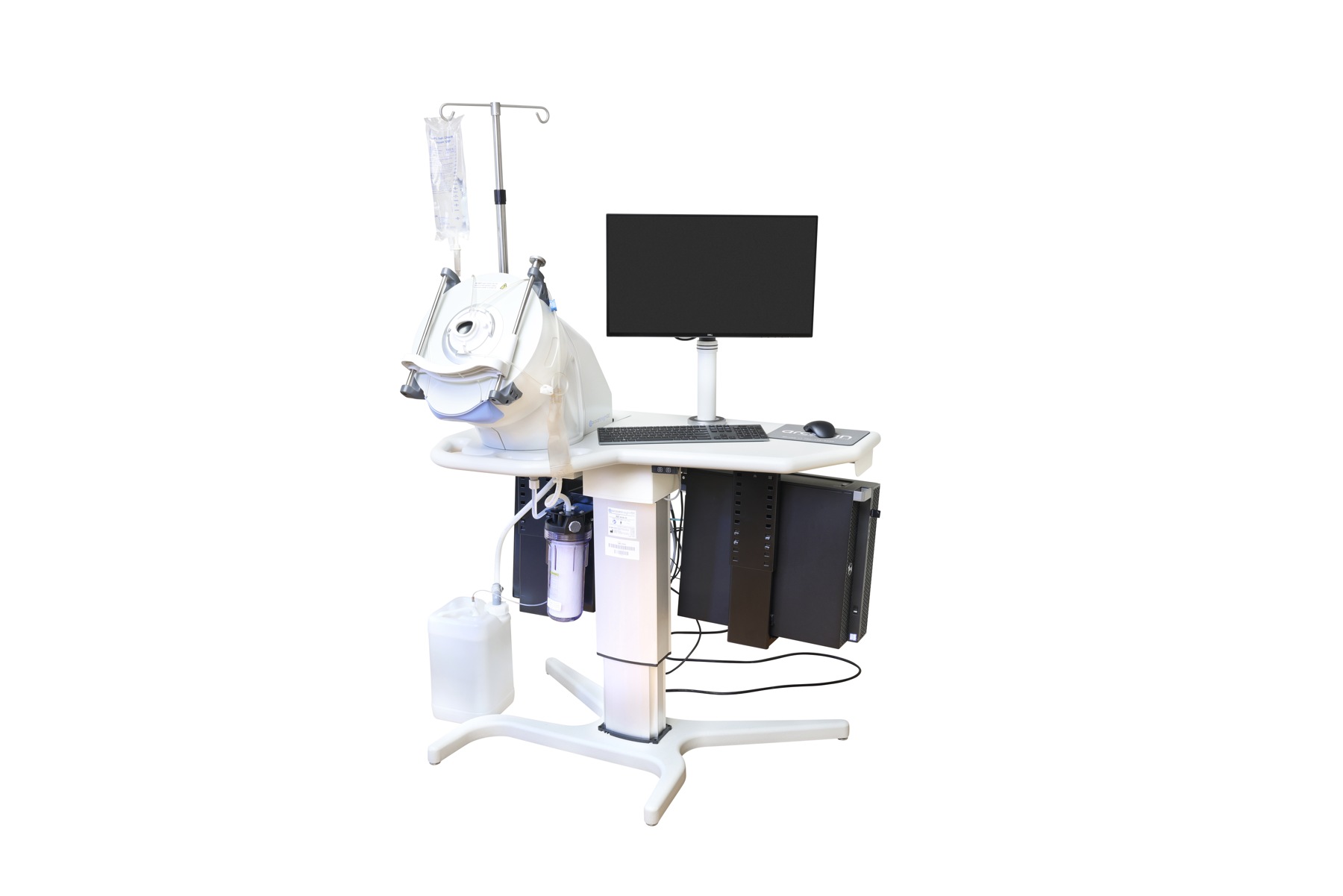
The robot’s job is to repeat itself
The instrument’s name contains a clue. Its transducer follows an arc corresponding to the curved front of the eye. Computer control guides the scan rather than leaving the entire movement to an operator’s hand. Configured scan sets and adjustable scan positions give clinicians different views. The engineering aim is consistency: return to a structure, measure it, and make a useful comparison.
The patient sits at the workstation with a disposable EyeSeal around the eye. Saline fills the interface; the probe itself does not touch the eye. ArcScan compares the arrangement to a swim goggle. The apparatus includes the scanner, software, fluidics and electronics. That unglamorous plumbing belongs in the story. Sound needs its liquid route, and a patient needs a position they can maintain.
- 01 Position
- 02 Scan
- 03 Measure
- 04 Review
Against handheld ultrasound biomicroscopy, the attraction is controlled acquisition and repeatable positioning. Against optical instruments, it is access to anatomy that light may not adequately reveal. Neither comparison makes every other machine obsolete. A 2022 study of lens biometry compared Insight 100 with Tomey’s CASIA2 OCT. It reported repeatable ultrasound measurements, while noting manual calipers and limits in the study population. The operator still has work to do.
A research instrument learns clinic hours
ArcScan began in February 2007 to commercialize Artemis 2 technology developed by Dan Reinstein and Ronald Silverman. The company’s account emphasizes simplifying the system and expanding its applications. FDA clearance and CE marking followed in 2016. By November 2017, ArcScan was announcing sales to Walter Reed National Military Medical Center and Naval Hospital Camp Lejeune. A laboratory lineage was becoming clinical equipment.
Walter Reed ophthalmologist Won Kim highlighted a revealing benefit in that purchase announcement: technicians could acquire the scans. His interest extended from implant planning to following anterior segment structures over time. A machine becomes more useful when obtaining its images fits an ordinary clinic day. ArcScan’s training materials accordingly include preparation, hands-on instruction, refreshers and clinical applications support.
The company’s undated history reports roughly 70 clinics worldwide, including academic, hospital and military sites. Its customers also include refractive surgery practices. Beyond lens sizing, the platform supports corneal epithelial mapping and keratoconus risk evaluation. Those applications share a basic purpose: give the clinician more anatomical information before deciding whether, and how, to intervene.
The other thing that needed fixing
The operational snag in a Qualio customer case study is almost comically analog. A company selling controlled imaging was relying on its contract manufacturer’s paper quality system. As sales grew, approvals became slow. ArcScan established an internal quality team and selected a cloud system that would avoid adding a server for its lone IT technician to manage.
“The system we were using didn’t seem to meet our needs.”Andrew Levien, then CEO, in Qualio’s customer case study
The migration involved roughly 300 to 400 documents. Qualio’s account says the transition also exposed incomplete procedural follow-through at the subcontractor; it reports no major resulting problems. This is a supplier’s case study, but the practical lesson is specific. Assign responsibility, preserve the record, and make an unfinished action visible. Better instrumentation still needs a business process that can keep up.
Follow the lens
In July 2021, ArcScan announced an agreement for an $11.15 million preferred Series B investment from Shanghai Haohai Biological Technology. Haohai’s ophthalmology portfolio made the relationship more than a financing headline. Lens products and the equipment used to plan their placement have an obvious connection. ArcScan presented the deal as a route toward expanding in China.
$11.15m investment agreement announced
NMPA approval announced in May
The company announced Chinese NMPA approval in May 2024. That July, J. Erik Giphart succeeded Andy Levien as CEO after five years leading engineering. The priorities included Chinese and US markets. Giphart had also brought R&D in-house. The pattern suggests a business concentrating on the machinery of expansion: technical control, clinical use and market access.
The approach depends on trained acquisition, patient cooperation and competent interpretation. ArcScan’s resources specify adults under its FDA clearance and a patient able to maintain the seated position. The 2022 lens study excluded poor fixation and several disease categories. For a clinic, the sensible question is which decisions the extra view improves. For anyone building a product, the transferable idea is equally concrete: find the hidden measurement that matters, then make it dependable enough to use again.