The scan is over there. The patient is here. Between them sits a surgeon, performing a private act of translation: turning slices on a monitor into an understanding of a living, three-dimensional body. Medivis was founded on the proposition that some of this mental work could move into software. The distance across an operating room looks small. The information has a surprisingly long journey.
- Medivis turns medical imaging into patient-specific plans and navigational views.
- Its spine and cranial navigation products have FDA clearance; body navigation remains investigational.
- Hospitals buy clinical tools. Educators use AnatomyX to teach anatomy in shared 3D sessions.
The scan is over there
The founders make an instructive pair. Osamah Choudhry is a neurosurgeon; Christopher Morley is a radiologist. One operates on the structures the other reads. They founded Medivis with engineers in New York in 2016, bringing knowledge of anatomy and imaging to the same problem. Today Choudhry is CEO and Morley is president. Their company’s premise is easier to understand than its vocabulary: put useful information where the clinician is already looking.
“They are forced to use their imagination to mentally fuse and display data.”
Osamah Choudhry · Medivis launch announcement, 2019
Medivis unveiled SurgicalAR at HIMSS in February 2019, using Microsoft HoloLens to place imaging in a hands-free spatial environment. The launch announcement disclosed $2.3 million in seed funding led by Initialized Capital. Hospital imaging integration was already part of the pitch. Even at the debut, the business needed to retrieve a real patient’s scans, rather than merely produce an impressive anatomical apparition.
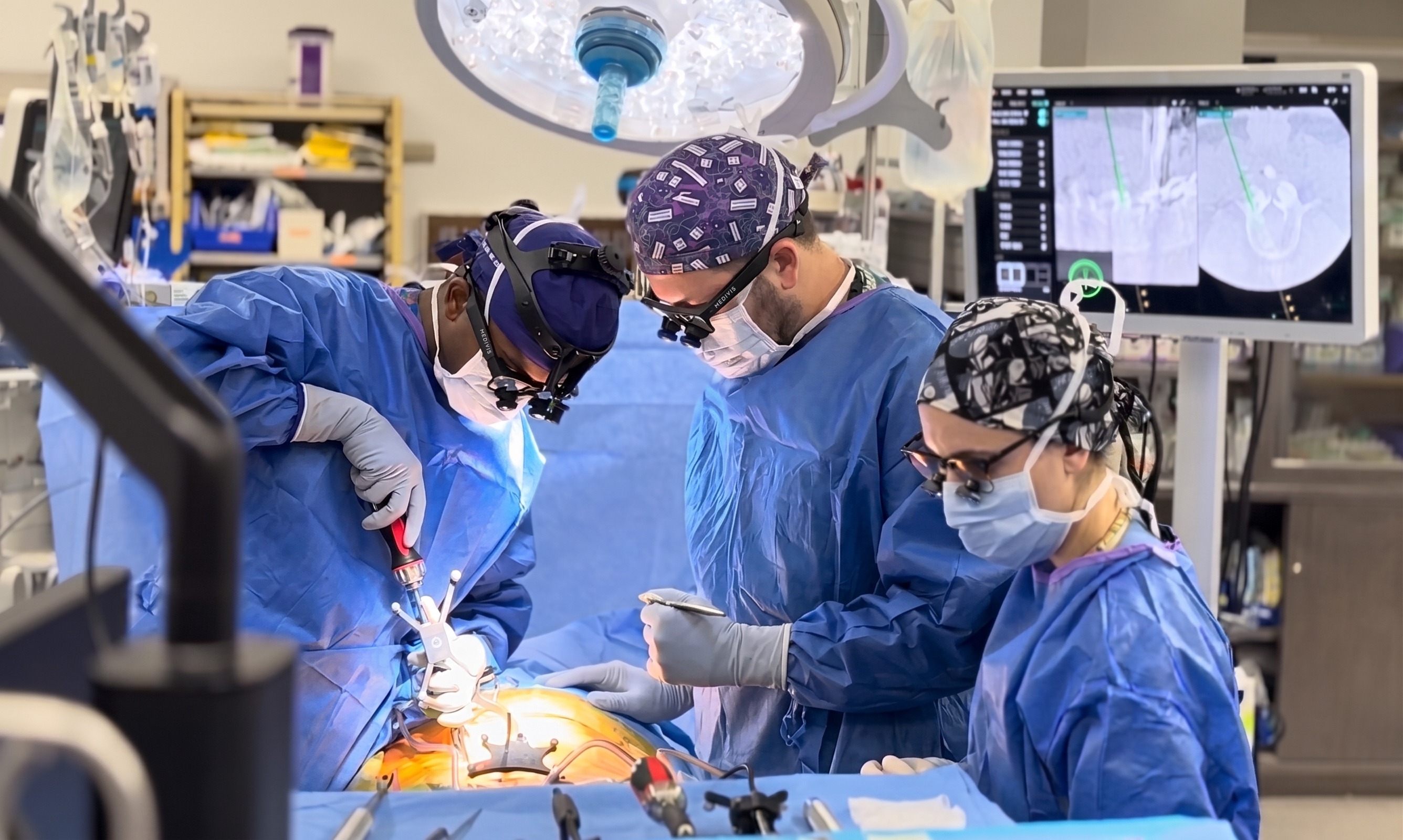
A hologram needs an address
A three-dimensional image can help someone understand anatomy. Navigation asks a stricter question: where is this instrument relative to this patient, right now? That requires registration, the process of matching image coordinates to physical anatomy, followed by tracking. A convincing picture cannot answer that question by itself. This distinction explains why Medivis’s history contains separate clearances for imaging and navigation.
The original imaging platform received clearance in 2019. Its planning work now sits under Medivis Studio: clinicians load imaging, segment relevant anatomy, reconstruct volumes and save trajectories or screw plans. The current product supports desktop and enterprise use, with optional spatial displays. AI-assisted segmentation helps prepare the model; the clinician can edit it. The surgeon still owns the plan.
Spine Navigation’s FDA clearance letter is dated July 26, 2024; Medivis announced its US commercial launch on April 2, 2025. The cranial NeuroAlign software was cleared on October 21, 2025, with the announcement arriving in December. Those are two clocks worth keeping separate. A regulatory decision establishes a permitted use. Commercialization brings the equipment and workflow to institutions.
The spine labeling supplies a useful reality check. Its virtual display must accompany the stereotaxic information and cannot be the sole basis for absolute position. Its indications also refer to rigid anatomy identifiable against CT imaging. Registration, tracking and the appropriate imaging remain essential. Attractive overlays do not repeal those requirements.
The hospital is part of the product
Providence Swedish offers a concrete early example. In June 2023, the Seattle institution reported more than 100 neurosurgical cases with holographic assistance. Its account described preparation for procedures, including brain-tumor removal, and seeing relationships between tissue and blood vessels. This was a planning story before the later cranial-navigation clearance. The Swedish Foundation provided the technology. Institutional adoption has patrons as well as procurement departments.
Company-reported on its current website. A measure of use, not a clinical outcome comparison.
Other named relationships include MD Anderson, UPMC, Northwell and Cincinnati Children’s. In 2020, VA announced Project Convergence with Medivis, Microsoft and Verizon at Palo Alto, combining imaging software, mixed-reality hardware and connectivity. The recurring lesson is that healthcare software travels through an organization. Scans, computers, identity systems and clinicians all have to cooperate.
Studio’s enterprise offering reflects that reality, advertising connections to imaging archives and identity providers, with cloud or on-premises deployment. Medivis sells into the market for image-guided surgery and planning, where existing navigation systems are serious alternatives. Augmedics’ xvision is the named predicate in its spine submission; Brainlab’s VectorVision Cranial appears in the cranial submission. Medivis’s pitch centers on spatial presentation and connected workflows. Clearance establishes no victory over those competitors.
For a hospital evaluating the system, the useful starting point is a particular procedure and its existing workflow. Which images does the team need? Where is the plan prepared? How will the patient be registered? Which display will the surgeon use? These questions turn an AR demonstration into a practical purchasing conversation. The glasses are visible; the answers determine how the equipment fits the work.
In June 2023, Thrive Capital led a $20 million Series A, with Initialized and Mayo Clinic participating. The disclosed spending priorities were engineering, regulatory clearances and commercialization across specialties. Bob Iger and Kevin Durant also joined the investor roster. Celebrity names enliven a funding announcement; the mundane work of integration gives the money something useful to do.
Anatomy class, with room to walk around
AnatomyX addresses a different customer and a related difficulty: learning a spatial subject from flat representations. Its models can be explored collaboratively, with instructors saving prosections and creating assessments. The product FAQ says shared sessions can accommodate up to 30 users. Yale, Emory and West Coast University appear among the named institutions. A class can examine the same anatomy while occupying different viewpoints.
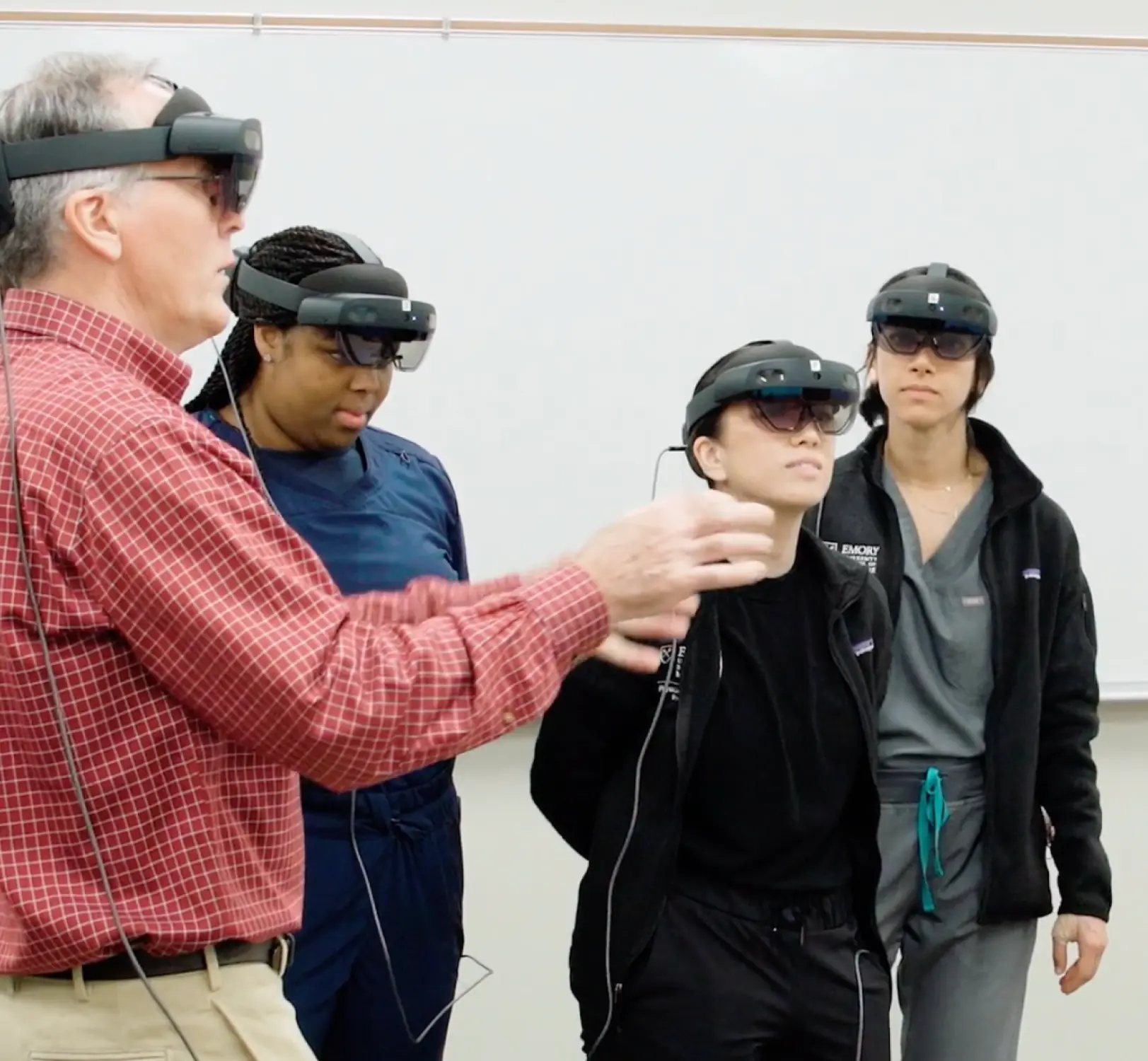
Here the commercial arrangement is explicit: annual subscriptions, plus compatible hardware. AnatomyX can supply a HoloLens 2 when needed. The teaching product is an educational purchase, with its own curriculum and deployment needs. It does not confer permission to use an anatomy lesson as surgical navigation. The same visual idea serves two settings with very different obligations.
Keep the plan. Change the view.
For another product builder, the useful lesson is to find a specific burden in an expert’s day, then connect the existing data to the task. Medivis also keeps conventional display options alongside AR. That gives institutions a way to use spatial tools without requiring every clinician to adopt an identical interface. The implementation can meet a workflow halfway.
The company’s next ambitions extend into ultrasound-based body navigation, contextual AI agents and robotics. Body Navigation remains investigational, and Frontier is research and co-development. Their promise belongs on a different footing from cleared products. For now, Medivis’s practical proposition is refreshingly tangible: let the clinician see the plan closer to the place where the work happens.