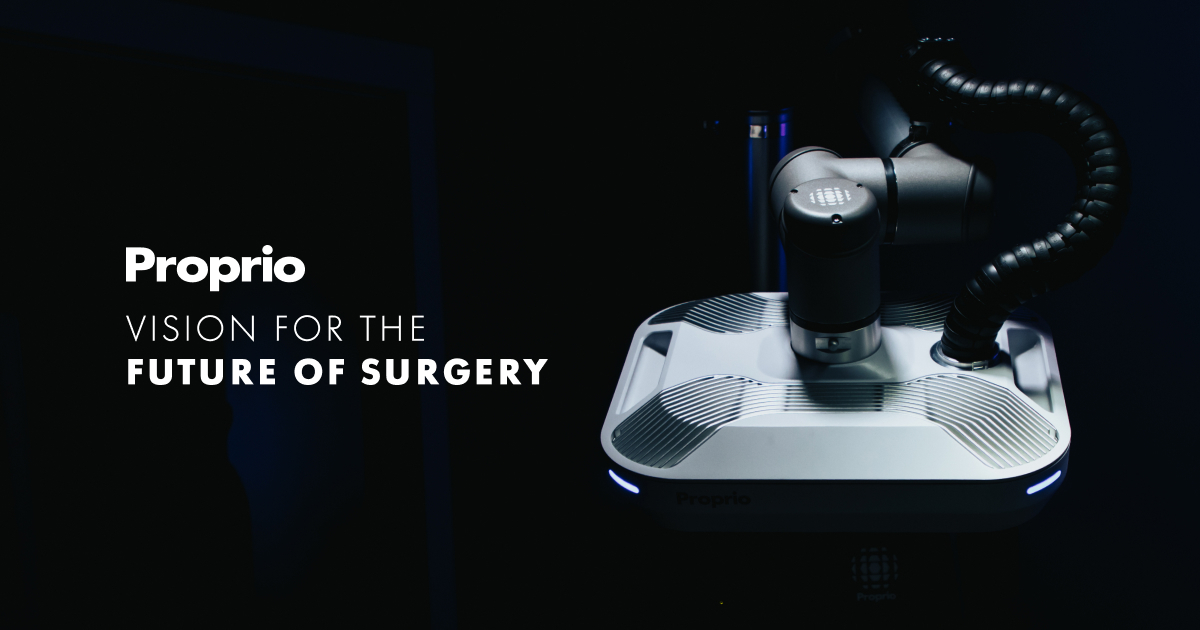
Teaching the operating room to see in 3D - with light field cameras, computer vision and AI.
Proprio is a Seattle medical technology company trying to fix a quiet contradiction in modern surgery: surgeons operate inside a three-dimensional body while relying on two-dimensional X-rays taken at intervals. Its answer is Paradigm - an AI-powered surgical navigation platform that uses light field imaging, computer vision and machine learning to build a continuous, radiation-free 3D view of a patient's anatomy and the surgical scene.
Spun out of the University of Washington in 2016, the company takes its name from proprioception - the body's innate sense of where it is in space. The founders wanted to give surgeons that same spatial awareness in the operating room. Proprio fuses live intraoperative sensor data with a patient's preoperative CT and MRI scans, a capability it calls Volumetric Intelligence, and does it without adding radiation or slowing the surgeon's workflow.
An FDA-cleared surgical navigation platform generating a real-time, radiation-free 3D view of anatomy and the surgical scene during spine procedures.
FDA cleared · 2023Fuses high-definition multimodal intraoperative sensor data with preoperative CT/MRI scans for live 3D visualization and measurement.
Core capabilityProprio's fourth FDA-cleared feature, extending Paradigm's intraoperative 3D measurement and visualization tools.
Cleared · Jan 2026A large, structured dataset captured from real procedures - the foundation for AI models covering segmentation, planning and guidance.
Unveiled · 2024Traditional spine navigation leans on intermittent X-ray or CT imaging - snapshots that expose staff and patients to radiation and interrupt the flow of an operation. Surgeons mentally translate flat images onto a moving, 3D anatomy.
Paradigm replaces those snapshots with a continuous 3D scene. It removes repeated radiation exposure, measures anatomy in real time, and captures a record of what actually happened in the OR - data that has historically gone uncollected.
Spine and orthopedic surgeons, and the hospitals that employ them. The first-in-human procedure was performed at the University of Washington's Harborview Medical Center by Dr. Richard J. Bransford.
The platform is expanding to leading hospitals across the US and abroad. Hundreds of surgeons have contributed to Proprio's AI model, and the company passed 50 completed surgeries on the platform.
Paradigm is the first platform to bring light field imaging to spine navigation - building a live 3D scene instead of relying on periodic radiographs.
Most medtech sells a device. Proprio's device is also an on-ramp to a proprietary surgical dataset used to train AI models for surgery.
Continuous 3D guidance without the repeated exposure conventional navigation requires - a benefit for patient and OR staff alike.
Alternatives include Medtronic (Mazor / StealthStation), Stryker (Mako, Q Guidance), Globus Medical (ExcelsiusGPS), Brainlab, and Augmedics (xvision).
Proprio is a B2B medical device and platform company. It sells and deploys the Paradigm hardware and software to hospitals and surgical centers for spine and orthopedic procedures. Its longer-term value sits in the surgical dataset and AI models generated from those procedures - the raw material for planning, measurement and decision-support capabilities.
The team blends software and medical device engineering, machine learning research and clinical practice, rooted in University of Washington research. Its advisory bench includes computer vision pioneer Dr. Takeo Kanade and leading spine surgeons - a mix of the technical and the clinical that the product depends on.
Co-founder & CEO. A technology leader with 10+ years in emerging tech and healthcare IP law; previously worked with the Bill & Melinda Gates Foundation.
Co-founder and neurosurgeon at Seattle Children's Hospital. Also co-founded high-tech football helmet maker Vicis.
Co-founder and University of Washington professor specializing in computer vision and sensor systems.
Co-founder and computer vision specialist who helped translate lab research into the Paradigm sensor suite.
Investors span healthcare and technology - DCVC, BOLD Capital Partners, Cota Capital, Intel, HTC, Wheelhouse Capital, and angels including Naveen Jain.
Spun out of the University of Washington by Gabriel Jones, Dr. Samuel Browd, Joshua Smith and James Youngquist.
Led by DCVC, funding development of the light field surgical navigation platform.
Paradigm receives FDA 510(k) clearance as the first light field-enabled spine surgery navigation platform.
Raised to commercialize the 3D surgical navigation system, with Intel and HTC among investors.
Completed the world's first light field-enabled spine surgery using Paradigm.
Reached 50 completed procedures and unveiled a large surgical dataset for AI training.
The Picasso feature is cleared, extending Paradigm's 3D measurement capabilities.
CEO Gabriel Jones on computer vision & AI in surgery (This Week in Startups, "Next Unicorns").
See how Proprio's light field navigation works in the operating room.
How Proprio fuses live sensing with preoperative scans in real time.
Proprio builds Paradigm, an AI-powered surgical navigation platform that uses light field imaging and computer vision to give surgeons a real-time, radiation-free 3D view of anatomy during spine surgery.
Proprio is headquartered in Seattle, Washington, and was spun out of the University of Washington in 2016.
It was co-founded by CEO Gabriel Jones, neurosurgeon Dr. Samuel Browd, UW professor Joshua Smith, and computer vision specialist James Youngquist.
Proprio has raised roughly $74-78M total, including a $23M Series A led by DCVC and a $43M Series B in 2023 with investors such as Intel and HTC.
Yes. Paradigm received its first FDA 510(k) clearance in 2023 and, as of January 2026, the company has secured four FDA clearances for capabilities within the platform.