The eye is a small place to build a career around, especially after beginning with the movement of an entire human body. Yet Erik Giphart's path to the chief executive's office at ArcScan is less a sudden narrowing than a steady sharpening. He has spent three decades asking machines to make concealed motion visible: first balance and posture, then bones moving inside joints, now structures tucked behind the iris. The anatomy changed. The engineering problem kept its familiar shape.
Giphart leads ArcScan from Colorado, but his technical vocabulary was formed in the Netherlands. At Delft University of Technology, he studied electrical engineering and specialized in information theory. This was useful preparation for a life spent extracting reliable signals from complicated systems. He finished his master's degree in 1994 and crossed the Atlantic for what was supposed to be a three-month research visit, with a vacation attached. The visit expanded. America has a habit of doing that to itineraries.
At Boston University's NeuroMuscular Research Center, computation met physiology. Giphart later recalled that the experience pulled his interest away from strict computer science and toward human motion. He stayed for doctoral work in biomedical engineering, studying postural control, and completed his PhD in 2001. Afterward, he built a virtual-reality laboratory at the university's Sargent College to examine how perception changes movement. Before “immersive” became a venture-capital adjective, it was a serious instrument in his lab.
A machine for catching bones in the act
Colorado offered a larger stage for the measurement problem. Giphart joined the Steadman-Hawkins Research Foundation in Vail in 2004 and helped establish a high-speed biplane fluoroscopy system. In plain English, two synchronized X-ray views could record bones moving inside a joint and turn that movement into three-dimensional measurements. The apparatus ran at up to 1,000 frames per second. Its industrial-looking hardware was not handsome, but elegance in a research machine is often found in what it can prove.
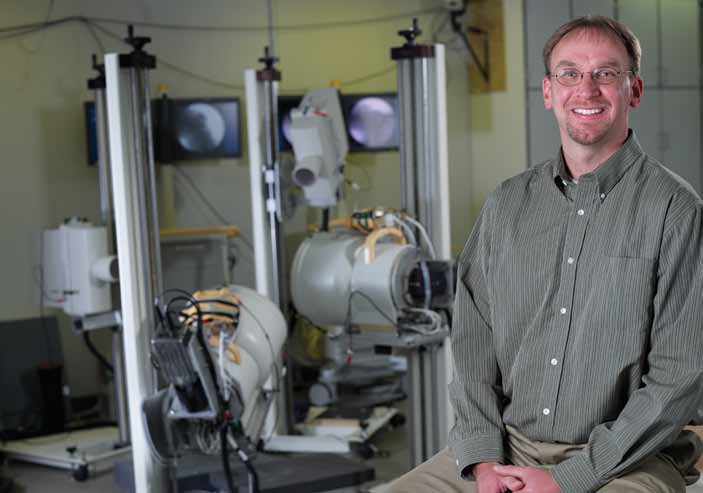
The work placed him between disciplines. Engineers worried about calibration, frame rates and reconstruction. Clinicians worried about knees, shoulders and the choices made in an operating room. Giphart described the biomechanics laboratory as a bridge between basic science and clinical research, able to show how bones move relative to one another and how loads affect joint structures. That middle position became the lasting geography of his career.
“Pressure has a negative connotation, but I see pressure as a positive thing.”Erik Giphart, on research work
He was also learning the social machinery of technical work. Asked whether accomplished colleagues increased the pressure, he turned the premise around: difficult questions raised the level of discussion. There was, he said, never a dull moment. The remark is cheerful, but it contains an operator's instinct. A demanding room is not merely a test. It is an instrument, too.
His research years produced more than 30 peer-reviewed papers, with studies of shoulder, knee and hip movement among them. They also produced patents, including a dual-fluoroscopy system and a framework for quantitative measurements from MRI maps. In 2009, alongside his laboratory work, he became acting president of the Rocky Mountain Chapter of the American College of Sports Medicine. The scientist was becoming a coordinator of people, programs and institutions.
There was a public-facing side to the laboratory as well. When local students visited, Giphart showed them an electromyography system that could sense muscle activity and explained how motion-imaging methods might illuminate an injury. It is a small scene, but a revealing one. The useful technical leader must repeatedly translate: from equations to apparatus, apparatus to evidence, evidence to a clinician, and sometimes the whole chain to a teenager wondering why the mathematics in school matters. A machine earns trust partly through performance and partly through the quality of the explanation beside it.
The laboratory learns about deadlines
In 2012, Giphart crossed from academic research into the medical-device industry. Halifax Biomedical in Canada was commercializing stereo X-ray technology, familiar scientific terrain with unfamiliar commercial weather. In engineering leadership and then a CTO role, he directed programs that combined surgical instruments, static and dynamic imaging equipment, three-dimensional analysis software, a tele-radiology framework and a mobile imaging trailer.
A prototype can be allowed to have a temperament. A medical device cannot. It must behave repeatedly, pass through quality systems and regulation, be manufactured, installed, serviced and understood by the person using it. Giphart's move into industry broadened the definition of a successful measurement. Accuracy remained essential, but so did the hundred operational details that keep accuracy from being trapped in a laboratory.
The translation discipline
Returning to Colorado, he joined Evergreen Research as director of engineering. That work introduced him to ArcScan, a Golden-based maker of ophthalmic ultrasound equipment. He arrived at ArcScan in 2019 as vice president of engineering. Over the next five years, he built the engineering function, brought research and development in-house, and took on responsibilities that stretched into operations, regulatory affairs and quality assurance.
That accumulation is easy to read as corporate housekeeping. It is better understood as system design at organizational scale. Engineering proposes a change. Quality asks whether it can be documented. Regulatory work asks whether it can be defended. Operations asks whether it can be repeated. Service discovers how it behaves outside the building. Put those functions too far apart and each one receives the signal late. Bringing them into conversation is less glamorous than inventing a scanner and far more likely to determine whether the scanner keeps its promises.
Electrical engineering master's at Delft, specializing in information theory.
Biomedical engineering PhD at Boston University, followed by a virtual-reality lab.
Joined the Vail biomechanics group and helped develop high-speed biplane fluoroscopy.
Moved into commercial medical-device development with Halifax Biomedical.
Joined ArcScan and began bringing its engineering and R&D capabilities in-house.
Named ArcScan's director and chief executive officer.
The engineer gets the whole company
ArcScan appointed Giphart CEO in July 2024, succeeding Andrew Levien. The timing paired an internal engineering transition with an external market opening: the company's Insight 100 system had received Chinese regulatory approval that May, and ArcScan's long-term investor, Shanghai Haohai Biological Technology, was looking toward growth in China and the United States.
The Insight 100 uses very-high-frequency ultrasound to image the anterior segment of the eye, including anatomy behind the iris. Its scanning process is robotically controlled. For Giphart, it is another meeting of mechanics, imaging and computation, but at a far smaller physical scale than the moving joints of Vail. He is named on patent applications covering a more compact ultrasound eye scanner and an adjustable method for controlling the eyelid during imaging. These details sound modest beside the word “robotic.” They are also the sort of details that decide whether an instrument is usable.
His first public agenda as chief executive was notably free of executive mist. He spoke about listening to customers, making practical improvements to the instrument, strengthening customer service and improving operational efficiency. He also pointed to AI and other technical advances. The sequence matters. Technology came with a verb, “develop.” Customers came with another, “listen.”
“I look forward to spending time listening to our customers.”Erik Giphart, on taking the CEO role
In 2025, Giphart appeared at the Insight 100's launch in China to explain the principles of ultrasound imaging and the technical approach behind the system. It was a global assignment for a company of modest size, and a return to a familiar role: the engineer who can stand beside a complicated machine and explain what it reveals.
One stubborn question
The temptation with a varied career is to celebrate reinvention. Giphart's is more interesting for its continuity. Information theory asks how a signal can survive noise. Biomechanics asks how movement can be measured without simplifying away its meaning. Medical-device engineering asks how a sophisticated method can survive manufacturing, regulation and daily use. Executive leadership asks much the same of an organization.
Even the personal geography has a tidy logic. Giphart once joked that life with his Colorado-born wife presented a choice between hundreds of rainy days in Holland and hundreds of sunny ones in Colorado. Colorado won. The comment supplies a rare bit of weather to a public record otherwise full of laboratories, patents and titles. It also echoes his advice from the early research years: be flexible enough to recognize a good opportunity.
ArcScan's future will be judged by clinicians, regulators, customers and results, not by the symmetry of its CEO's biography. Still, the biography explains the bet. Giphart has built places where difficult images become dependable evidence. He has taken research tools into companies and company problems back to engineering. His career has zoomed steadily inward, from bodies to joints to the interior of the eye, while the purpose has stayed broad: help a person see enough to decide.