Daniel Hawkins once flew overnight to New Zealand, went straight from the airport to a procedure room, watched three medical cases, ate dinner and flew home. The trip succeeded. That was the problem. Expertise had crossed an ocean because a person had crossed an ocean, and the medical-device business had quietly accepted this as normal.
Avail Medsystems was Hawkins's attempt to separate knowledge from airfare. The company put a mobile tower in operating rooms, gave remote specialists control of its cameras, connected the tower to surgical imaging and wrapped the whole thing in secure software. A device representative in California could observe a case in Tennessee. A surgeon could teach another surgeon without giving up two days to travel. An engineer could see how a product behaved where it mattered, surrounded by beeping equipment and people in masks.
The short version
- Avail sold remote presence for live medical procedures, not remote patient visits.
- Hospitals could receive consoles without buying capital equipment; industry customers paid for network access and usage.
- The company raised about $126.6 million and reached hundreds of console placements.
- It shut down in November 2023 after a new funding round failed to close.
- Mendaera bought substantially all of the assets in 2024 and kept the technology alive.
The person beside the surgeon whom nobody talks about
Modern medical devices arrive with expertise attached. A knee implant system may include an alarming number of components and instruments. The surgeon operates; the device specialist often knows the inventory, sequence and peculiarities of that particular system. The specialist is not treating the patient, but the workflow may depend on their product knowledge.
Ordinary videoconferencing was an awkward answer. A laptop camera sees what someone points it at. In a procedure room, everyone already has a job. Avail's remote participant could pan, tilt and zoom the cameras, choose between room video and medical imaging, freeze a frame, annotate it and talk back through audio designed to cope with a noisy clinical environment. The small design revelation was agency: the remote person could look around without turning an in-room nurse into a camera operator.
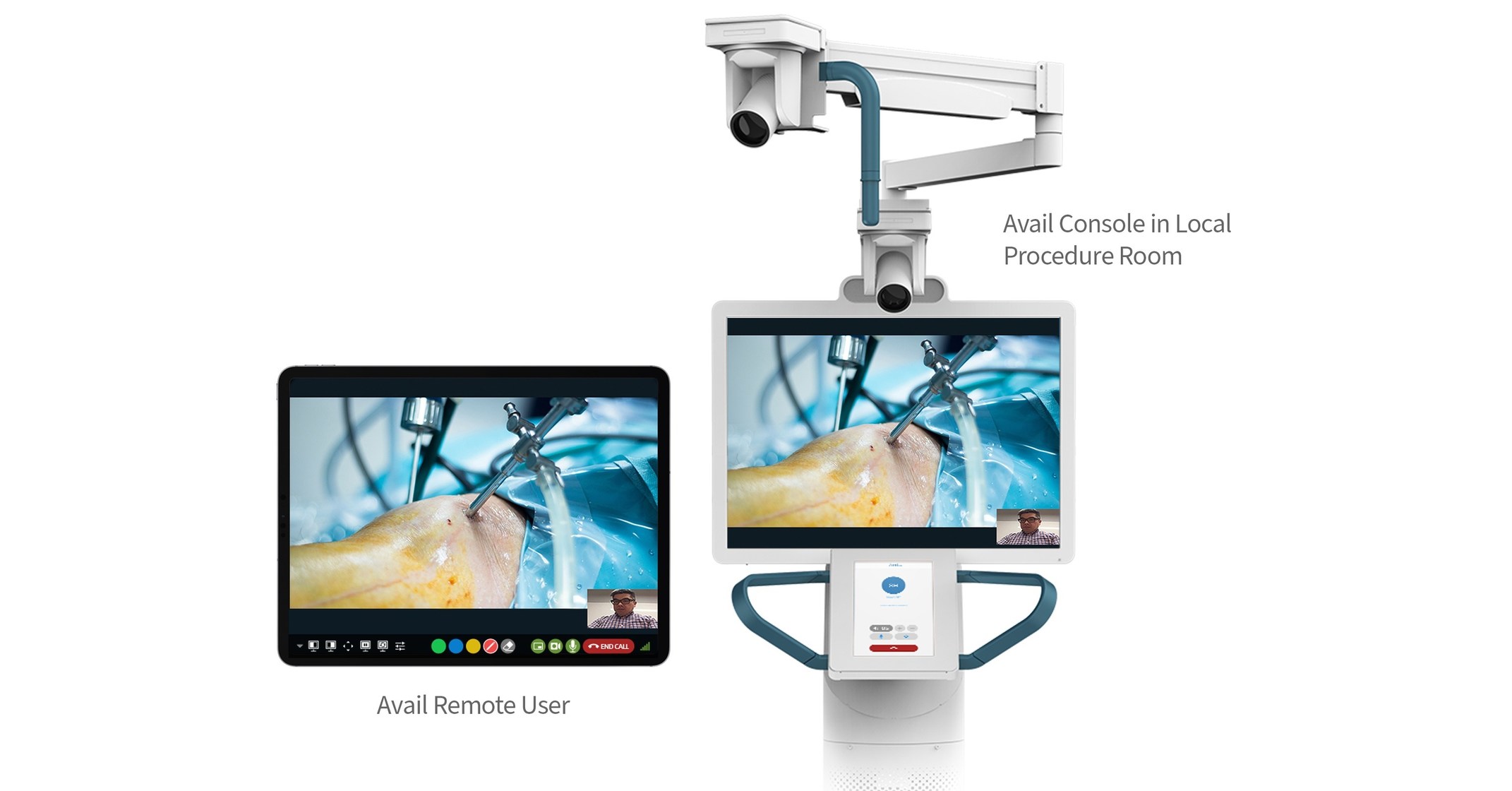
Avail did not invent the video call. It redesigned who had to touch the camera while everyone else was busy.The product insight
The clever bill: let the hospital say yes for free
The company's commercial idea was as important as its camera boom. Avail owned the consoles, installed them and handled maintenance, upgrades and around-the-clock support. A hospital or ambulatory surgery center did not need to make a capital-equipment purchase. Medical-device companies and other members bought access to the network, often based on time or subscription usage.
That arrangement matched the benefit to a plausible payer. Hospitals gained collaboration tools. Surgeons gained access to colleagues and product experts. Device companies saved travel, stretched specialists across larger territories, trained customers and watched products in use. In 2022, Medtronic Neurovascular agreed to use several hundred consoles in a three-year arrangement described at the time as worth tens of millions of dollars.
It was elegant, and it carried a concealed weight. Removing capital friction for the customer does not eliminate capital. It moves the burden onto the vendor. Every new site meant another physical unit, installation, service obligation and support relationship before usage necessarily matured.
A pandemic accelerant, not a founding myth
Avail was founded in 2017 and had its first consoles in hospitals before Covid-19. The pandemic did not create the idea. It changed the answer to a sales question: from “Why would we do this?” to “How quickly can we?” Hospitals restricted visitors, device representatives lost access to procedure rooms, and a digital doorway became operationally urgent.
Capital followed urgency. Avail's reported financing totaled about $126.6 million, capped by a $100 million Series B led by D1 Capital Partners in October 2020. The staff grew from fewer than ten people in July 2018 to 135 by June 2021. The company left Playground Global's incubator, a former apricot cannery in Palo Alto, for its own Santa Clara headquarters.
The useful proof was smaller than the vision
Avail liked the language of platforms and digital operating rooms. Its clearest evidence was more modest and more persuasive. In a 2023 Smith+Nephew sports-medicine R&D lab, an on-site group of one surgeon and four engineers was joined by a remote surgeon and fourteen remote engineers. Avail reported that the proctoring surgeon recovered 1.5 to 2.5 days, ten R&D participants each recovered two to three days, and a comparable lab avoided an estimated $12,500 in travel and expenses.
This is the practical Avail: not science fiction, not remote robotic surgery, and not a substitute for clinical judgment. The system passively displayed information and enabled people to communicate. Its value appeared when a specific expert needed a specific view for a limited period and travel was the expensive alternative.

What failed first was the runway
By late 2023, Avail said hundreds of consoles were placed and that agreements with health systems covered roughly 1,100 U.S. facilities. Two weeks before the end, it announced the ability to host third-party clinical applications, turning the console into a broader operating-room software hub. Then, on November 1, employees learned that the company was shutting down immediately.
Contemporary reporting identified the immediate cause: Avail could not close another financing round needed to maintain growth. The product had not suffered a theatrical public failure. The network was not undone by a single camera, security incident or lost flagship customer. Money failed first.
The timing exposed a harder change. During the pandemic, remote access was a requirement and venture money was abundant. Later, representatives could re-enter hospitals while digital-health funding contracted sharply. Avail had to prove that pandemic behavior had become durable workflow before the cost of hardware, service and expansion consumed its time. Even a large Medtronic agreement and visible product progress were not enough to bridge that interval.
Hawkins starts Avail to move procedural expertise without moving the expert.
Hospital restrictions accelerate adoption; D1 leads the Series B.
A three-year Neurovascular deal covers several hundred consoles.
Fifteen days separate the October product announcement and the reported shutdown.
Mendaera acquires substantially all assets and hires part of the team.
What another builder can actually copy
Avail's legacy is useful because it contains both a product lesson and a financing warning. Mendaera, a medical-robotics startup, bought substantially all of Avail's assets in 2024, hired some former employees and said it would support existing users while evaluating the roadmap. The company disappeared; the thesis that connectivity belongs beside imaging and robotics did not.
Find the repeated, costly behavior people tolerate because nobody has redesigned it.
A collaborator who can choose a view creates less work than a passive video guest.
The hospital, surgeon and device company received different benefits. Avail charged the party with measurable commercial savings.
Installation, field service, security, support and idle hardware still exist inside a SaaS story.
Where the model gets expensive
This approach needs enough recurring procedures at each location to justify a dedicated console. It needs dependable hospital connectivity, security approval, workflow acceptance and a remote expert whose presence is genuinely valuable. It works best when travel is frequent, expertise is scarce, equipment is complicated and many sites can share a smaller pool of specialists.
It works less well when a generic video setup is good enough, in-person access is easy, case volume is thin, or the paying company cannot connect remote support to revenue or cost savings. Most of all, a vendor-owned hardware network needs capital patient enough to wait for utilization. Avail removed the purchase order from the hospital's desk. It could not remove the hardware from its own balance sheet.
A place in the market, after the company
Avail sat between ordinary telehealth and surgical intelligence. Proximie pursued remote collaboration and operating-room data. ExplORer Surgical combined workflow guidance with remote support. Hospital audiovisual systems and healthcare editions of general video tools supplied cheaper, less specialized alternatives. Avail's difference was the managed combination: mobile hardware, remotely controlled optics, medical-imaging integration, secure software and a network available across institutions.
That combination made the experience coherent and the business demanding. It also explains why the assets appealed to Mendaera. Robotics can improve the hand performing a procedure; telepresence can extend the eyes and judgment around it. The company that first assembled those pieces ran out of financing. The assembly itself remains interesting.