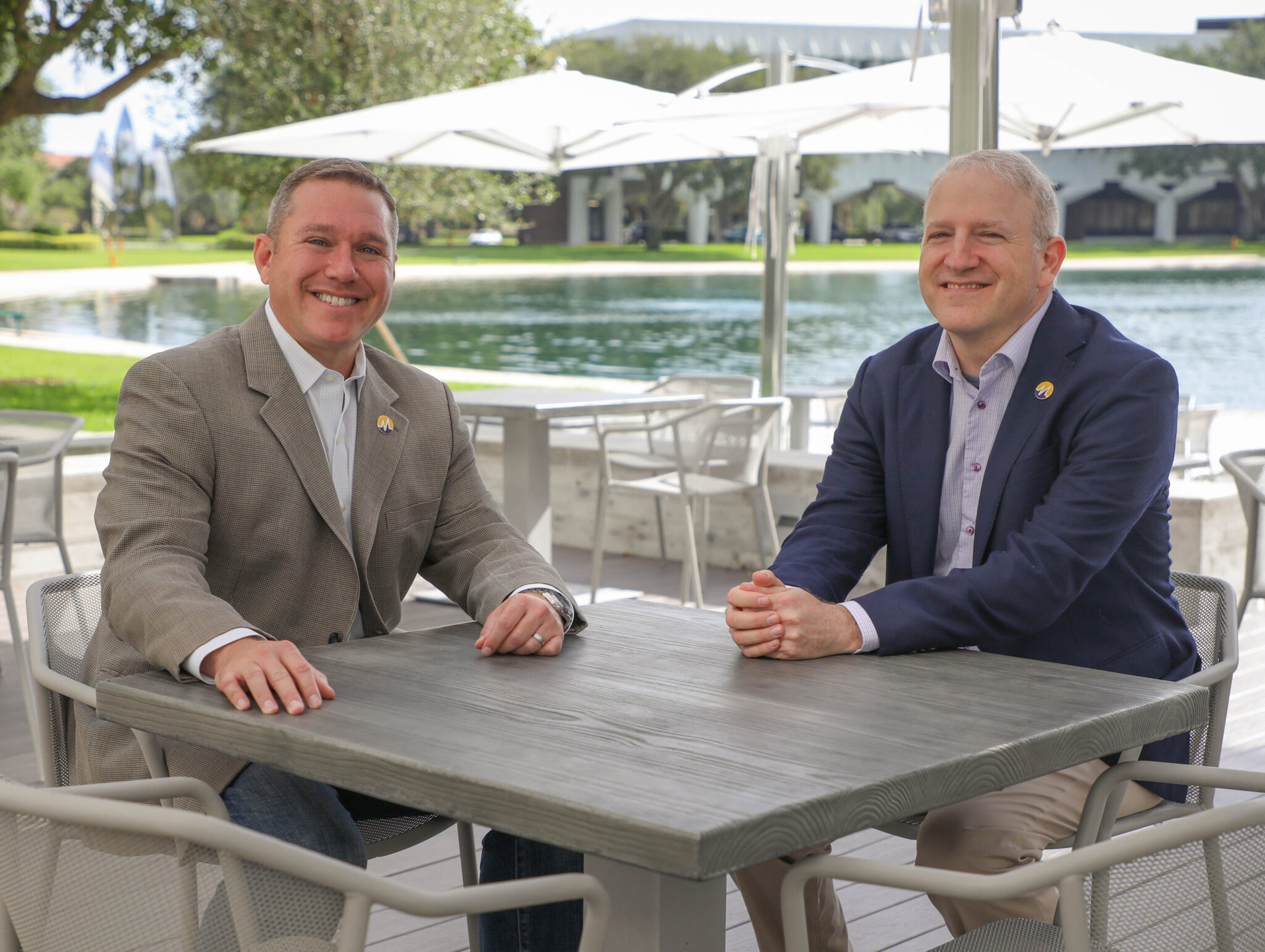
The founding scene sounds engineered for a pitch deck, except it happened in an exam room. In 2010, dermatologist Michael Sherling treated Dan Cane, the software entrepreneur who had co-founded Blackboard. Sherling had the medical workflow; Cane knew how to turn workflows into products. Their shared irritation was the computer sitting between doctor and patient. General-purpose electronic records forced specialists through screens and fields that did not match how they actually practiced. The first thing to fail was not medicine or software. It was fit.
They started Modernizing Medicine, now ModMed, around a stubborn counterproposal: build for one specialty deeply before moving to the next. The flagship Electronic Medical Assistant, or EMA, began in dermatology. ModMed later carried the model into gastroenterology, ophthalmology, orthopedics, otolaryngology, urology, plastic surgery, podiatry, OBGYN and other ambulatory specialties. The company says nearly 50,000 providers now trust its products.
The trick was putting the white coat near the code
ModMed’s line is “software for doctors by doctors.” The interesting part is the operating choice beneath it. The company hired practicing physicians and brought their specialty knowledge into product development. In ModMed’s own blunt formulation, it hired doctors and taught them to code. The point was not to mint a small army of full-stack dermatologists. It was to reduce the translation loss between the person who knows why a procedure is documented a certain way and the person who must encode that behavior.
EMA ships with specialty vocabulary and clinical patterns, then uses adaptive learning to follow a provider’s preferences. That approach earned a U.S. patent for core adaptive functionality in 2022. It also gave ModMed a way to differ from hospital-centered systems such as Epic and Oracle Health, broad ambulatory platforms such as athenahealth, eClinicalWorks and NextGen, and specialty competitors such as Nextech. ModMed is not selling the biggest possible record. It is selling fewer moments in which a specialist has to teach the record what kind of doctor is using it.
“We hired doctors and taught them how to code.”ModMed’s description of its product model
That focus widened into a suite. The EHR connects to scheduling, practice management, revenue-cycle services, payment processing, patient messaging, analytics, inventory and marketing tools. A dermatologist can document the encounter; the front office can schedule the next one; the billing team can submit the claim; and the patient can receive instructions and pay without the practice stitching together a fresh identity at each step.
The buyer is usually not a hospital CIO shopping for a single record across emergency rooms, inpatient beds and dozens of departments. It is the owner, administrator or clinical leader of a specialty practice - from a solo office to a multi-state group or management-services organization - trying to run both medicine and a small enterprise. Their problems are unusually connected. A slow note delays a code. A weak code delays a claim. A missed patient message leaves a hole in tomorrow’s schedule. A generic tool may solve each task separately while creating another handoff between them.
That puts ModMed between two markets. On one side are broad records with large interoperability networks and hospital reach. On the other are focused point products for scribes, messaging, payments, analytics or billing. ModMed’s defense is the integrated specialty suite: one vendor with more context across the visit. Its vulnerability is the same bundle. A practice may prefer a best-of-breed scribe, a cheaper scheduler or a billing partner it already trusts. The suite wins when shared data removes meaningful work. It loses when integration becomes a reason to tolerate a weaker component.
One visit, fewer handoffs
What it does after listening is the AI pitch
Ambient clinical scribes are no longer exotic. Plenty of products can listen to a visit and draft a note. ModMed’s Scribe 2.0, released in late 2025, argues that the transcript is only the opening move. Because it sits inside EMA, it can suggest structured notes and billing codes, then help prepare downstream work such as prescriptions, labs and patient education for the clinician to review.
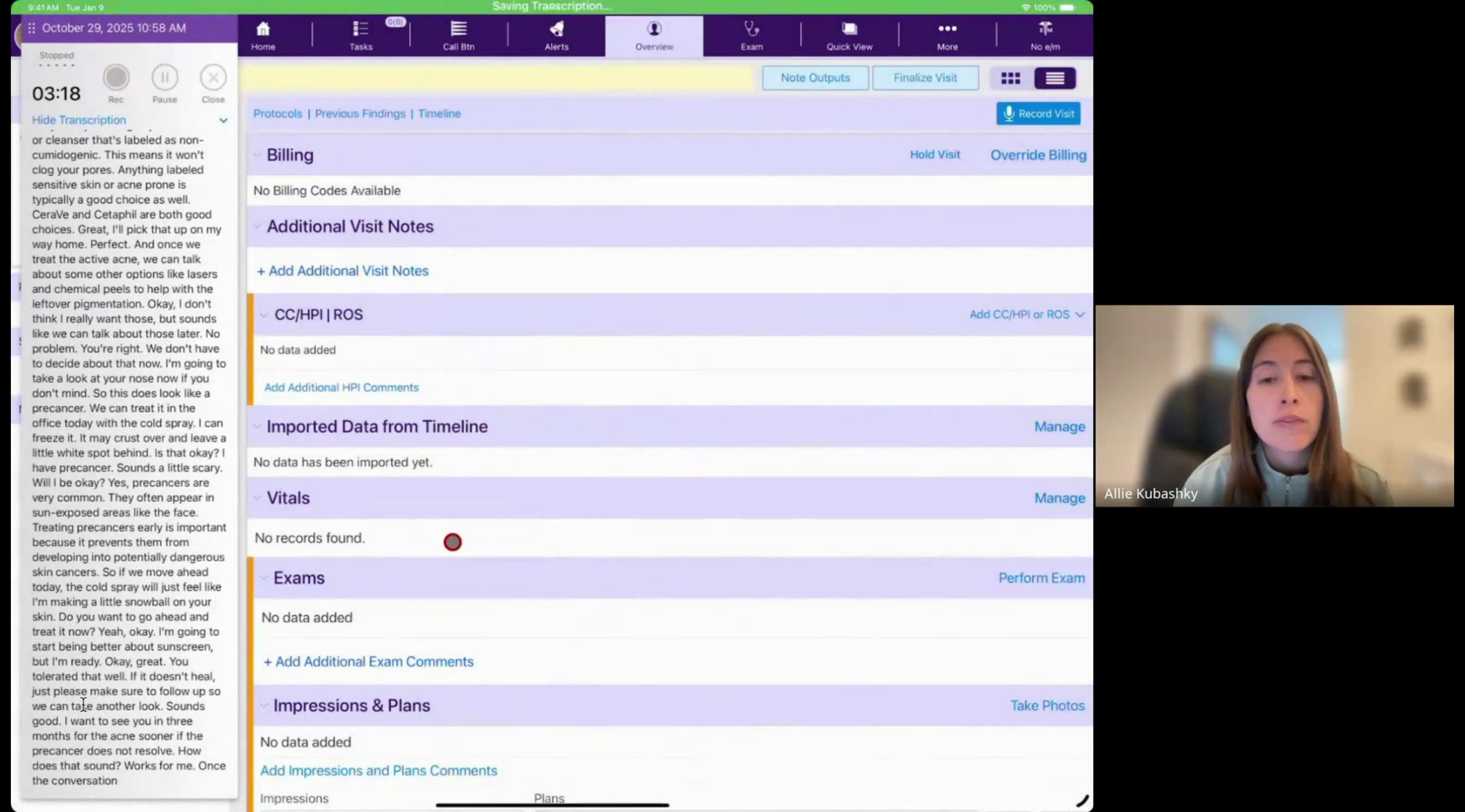
The company says its specialty models draw on de-identified samples from more than 750 million encounters, two billion diagnoses, four billion care plans, 500 million prescriptions and 400 million labs. Those are company-reported training foundations, not an independent scorecard of accuracy. Still, they explain the strategy. A generic model hears words; ModMed wants its system to recognize the clinical pattern and know which structured action usually comes next.
Usage moved quickly: ModMed reported that Scribe 2.0 climbed from 240,000 patient visits in March 2026 to more than one million in June. Customers quoted by the company described saving from an hour to two hours a day, and one physician reported a 96 percent reduction in note-finalization time. These are customer accounts, not universal outcomes. They do reveal what buyers want: less evening charting, more eye contact and fewer clerical steps after the patient leaves.
The price of replacing friction
ModMed does not post a simple public price card. It sells subscriptions based largely on provider count, with implementation and services layered around them. A ModMed-commissioned Forrester study modeled a composite practice with 10 physicians and five advanced practice providers. It assumed $1,200 a month per physician and $800 per APP, plus $220,000 for deployment and almost $39,000 a year for management and training. The three-year risk-adjusted cost came to $941,788 before discounting.
$941,788 over three years
A commissioned composite, not a universal quote. It also excluded ModMed BOOST and ModMed Pay. Actual economics move with provider mix, products, migration and training.
That is the unglamorous truth of medical software: the invoice is not the cost. Migration, workflow redesign, training, downtime and the difficulty of leaving later all matter. ModMed works best when a practice’s specialty matches one of its deep verticals and when the group intends to use the connected suite. A tiny practice wanting a basic record, a multispecialty system centered on hospital interoperability, or a clinic unwilling to standardize its operations may find the specialization expensive or constraining.
Growth added a trust problem
The money followed the thesis. ModMed raised more than $2 million in its first outside financing, $38 million in a 2015 Series E and $231 million from Warburg Pincus in 2017. Clearlake Capital agreed to buy a majority position in 2025. Official terms were undisclosed; Axios reported a $5.3 billion valuation. Clearlake’s playbook is expansion through operations and acquisitions, and ModMed has obliged.
In April 2026 it bought Bonsai Health, adding agentic patient reactivation and self-scheduling to the communications tools it already owned through Klara. It expanded its long-running AWS relationship for the “AI-Powered Practice,” allied with IntrinsiQ Specialty Solutions and, in August, announced an agentic revenue-cycle platform. Early access for self-managed billing teams is planned for late 2026, with broader availability beginning in 2027.
Automation inherits the company’s history.
In 2022, ModMed agreed to pay $45 million to resolve federal False Claims Act allegations involving alleged kickbacks and inaccurate reporting tied to incentive payments. The episode matters now because billing agents will operate where product design, coding and reimbursement meet.
The settlement is not a footnote that AI can erase. It is the reason governance belongs inside the product story. ModMed says its new assistants use a human-in-the-loop design: software recommends or performs repetitive steps while people retain control over consequential decisions. That boundary needs to remain visible. A billing suggestion can alter reimbursement; a clinical suggestion can alter a chart; an outreach agent can change how a patient experiences care. Efficiency is useful. Auditability is mandatory.
What another company can copy - and what it cannot
The transferable lesson is not “hire a doctor who codes.” It is to give domain experts enough product authority that edge cases reshape the default workflow. Start with a narrow user whose work has expensive, repetitive friction. Capture the process in structured data. Integrate the next action, not merely the first output. Expand only after the first vertical produces a repeatable language.
Copy this
Pair a builder with the person living the workflow. Let real use change the data model, defaults and sequence of actions.
Do not copy blindly
Deep verticalization fails when the market is too small, workflows vary without pattern, or customers need broad interoperability more than tailored depth.
Measure this
Time to complete the whole job, error and denial rates, after-hours work, adoption by role and the cost of implementation.
Protect this
Human review, provenance, permissions, exportability and an audit trail that explains what the system suggested or changed.
ModMed’s next act is more ambitious than its first. Specialty EHRs asked software to learn how a doctor works. The AI-Powered Practice asks software to coordinate the clinic around that doctor - from the first appointment message to the final claim. If it works, the computer recedes. If it fails, it fails across more of the practice at once. Sixteen years after an awkward exam-room encounter changed Cane’s mind, fit remains the advantage and the risk.