Here is a fact about American medicine that sounds made up but isn't: for roughly every hour a physician spends with patients, they spend close to two more hours on documentation and desk work. Some of that charting happens after the clinic closes, in a genre of unpaid overtime that doctors have nicknamed "pajama time." DeepScribe, a company founded in San Francisco in 2017, exists because someone decided that this arrangement was both bad and, importantly, solvable.
The someone, in this case, was a small founding team - Matthew Ko, Akilesh Bapu, and Kairui Zeng. The origin story is the kind that venture capitalists love and that also happens to be true: Bapu is the son of an oncologist, and grew up watching his father come home late, night after night, buried in paperwork that had nothing to do with medicine and everything to do with the ritual of writing it all down. Years later, oncology would become the exact specialty where DeepScribe planted its flag. Sometimes a company's whole strategy is hiding in its founder's childhood.
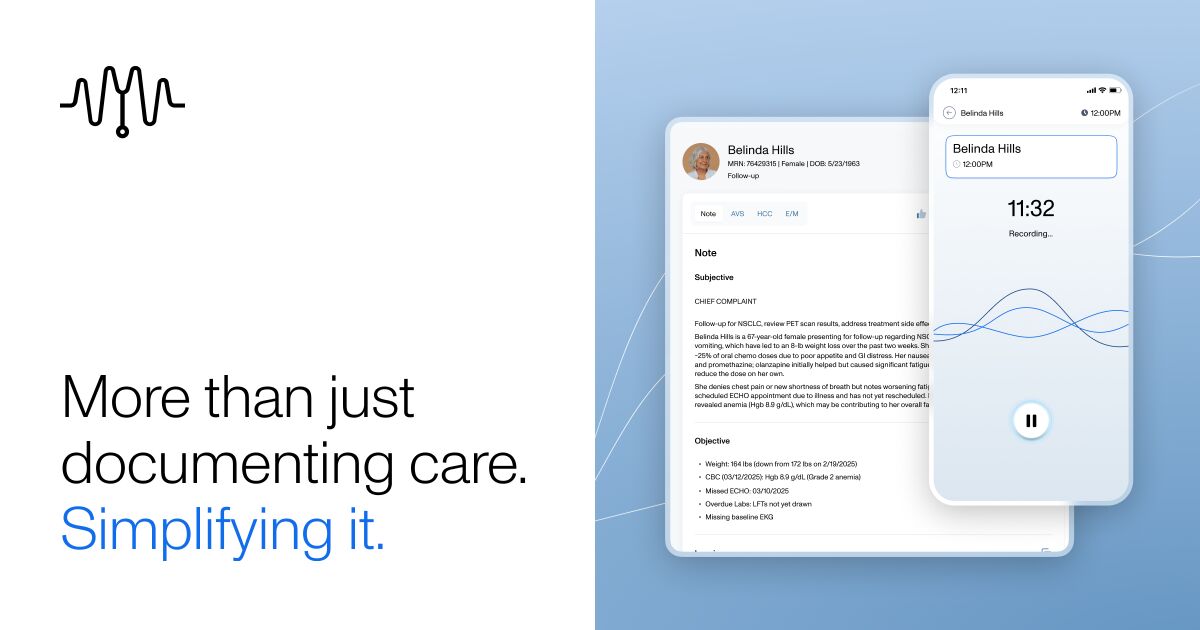
The product itself is easy to describe and hard to build. DeepScribe is an "ambient" AI scribe, which means you don't dictate to it and you don't fill out forms. You just talk to your patient the way you normally would. The software listens, using a stack of speech recognition, natural language processing, and machine learning, and then does the tedious part: it pulls the medically relevant information out of a rambling human conversation and arranges it into a proper clinical note, structured the way an electronic health record wants it. The doctor reviews, edits if needed, and signs.
"Turn each patient conversation into a complete, accurate note with real-time insights" is the pitch. The subtext is quieter: stop making the doctor be the stenographer.
Why the note is the whole game
It is worth pausing on why documentation is such a load-bearing problem, because it explains why so much money has flowed into companies like this one. The clinical note isn't just a diary. It's the legal record, the billing basis, the thing that determines whether a visit gets reimbursed and at what level, and - increasingly, under value-based care - the raw material for measuring quality and risk. A note that misses a diagnosis or fails to capture a comorbidity isn't just sloppy; it's money left on the table and a compliance question waiting to happen. So documentation sits at the exact intersection of "clinicians hate doing it" and "the system cannot function without it done well." That is a genuinely attractive place to build a business.
DeepScribe's answer has grown from a single scribe into something closer to a suite. There's the core ambient note. There's DeepScribe Assist, which coaches the clinician live during the visit - surfacing prompts, insights, and HCC-compliance nudges using the MEAT criteria that risk-adjustment coders live by. There's AI Coding, which captures E/M, ICD-10, and HCC codes so the billing and the medicine come out of the same conversation. And there's Customization Studio, which is the part clinicians seem to genuinely warm to.
The customization insight
Customization Studio is DeepScribe's acknowledgment of an awkward truth about doctors: no two of them document the same way, and they will not use a tool that forces them to change. So the studio lets a clinician or an organization define custom physical exams, build "blueprints" for the sections and discrete fields they want captured, and pull previous notes forward to document longitudinal care across visits - a feature that matters enormously in specialties like neurology, rheumatology, and oncology, where the story unfolds over months. Better still, the system watches the edits a clinician makes and proposes future customizations based on them. It is, in effect, an AI scribe that learns your handwriting.
DeepScribe made a decision most AI companies resist: it got narrower. Instead of scribing every specialty adequately, it went deep on oncology - and turned focus into market share.
The oncology bet
Which brings us to the most interesting strategic move in the DeepScribe story. Ambient AI scribing is a crowded field - Abridge, Nuance's DAX under Microsoft, Suki, Nabla, Ambience, and others are all chasing the same doctors. In a crowd, the temptation is to be everything to everyone. DeepScribe went the other way and specialized. The company now says it serves roughly 90% of U.S. community oncology organizations, and it has built an oncology-specific model, marketing materials, and even a podcast ("Beyond the Chart") around the specialty. Oncology is a shrewd choice: the visits are complex, the documentation is unforgiving, the longitudinal history is essential, and the coding stakes are high. If you can be the best in the hardest room, being merely good everywhere else stops mattering.
The proof that the bet is working shows up in the customers. In 2024, Ochsner Health - a 46-hospital system in the Gulf South - selected DeepScribe to deploy ambient AI to 4,700 clinicians. Enterprise health systems are famously slow and famously risk-averse about anything that touches the exam room, so a deal of that size is less a sale than an endorsement. During the pilot, Ochsner reported that 96% of patients said they were likely to recommend their provider - a number DeepScribe is happy to cite, because it points at the softest and possibly most important benefit: when the doctor isn't typing, patients feel looked at.
The money, and the tell in the cap table
DeepScribe has raised roughly $64 million across three rounds: a $5.2 million seed in 2021, a $30 million Series A in early 2022 led by Index Ventures (with angels including Scale AI's Alex Wang and Figma's Dylan Field), and a Series B of about $24 million in late 2023. The Series B is the one worth reading closely, because the investors include Kaiser Permanente, Providence Ventures, and Mass General Brigham - which are not just financiers but exactly the kind of large health systems that buy and deploy ambient AI. When your customers are also your investors, two things are true at once: they've done deep diligence on the product, and they have a strong incentive to see it succeed. It's a comfortable position, if you can get it.
None of this makes DeepScribe a sure thing. The competition is well-funded, the biggest players have distribution advantages through the EHR itself, and "AI writes your medical note" is a category where trust is earned slowly and lost instantly. But DeepScribe has assembled the ingredients that matter in health tech: a real and expensive problem, a focused wedge into it, marquee customers who double as validators, and a 98.8 score from KLAS - the research outfit whose ratings health-system CIOs actually read - with A+ marks across all six categories in its 2025 Emerging Company Spotlight. For a company selling something as intimate as a scribe in the room, that report card is the closest thing to a bedside recommendation.
The tagline on DeepScribe's own marketing reads: "More than just documenting care. Simplifying it." It's a modest line for an ambitious idea. The company is betting that the future of the exam room looks a lot like its past - a doctor, a patient, a conversation - with the one difference that nobody has to remember it all afterward. If that sounds small, ask any physician what they'd do with two hours back at the end of the day.