The therapy session is over. The work is not. Somewhere between the counselor’s last question and the insurer’s eventual payment sits a clinical note, a billing rule, and a person trying to make the two agree. Ease Health has made that interval its business. It is a peculiar place to look for a technology company: the territory where care becomes paperwork, and paperwork becomes cash.
- One platform connects referrals, clinical records, and billing.
- Customers include mental health practices and addiction treatment organizations.
- AI assists the work; configurable forms and specialist billers matter too.
- A $41 million Series A funds more engineering and enterprise expansion.
The expensive space between two clicks
At Christian Counseling Associates, the billing team had been logging into as many as six systems. A completed encounter had to find its way from clinical documentation to reimbursement. The organization evaluated more than a dozen alternatives before choosing Ease, according to the company’s customer account. What persuaded it was usable design and a vendor willing to adapt.
CCA’s experience offers a useful way to understand the product. The irritating part of healthcare software can be the space between perfectly respectable applications. Someone has entered the information. Someone else must enter it again. A tool saves a minute in one department and quietly spends it in another.
“It being in one system made a huge difference.”
Alex Hoffman · Christian Counseling Associates
Three departments, one patient
Ease joins customer relationship management, electronic health records, and revenue cycle management: CRM, EHR, and RCM. In ordinary language, those are the front door, the clinical chart, and the route to getting paid. Its target customers include independent practices and larger organizations delivering mental health and substance use treatment across multiple locations.
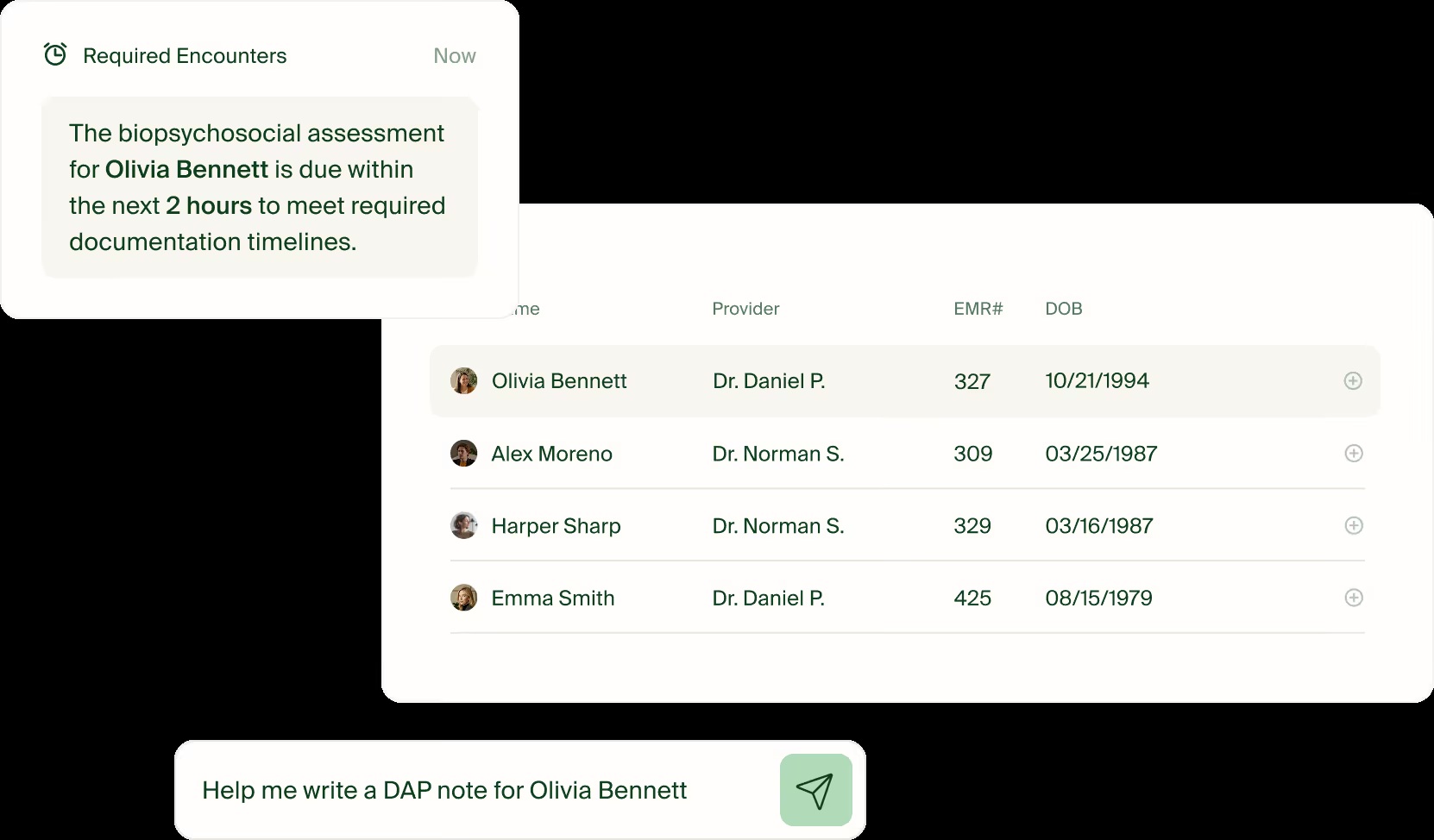
The CRM captures inquiries and referrals, tracks admissions, checks eligibility, and converts a prospect into a patient in the clinical system. The EHR handles documentation, scheduling, tasks, and a patient portal. Completed encounters feed claims workflows. Embedded Power BI dashboards give operators a view across the business. The point is that a patient’s information survives the journey.
AI occupies several positions along that route. Ease advertises ambient documentation, chart review, patient-provider matching, and automated data completion. Its admissions tools include AI-summarized benefits verification. These are operational assistants, aimed at administrators and billers as well as clinicians. The business proposition depends on information moving through connected workflows, rather than remaining trapped in a clever individual feature.
The checkbox deserves some applause
The customer stories contain an almost comic counterweight to the AI pitch. NOW Counseling, in southwestern Indiana, describes large text boxes giving way to dropdowns and checkboxes. Templates could reflect its treatment approach and payer requirements. Group documentation could combine a shared note with individual responses. Its clinicians estimated two to three administrative hours saved each week.
Those improvements deserve their own credit. Better forms can help a newer therapist make fewer mistakes and leave a supervisor fewer corrections. Calling every improvement an AI achievement would obscure the practical design work. NOW’s case study also describes a claims-transfer delay that Ease resolved with its outside billing partner, MedPro. Connected software still requires people who can fix a connection.
Treatment Trends, a Pennsylvania nonprofit, supplies another example. Its earlier paper records allowed missing documentation and medication-tracking gaps to emerge late. Ease helped it build encounter checks and supervisor review into the work. Claims could be generated from completed encounters instead of being handwritten or entered individually into payer portals. An implementation specialist also worked with staff on-site. Buying software meant changing a routine.
A venture investor crosses the table
Ease announced its $41 million Series A on March 2, 2026, led by Andreessen Horowitz. CEO and co-founder Zach Cohen had previously been an investing partner there. Co-founder and CTO Raymond Wang brings engineering experience. President Steve Gold, identified by a16z as part of the founding team, previously built Refresh Mental Health and sold it to Optum.

The combination matters: software engineering, an investor’s view of company building, and experience running a behavioral health business. Ease says the funding will expand product and engineering teams, advance automation, and support enterprise growth. Its stated mission links practice growth with preserving time for patients. That makes saved administrative time central to both its product argument and its commercial ambitions.
The invoice behind the promise
Ease sells cloud software through subscription agreements. Revenue-cycle services add a second commercial route: per-claim pricing or a percentage of collections, with volume tiers. Practices can keep their own billing teams and use the claims engine, or buy specialist billing support. The service covers benefits verification, authorizations, utilization review, and claims follow-up.
The company reports more than $2.5 billion in claims processed. That figure measures billing activity, not Ease’s revenue. For a buyer, the useful comparison is the total operating bill: subscriptions, billing work, training, migration, and repeated administrative effort. A lower software bill matters little if staff spend the difference repairing the workflow.
Make the vendor follow the patient
Ease competes in an occupied market. Kipu also offers CRM, clinical software, and RCM for behavioral health; Qualifacts supplies behavioral health EHR platforms and related services. Ease’s claim to differentiation rests on its shared architecture, automation, and implementation. The existence of three product categories on one website cannot settle the comparison.
The practical test is to follow one patient from referral to payment, using the practice’s actual forms and billing rules. Count repeated entries. Watch what happens when documentation is incomplete. Ease’s September case-management guide even names current gaps, including external referral follow-up tracking and dedicated case-manager permissions. Organizations requiring those functions need to check fit carefully. The most persuasive demonstration would end with less work waiting for someone tomorrow.