The man who started college math at 13 is now rebuilding how every doctor in America finishes their paperwork.
Nikhil Buduma / San Francisco, CA
At 13, Nikhil Buduma was studying university-level mathematics simultaneously at San Jose State and Stanford while his classmates were navigating middle school. At 15, he was a managing scientist at a university drug discovery lab, contributing to the design of a pertussis vaccine. By the time he graduated Bellarmine College Preparatory as valedictorian in 2013, he had already earned two gold medals at the International Biology Olympiad - in Singapore and Bern - becoming the first person of Indian descent to do so at the international level.
None of that is what he talks about most. What Nikhil talks about is the doctor who spent 4.7 hours a day on paperwork and got 1.2 hours back.
Ambience Healthcare, which Nikhil co-founded in 2020 with Mike Ng and now leads as CEO, is an ambient AI platform that listens to clinical conversations, generates documentation in real time, and automates the ICD-10 and CPT coding that determines whether hospitals get paid. The platform runs across outpatient clinics, emergency departments, and inpatient floors. It supports more than 100 medical specialties. In May 2025, an independent evaluation found it exceeded board-certified physicians in ICD-10 coding accuracy by 27%.
The $243 million Series C that closed in July 2025 - co-led by Oak HC/FT and Andreessen Horowitz, with participation from the OpenAI Startup Fund, Kleiner Perkins, Optum Ventures, and others - valued the company at $1.25 billion. Ambience had raised $343 million total by that point. The investors are not placing a speculative bet: they are following a company that had already won a competitive bake-off at Cleveland Clinic, a notoriously rigorous evaluator of healthcare technology.
"We started by running a medical practice before building a platform company - that's why we understand what clinicians actually need."
- Nikhil BudumaBefore building the platform, Nikhil and the Ambience team ran an actual medical practice. Not as a proof of concept - as the thing itself. They saw what clinicians dealt with: the EHR burden, the after-hours charting, the cognitive tax of documentation creep. The product they built came out of that friction. It is why Ambience talks about "workflow-native" AI not as marketing language but as a design constraint.
At MIT, Nikhil studied Computer Science and Engineering through both his bachelor's and master's degrees, graduating with a perfect GPA. In 2017, while still deeply embedded in research, he published Fundamentals of Deep Learning with O'Reilly Media - the first widely adopted modern textbook on the subject. It arrived at exactly the moment when practitioners needed something to hold onto. The field was moving fast; the book gave it structure.
His GitHub handle is "darksigma" - a reference to the population standard deviation in statistics. It is a quiet signal about how he thinks: in distributions, not data points; in systems, not snapshots.
The move from Chief Scientist to CEO at Ambience was not a pivot from technical to business. It was a recognition that the company had reached the stage where the same rigor applied to biology olympiad training, deep learning research, and vaccine design needed to be applied to strategy, hiring, and go-to-market. Nikhil carries all of it into the same room.
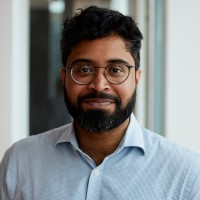
The story of Ambience Healthcare does not start with a pitch deck. It starts with a medical practice. When Nikhil and Mike Ng founded the company in 2020, they embedded themselves in clinical settings before writing a single line of product code. They ran the practice. They saw the documentation backlog. They sat with the problem until they understood it from the inside.
This is the detail that separates Ambience from the ambient AI field it helped define. Most AI scribing tools are pattern-matching engines layered on top of existing workflows. Ambience built the workflow. The platform handles pre-charting (pulling patient history before the encounter), ambient listening (real-time note generation during the visit), clinical documentation integrity, ICD-10 and CPT coding, and revenue cycle automation - end to end. It is not a point solution. It is infrastructure.
The results are not theoretical. At Alpine Physician Partners, physicians went from 4.7 hours of daily charting to 1.2 hours. Cleveland Clinic ran a competitive AI scribe evaluation - a multi-vendor bake-off - and Ambience came out on top. The company now supports 100+ medical specialties across outpatient, emergency, and inpatient settings. It became the first ambient AI platform to launch inpatient CDI (Clinical Documentation Integrity) in September 2025.
The platform is built on OpenAI technology - and OpenAI itself is an investor. So are Andreessen Horowitz, Kleiner Perkins, and Optum Ventures. The investor list reads like a conviction bet that ambient AI in healthcare is not a feature - it is a category.
In 2025, when Nikhil moved from Chief Scientist to CEO, the company was already operating at scale. The transition was less a promotion and more a recognition of what the moment required: someone who could hold the technical depth and the organizational weight simultaneously. He had been doing both. The title caught up.
Published in 2017, when most practitioners were learning deep learning from scattered arXiv papers and YouTube lectures, Fundamentals of Deep Learning was the textbook the field needed before it knew to ask for one. Nikhil wrote it while at MIT, synthesizing the mathematics of neural networks into something teachable. A second edition followed. The book remains one of the most widely adopted introductions to the subject ever published.
That he pivoted from writing one of the defining deep learning texts to building a healthcare AI unicorn is less a contradiction than a through-line. He was never doing ML for its own sake. He was solving problems that required it.
O'Reilly Media, 2017Won gold medals at the International Biology Olympiad in Singapore (2012, 17th globally) and Bern (2013, 8th globally). First person of Indian descent to earn two international gold medals in the competition.
Completed BS and MEng in Computer Science and Engineering at MIT with a perfect GPA. Focused on large-scale data systems for healthcare delivery, mental health, and medical research.
Published Fundamentals of Deep Learning (2017) - the first widely adopted modern deep learning textbook. A second edition followed. Still referenced in courses worldwide.
Ambience Healthcare won Cleveland Clinic's competitive multi-vendor AI scribe evaluation - one of the most rigorous hospital technology assessments in the U.S.
In May 2025, Ambience's AI became the first ambient AI platform to exceed board-certified physicians in ICD-10 coding accuracy - by 27%, per independent evaluation.
Ambience Healthcare won the 2026 KLAS/CHIME Trailblazer Award for emerging vendor leadership - recognition from the most respected evaluators in health IT.
Nikhil started taking university math at two colleges simultaneously at age 13 - before he had finished middle school.
His GitHub username is "darksigma" - a nod to the statistical symbol for population standard deviation. Data, not drama.
Before building the ambient AI platform, the Ambience team ran an actual medical practice to understand clinical workflows from the inside out.
He contributed to whooping cough vaccine design before he was old enough to vote.
Ambience's platform supports 100+ medical specialties - more than most individual hospital systems staff in a given year.
He wrote the deep learning textbook that helped train the engineers who are now building the AI models his company runs on.