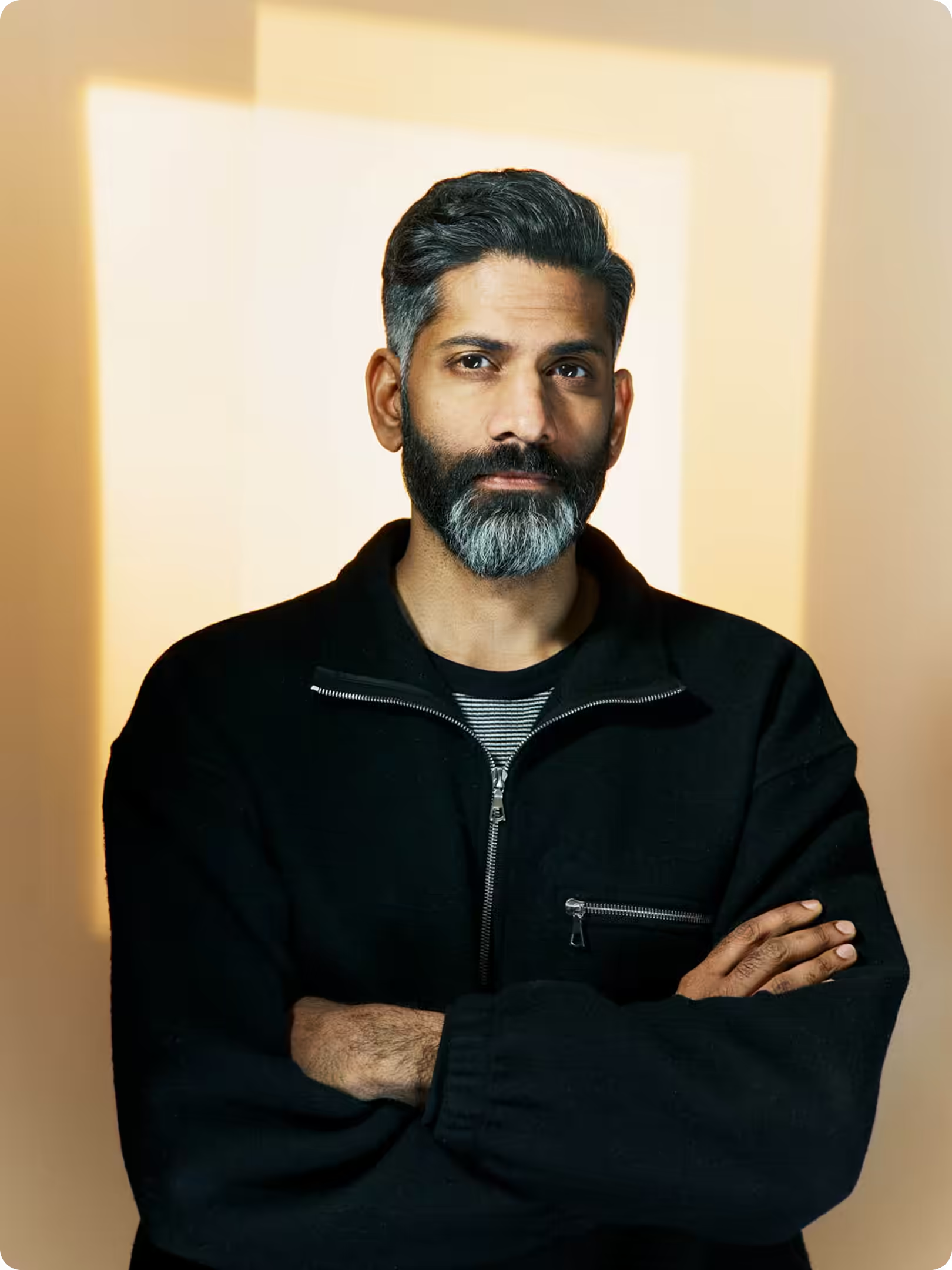
Every Indian Parent's Nightmare - Until He Wasn't
Shiv Rao spent his college years at Carnegie Mellon not in pre-med, but at the intersection of art and computer science. He was a DJ at Pittsburgh art museums. He programmed virtual synthesizers in the style of Aphex Twin and Autechre. He appeared in IMAX skateboarding films. His musical touchstones were Fugazi, Minor Threat, Depeche Mode, and The Cure. "Every Indian parent's nightmare for most of undergrad," he later described himself - with a grin attached.
He graduated in 2001 with a BA in history and a minor in minority studies. Medicine wasn't the plan. Then he sat in a lecture by architect William McDonough, who told the story of an Indian ophthalmologist who had revolutionized cataract surgery - restoring sight to over one million people through systematic, accessible care. Something clicked.
Rao enrolled at the University of Pittsburgh School of Medicine. He didn't love the rote memorization, but he loved the humanity of the work - the intensity, the closeness. He completed internal medicine residency at the University of Michigan between 2007 and 2010, and it was there, during late nights between rounds, that he taught himself to code and built his first health app. Fourteen years before Abridge became a $5.3 billion company, the shape of the idea was already forming.
"Side quests serve the long game if they're strategic."
- Shiv Rao, on his unconventional path to medicine and technologyAbridge: Where Every Conversation Counts
Rao trained as a cardiologist at UPMC and joined the faculty in 2013. The years from 2013 to 2019 were spent inside the system - leading UPMC Enterprises' provider-facing investment portfolio, funding healthcare startups, and helping build a Machine Learning in Health program at Carnegie Mellon. He was investing in others' ideas. His own was developing in the background, born of a very specific frustration: nightly dictation sessions after a long day of seeing patients.
Every evening, he would dictate the day's patient encounters into a recorder - the audio going nowhere useful, the information locked away in formats nobody could quickly find. Meanwhile, his wife was going through fertility treatments and struggling to retain what doctors told her in appointments. The same information asymmetry, from both sides of the stethoscope.
In 2018, he co-founded Abridge with Sandeep Konam, a Carnegie Mellon robotics graduate. The premise was direct: use AI to record clinical conversations and transform them into structured, billable medical documentation in real time. Not after the fact. Not the next morning. During the conversation itself.
The team Rao assembled is itself a story. His COO, Julia Chou, is a former Googler who also graduated from culinary school. His CTO since 2023, Zachary Lipton, is a Carnegie Mellon machine learning professor who played jazz saxophone professionally. Rao once recruited an interior designer (Rufus Knight) and a magician (David Gerard) to sharpen Abridge's product intuition. He sought out Rick Rubin - the legendary music producer - as an intellectual touchstone. The logic: artistry and diverse perception produce better software.
$907 Million and a Doctor Who Won't Stop Practicing
In February 2025, Abridge raised $250 million in its Series D at a $2.75 billion valuation. Four months later, in June 2025, Andreessen Horowitz and Khosla Ventures led a $300 million Series E that pushed the valuation to $5.3 billion. Total funding since founding: over $907 million. Annual revenue run rate by Q1 2025: $117 million.
Rao is not rushing toward an IPO. "We have decades of runway," he said after the Series E close, adding that the company should "preserve optionality" while staying mission-focused. The priority is depth, not velocity toward an exit.
He is also, notably, still a cardiologist. One weekend per month, Rao takes on-call hospital shifts at UPMC. He describes continuing to practice medicine as "an incredible privilege" - to grow old alongside patients, to remain the person his company's technology is designed to serve. There is no performance in this. He was on call the night before at least one major press interview.
"Precision, accuracy, trust - these aren't just features. They're existential."
- Shiv Rao, on what healthcare AI actually requiresGoing Millions of Miles Deep
Rao builds Abridge with an unusual constraint: no overpromising. In healthcare AI, where hallucinations can mean wrong diagnoses and wrong billing codes, the stakes are existential in the most literal sense. His stated rule is direct - "We won't overpromise, we won't pitch ahead of our skis, and we won't tout product features we haven't built and thoroughly tested."
The platform supports 28 languages, serves 55 medical specialties, integrates with Epic, Cerner, and other major EHR systems, and is built on what Rao calls a "contextual reasoning engine" - AI that links generated notes to the specific moments in a conversation that produced them, making output verifiable and transparent.
He draws a deliberate distinction between AI that shifts administrative work to other people and AI that eliminates it entirely. "In this case, it actually didn't shift any work anywhere. It really just eliminated keystrokes." Three hours per clinician per day, returned to patients instead of paperwork.
His view of competition is clear-eyed. He has publicly named Microsoft as Abridge's primary competitor in the ambient AI documentation space. His response: go deeper, not broader. "We're going millions of miles deep on this idea."
On where AI fits in medicine longer term: "We're not going to fully automate a doctor or a nurse in the next five to ten years. Conversation will continue to drive healthcare workflows." Abridge is betting on augmentation, not replacement - and building the infrastructure layer to prove it.
What He Says When He Means It
"With purpose-built AI, we're giving agency back to clinicians, creating clarity for patients, and establishing radical efficiencies to transform healthcare from the conversation up."
"We're not just building tools for healthcare; we're building tools that I want to use myself."
"We started Abridge with a simple thesis that healthcare is about people, and that our technology can bring those people closer together."
"You always want to acquire chips on your shoulder and retire them quickly."
From Art Museums to the ICU to $5 Billion
-
1997-2001Carnegie Mellon University - BA in History, minor in Minority Studies. DJed art museums, programmed virtual synthesizers, appeared in IMAX skateboarding films. "Every Indian parent's nightmare for most of undergrad."
-
2001-2007University of Pittsburgh School of Medicine - Redirected by a lecture on an Indian ophthalmologist who restored sight to over one million patients. Found the humanity in medicine worth the rote memorization.
-
2007-2010Internal medicine residency at University of Michigan. Taught himself to code and built a health app between rounds.
-
2010-2013Cardiology fellowship at UPMC. Becomes a practicing cardiologist and joins UPMC faculty.
-
2013-2019EVP at UPMC Enterprises. Leads provider-facing investment portfolio, funds healthcare startups, helps build the Machine Learning in Health program at Carnegie Mellon.
-
2018Co-founds Abridge with Sandeep Konam to turn clinical conversations into structured, billable medical documentation using AI.
-
2023Carnegie Mellon ML professor Zachary Lipton joins as CTO. Enterprise deployments accelerate across major health systems.
-
2024Named to TIME's 100 Most Influential People in AI. Abridge hits Forbes AI 50, Fast Company Most Innovative, TIME Best Inventions. Delivers keynote at American Heart Association Scientific Sessions.
-
Feb 2025Series D: $250M raised at $2.75B valuation. Fortune publishes major founder profile. 100+ health systems deployed.
-
Jun 2025Series E: $300M led by a16z and Khosla Ventures. Valuation hits $5.3B. 150+ health systems, 50,000+ clinicians, $117M ARR.
Things That Don't Fit the Bio Line
- He spun records at Pittsburgh art museum events during his Carnegie Mellon years - the kind of DJ set where the art was the audience.
- His musical DNA runs through Aphex Twin, Autechre, Fugazi, Minor Threat, Depeche Mode, and The Cure. He built virtual synthesizers as a student. The software instinct came first.
- He appeared in IMAX skateboarding films before he ever appeared in a medical journal.
- His co-founder team includes a culinary school graduate (COO Julia Chou) and a former jazz saxophonist (CTO Zack Lipton). The company was built by people with other lives.
- He recruited a magician - literally a magician - to help develop Abridge's product intuition. The logic: misdirection and attention are design problems.
- He recorded a podcast while unknowingly incubating influenza A, later joking that listeners could "hear what a viral prodrome sounds like in real time."
- Despite a $5.3 billion valuation, he still takes on-call cardiology weekends at UPMC - roughly once a month. He was on call the night before at least one major profile interview.
- He grew up in Pittsburgh. He stayed. UPMC is his hospital. Carnegie Mellon is where his co-founders teach. The company is San Francisco-headquartered, but Pittsburgh-rooted.