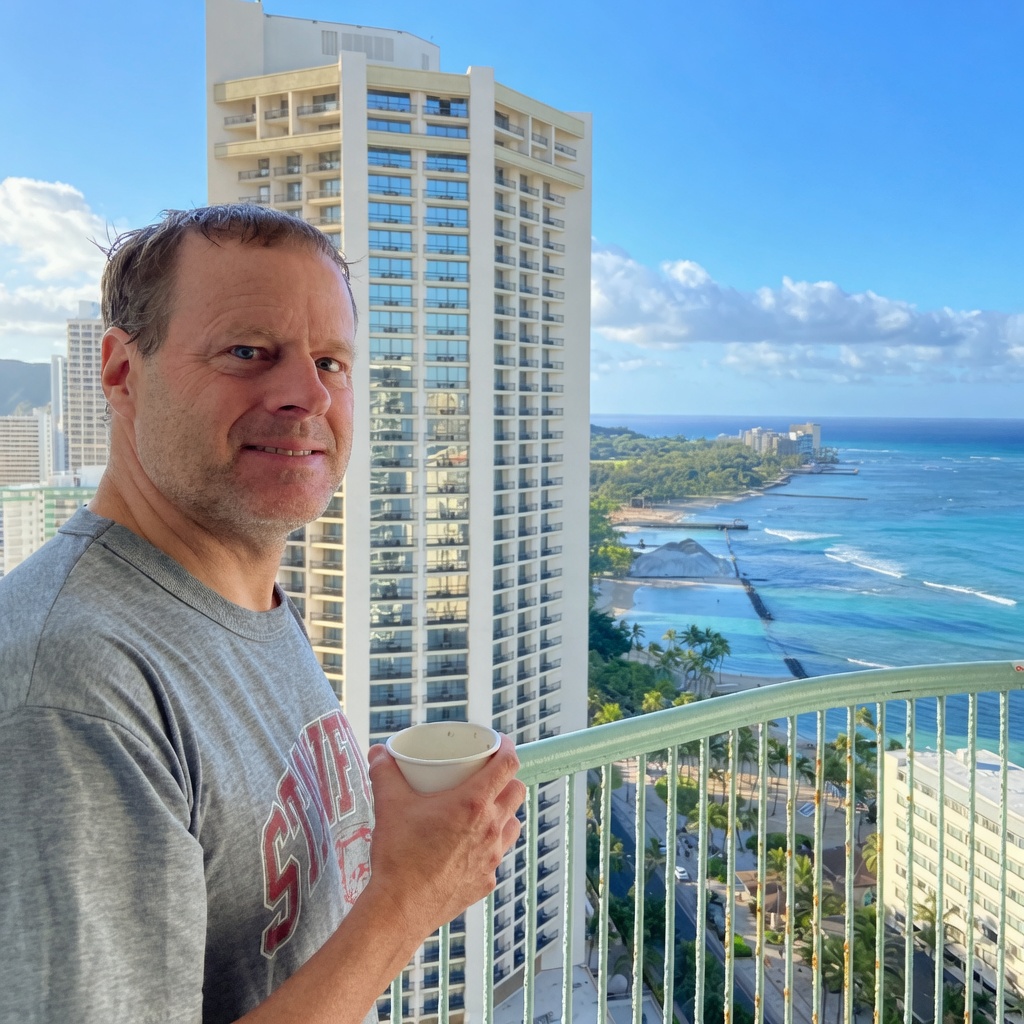
Profile
The Scan That Sees What Doctors Miss
Seven minutes. Fully clothed. The radiation equivalent of eating four bananas. That's what a DexaFit full-body DXA scan costs you. What it returns - at least according to Barton Wells and his co-founders - is a look at what chronic disease has been quietly building inside you for years.
Wells, who serves simultaneously as CEO and CTO of DexaFit Dx, is one of those rare people who actually owns the technical stack he's running a company on. He isn't the founder who hands the hard problems to an engineering team. He is the engineering team, or close enough to it. With over 30 years of experience in AI, machine learning, computer vision, macOS and iOS development, Wells came to DexaFit having already worked inside one of Silicon Valley's most sophisticated ML operations - Dropbox's computer vision and machine learning team.
His path there wasn't straight. It rarely is for people who end up solving genuinely hard problems. Barton Wells graduated from Stanford University in 1988 with a degree in theoretical mathematics - the kind of mathematics that has no immediate application and eventually finds all the important ones. He spent the next three decades in software: graphics, video production, mobile development, computer vision. He also spent a significant stretch of that time in the water.
"We learned how much less we train than all of the other swimmers. We train about half as much."- Barton Wells, on competing in the FINA Marathon Swimming World Cup
Wells is the kind of person who hears "you're doing it wrong" and files it away as a hypothesis to test rather than a verdict to accept. It served him well in the water, and it serves him now in a healthcare industry that has spent decades building expensive, reactive systems and calling them prevention.
The Other Career
Racing the Clock in Open Water
FINA World Cup Career
Before DexaFit, before Dropbox, before any of it, Barton Wells was a swimmer. He competed for Stanford's team from 1984 to 1988, earned All-American honors in pool events across 12 years of competition, and later transitioned from the pool to the open ocean.
Open water marathon swimming - the FINA 10K circuit - is a peculiar sport. Competitors swim in natural bodies of water with no lane lines, no walls, and no guarantees about what they'll encounter. Wells raced in Shantou, China. He raced in Copenhagen. He raced in conditions he described as "much faster, much more competitive, much rougher, and much longer" than anything the masters circuit had prepared him for.
"Getting elbowed in the nose, kicked in the face, hit in the head, feet pulled on, and goggles ripped off are all common."- Barton Wells, on professional open water racing
He trained under coach Jose Bonpua at Los Altos Mountain View Aquatics. His training partners and mentors included some of the best open water swimmers of that era: Petar Stoychev of Bulgaria, Brian Ryckeman of Belgium, Thomas Lurz of Germany - all world champions in their own right. Wells entered this world not through a national program but on the recommendation of Lisa Hazen, a former pro competitor who saw something in him worth developing.
What makes the swimming chapter notable isn't the world ranking, though finishing 2009 seventh in the world on a global professional circuit is worth noting. What's notable is that Wells competed at that level while simultaneously running a technology startup. He was operating as a high-tech founder and a professional athlete at the same time, in two fields that both demand full attention. He chose not to treat either as a hobby.
His Twitter handle remains @liveswimmer. Some identities stick.
Engineering Career
From Computer Vision to DexaFit
Wells built his technical career in layers. Graphics development in the early days of macOS, then iOS when mobile became the platform that mattered, then computer vision as sensors and cameras created new problems worth solving. He joined Dropbox in January 2015 as a Staff Engineer on the CVML team - computer vision and machine learning. This was not a peripheral Dropbox project. This was core to what Dropbox was building as it moved beyond simple file sync into intelligent document understanding.
Eighteen months later, he co-founded DexaFit alongside Amy Stanbery and Adam Kadela, also taking a concurrent role as Director of Sport Science and Technology at Athos - a company using EMG sensor data to improve athletic performance. The combination of sports science and computer vision work was not an accident. DexaFit sits precisely at that intersection.
DexaFit AI: The Platform in Numbers
Before Dropbox, Wells was Director of iOS Engineering at CloudOn (2013-2015), bringing enterprise Office applications to mobile - a technically demanding problem that required bridging document formats, rendering engines, and mobile performance constraints simultaneously. Before that, Senior Graphics Software Developer at Condition One (2012-2013), a company working on immersive 360-degree video.
The résumé reads like a tour through the emerging technical problems of the 2010s: mobile productivity, immersive video, cloud storage intelligence. Each role was its own research problem. Wells approached them the same way a distance swimmer approaches an open-ocean course: methodically, reading the water, adjusting for conditions, finishing.
The Company
DexaFit Dx: Rethinking the Checkup
DexaFit Dx's premise is straightforward and, if you sit with it, slightly embarrassing for the broader healthcare industry: a technology that has existed for decades - the DXA (Dual-Energy X-ray Absorptiometry) scan - can be paired with modern AI to detect coronary artery disease, Type 2 diabetes risk, and musculoskeletal conditions early, cheaply, and without putting the patient through invasive procedures. The question Wells and his team are answering is: why wasn't this already happening?
The DXA scan was originally designed for bone density assessment. What DexaFit's AI extracts from that same scan goes considerably further. The platform analyzes visceral fat distribution, muscle quality, body composition ratios, and metabolic markers - all from a scan that takes under eight minutes, requires no special preparation, can be performed fully clothed, and exposes the patient to roughly the radiation they'd absorb from eating four bananas.
The company serves four types of customers: individual consumers who want visibility into their own risk profiles, physicians who want objective data to complement their clinical assessments, employers who want to reduce long-term healthcare costs across their workforces, and health insurance plans looking for a better risk stratification input than the questionnaires and claim histories they currently rely on. That last category is where DexaFit's ITC Vegas presentation landed: the insurance industry's actuarial models are built on lagging indicators, and a scan that catches coronary artery disease in asymptomatic patients could change that math substantially.
The platform is currently pursuing FDA clearance as a Software as a Medical Device (SaMD) - a regulatory category that reflects how seriously the company is positioning its AI diagnostics claims. The mobile app, available on both iOS and Android, lets individuals track their results over time with AI-powered personalized insights. The enterprise offering provides healthcare workflow integration for physician and employer clients.
Primary focus: detecting coronary artery disease in asymptomatic patients before clinical symptoms appear
AI estimates biological age based on body composition and metabolic markers from a single scan
Targeting insurers, employers, physicians and individuals - four distinct market channels simultaneously
DexaFit AI mobile app on iOS and Android tracks results over time with personalized risk insights
FDA-pending SaMD (Software as a Medical Device) classification for AI diagnostics platform
63-person team building toward widespread adoption of DXA-based screening across healthcare systems
Career Timeline
The Long Arc
1984 - 1988
Studied Theoretical Mathematics at Stanford University; competed as a varsity swimmer on the Cardinal squad
1988 - 2012
Built a 30-year career in software: macOS, iOS, video production, computer vision, and machine learning across multiple companies and independent projects
2009
Ranked 7th in the world on the FINA 10K Marathon Swimming World Cup circuit while simultaneously operating in the tech industry
2012 - 2013
Senior Graphics Software Developer at Condition One, working on immersive 360-degree video technology
2013 - 2015
Director of iOS Engineering at CloudOn, bringing enterprise Office applications to mobile devices
2015 - 2016
Staff Engineer at Dropbox on the CVML (computer vision and machine learning) team
2016
Co-founded DexaFit Dx with Amy Stanbery and Adam Kadela; took on dual CEO/CTO role
2016 - 2017
Concurrent role as Director of Sport Science & Technology at Athos, a wearable EMG sensor company for athlete performance
2023 - 2024
Presented DexaFit's continual health risk assessment model at ITC Vegas to the global insurance technology community
Present
CEO/CTO at DexaFit Dx, leading AI development for a multi-disease screening platform pursuing FDA SaMD clearance
Links & Resources