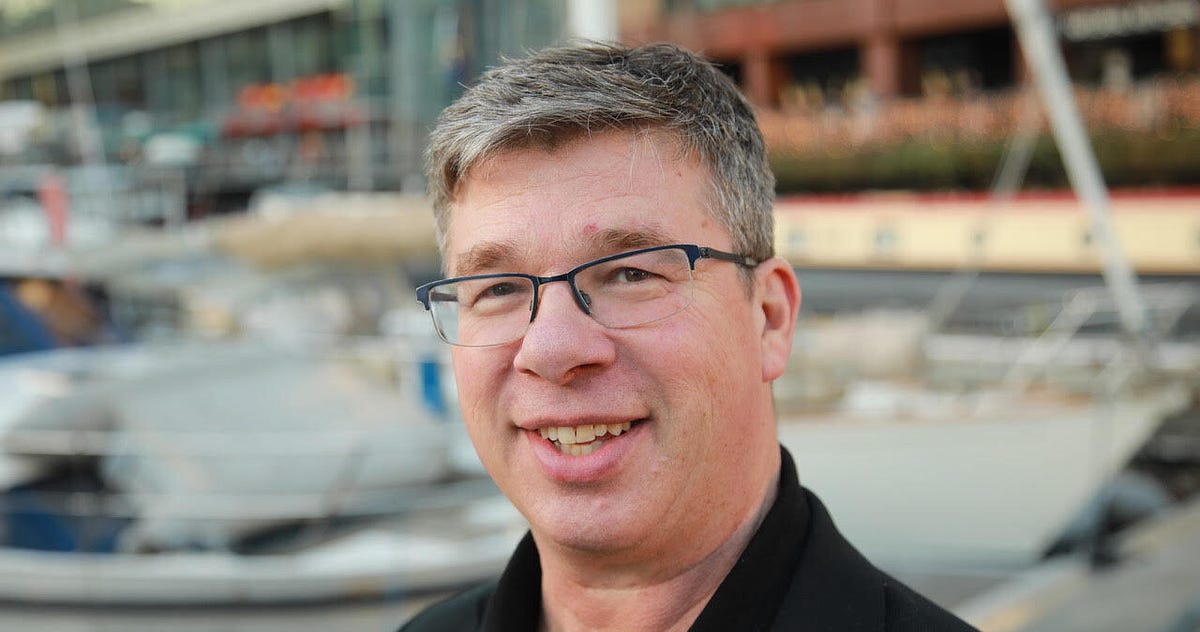
The meeting that started Oii.ai wasn't a pitch deck. It was a book research interview. Bob Rogers, Harvard PhD in physics and newly minted author, was calling supply chain experts for a chapter in "Demystifying AI for the Enterprise." He reached David Evans - a man who had spent decades configuring global supply networks. They talked. Then they talked more. Then Evans told him something that changed the conversation entirely: most supply chains are designed on the assumption that market conditions stay stable. They don't. And nobody had built a system that actually treated them as the unpredictable, dynamic, high-dimensional systems that they are.
Rogers knew exactly what that felt like - because he'd been modeling chaotic systems his entire career. At Harvard, his dissertation work involved building simulations of the physical processes near supermassive black holes. The term "digital twin" wouldn't become fashionable for another decade, but that's what he was building: computational stand-ins for systems too complex and too remote to observe directly. The physics was brutal. The math was elegant. The lesson stuck.
AI is only at the beginning. When AI actually knows things for real - not just predicts from patterns, but understands causally - that will dramatically change everything.
- Bob Rogers, CPTO & Co-founder, Oii.ai
After Harvard, Rogers made a move that surprised most physicists: he co-managed a quantitative futures trading hedge fund for twelve years. Not a detour - a laboratory. Financial markets are supply-chain-like systems with high noise, adversarial agents, and brutal feedback loops. You either learn to model uncertainty correctly or you lose money. Rogers learned. He also wrote his first book during that period: "Artificial Neural Networks: Forecasting Time Series," published in 1993 - when most people hadn't heard of the internet, let alone deep learning.
In 2006, he pivoted to healthcare. Not because it was lucrative - because clinical data was the messiest, most underexploited signal set he'd ever seen. He became a medical device product manager, then joined Intel as Chief Data Scientist for the Data Center Group, leading enterprise-scale AI initiatives. At Intel, he built award-winning data science teams and ran the "Intel Inside: Safer Children Outside" program - using AI to help the National Center for Missing and Exploited Children process exploitation reports faster. That last project doesn't appear on many slide decks, but Rogers mentions it. Telling.
He co-founded Apixio while still at Intel - a healthcare AI company built on the premise that unstructured clinical notes were a goldmine most systems ignored. Apixio was acquired by Centene in 2020. Rogers didn't stop. He was already three years into the research for what would become Oii.ai.
Oii.ai's product is called Optii, and its central concept is the probabilistic digital twin. Not a deterministic model that assumes you know the future - a stochastic one that hands you thousands of "what if" scenarios with quantified probabilities attached to each. Healthcare clients use it to manage pharmaceutical supply chains. Food distributors use it to stop perishables from becoming write-offs. The scenarios are generated in real-time, not in the weekly report that arrives after the decision window has closed.
Rogers is precise about what "digital twin" means in this context - and what it doesn't. A lot of software vendors slap the phrase on dashboards and call it done. Oii.ai builds a model that encodes actual causal structure: how demand shifts ripple into inventory, how inventory gaps propagate into cost and service failures, how disruptions in one node cascade through the network. The physics PhD is not an accident. This is how you model a black hole's accretion disk. It's also, as it turns out, how you model a global food distribution network during a port strike.
Knowing all the answers is counterproductive. Ask probing questions about what customers need, what market conditions are doing, and what your stakeholders actually care about.
- Bob Rogers
Away from the platform, Rogers is a sports omnivore: SF 49ers, SF Giants, Manchester City. He surfs. He cycles. He swims. He's also a self-described Home Depot regular - a detail that feels cosmically appropriate for someone who builds systems designed to make sure the hardware store never runs out of screws. He listens to hard rock. He co-authored a book with ChatGPT and his wife - partly as an experiment, partly because it seemed like fun, and partly because if you're writing about AI, you should probably use it.
That book, "ChatGPT, An AI Expert, and a Lawyer Walk into a Bar," is exactly as playful as the title suggests. It also represents something Rogers does that most technical founders don't: he translates. The books, the TechArena columns, the podcast appearances, the Forbes and Inc. clips - they're all part of the same project. Making AI legible to the people who actually have to make decisions with it.
TechArena named him 2024-2025 Voice of Innovation. His recent writing has focused on AI agents and what they might actually mean in practice (as opposed to the buzzword fog surrounding the topic). His 2025 AI predictions column was widely circulated. The common thread: rigor over hype, specificity over abstraction, honesty about where AI currently falls short.
With Oii.ai running a 64-person team out of San Francisco and having secured $1.85M in seed funding, Rogers is mid-stride on the bet he placed when he cold-called a supply chain expert for a book chapter. The black holes are still there, spinning. The supply chains are still fragile, cascading, and riddled with assumptions that the future will look like the past. Bob Rogers built a system for the former. He's deploying it on the latter.