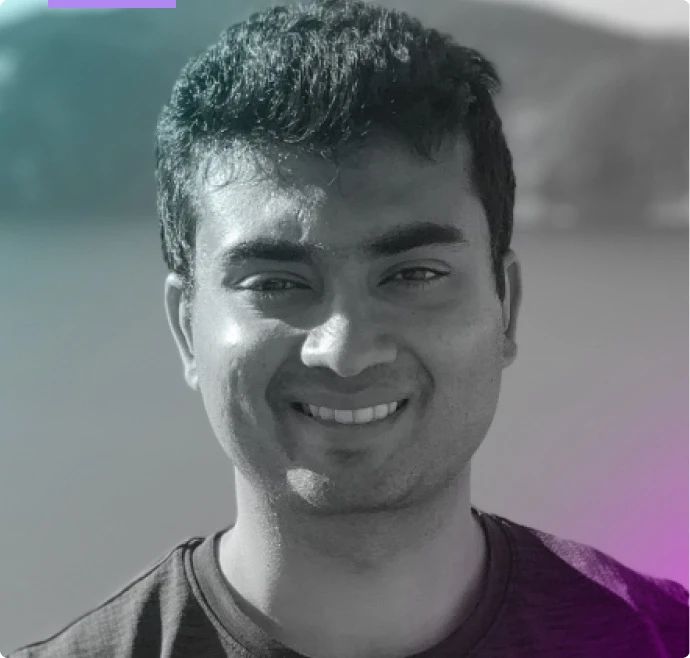
A patient is diagnosed with bladder cancer. Standard protocol says try BCG therapy first. It works for some people. For others, it buys them a year of side effects and false hope before they end up in surgery anyway. For decades, oncologists have had no reliable way to know in advance which patient is which. Anirudh Joshi decided that was the problem worth solving.
Joshi's company, Valar Labs, does something that sounds obvious once you hear it and turns out to be genuinely hard to build: it looks at a pathology slide - the same image a pathologist already reviews - and extracts signals that predict whether a treatment will work. No new blood draws. No extra biopsies. The tissue is already there. The AI just reads it differently.
Pathology is Untapped
The insight behind Valar Labs isn't algorithmic - it's observational. Joshi and his co-founders, studying AI and medicine at Stanford under Prof. Pranav Rajpurkar (who ran the AI lab Andrew Ng founded), looked at the data modalities oncologists were using to make treatment decisions. Genomics gets the headlines. PET scans get the budgets. Pathology slides - the oldest, most ubiquitous artifact in cancer care - sit on a server, reviewed once by a human eye and then filed.
"Pathology is an untapped modality in cancer care," Joshi has said. His team saw a specific window: COVID-19 had accelerated digital pathology adoption at hospitals faster than anyone predicted. Centers were scanning slides and storing them digitally at scale. The infrastructure that had blocked computational pathology for years was suddenly, accidentally, in place.
The majority of cancer patients today, their treatment plan is really unclear. If we knew which patient was which, we wouldn't waste a year of therapy.
- Anirudh Joshi, Co-Founder & CEO, Valar LabsFrom Microsoft Word to Tumor Microenvironments
Joshi's path to cancer AI is not the one you'd predict from a resume scan. He graduated Georgia Tech with a biomedical engineering degree in 2017, then spent time as a computer vision scientist at Boston Scientific and a machine learning engineer at Capital One before landing at Microsoft. There, he built one of the more widely used AI features most people have never thought about: the Rewrite Suggestions tool in Microsoft Word. Sequence-to-sequence deep learning, trained and deployed at scale, quietly improving the prose of hundreds of millions of documents.
Then he went to Stanford for a master's in computer science, landed in Rajpurkar's group, and turned all of it - the computer vision from Boston Scientific, the production ML from Microsoft, the pathology exposure from PathAI, the telemedicine AI from Curai - toward oncology. The crossover isn't a pivot. It's accumulation.
Vesta: The First Commercial Test
Valar's first product, Vesta, launched commercially in 2024. It combines two models: a computer vision system that processes histology images to extract cellular-level biomarkers invisible to the naked eye, and a clinical model that uses those biomarkers to identify which bladder cancer patients are at elevated risk of not responding to BCG - the standard first-line immunotherapy for the disease.
The validation behind it is not thin. Joshi's team ran studies across 12+ medical centers worldwide, covering more than 1,000 patients. By mid-2024, Vesta was live in 20 hospitals across the United States with insurance reimbursement already secured - an unusually fast commercial trajectory for a diagnostic that touches oncology workflows.
"The doctor is always in the driver's seat. This is just more data, and they like it."
- Anirudh JoshiThat framing - "just more data" - is deliberate. Oncologists are not being replaced by a model. They're getting a number they didn't have before. Joshi understands that the clinical workflow isn't an obstacle to work around; it's the product. A diagnostic that doesn't integrate seamlessly into how urologists already see patients won't be used, no matter how accurate it is.
The Backing and the Bet
Valar Labs has raised $26M total - $4M in a seed round in March 2022 led by Andreessen Horowitz, and a $22M Series A in May 2024 led by DCVC and a16z, with Pear VC participating. The a16z investment memo, written by Vineeta Agarwala and Jay Rughani, framed the problem bluntly: "Today, oncologists have more therapeutic options... yet we lack the routine ability to query historical outcomes."
DCVC, which has backed computational biology and life science AI for years, led the round. The combination - a16z's health AI conviction plus DCVC's hard-science credibility - reflects how Valar Labs sits between two worlds that don't always talk to each other: enterprise software and clinical medicine.
Pancreatic Cancer and the JCO Paper
Bladder cancer was the entry point. The ambition runs further. In February 2026, Valar Labs published a pivotal study in the Journal of Clinical Oncology - one of the most authoritative publications in the field - validating their AI model for predicting chemotherapy response in pancreatic cancer patients. This matters because pancreatic cancer is one of the hardest treatment decisions in oncology. As UCSF advisor Dr. Eric Collisson put it: "Actionable genomic mutations in pancreas cancer are like Bigfoot - you always hear about them but you never see them."
The Valar approach - look at the tissue, not just the genome - offers a different axis of information. The JCO publication represents a significant clinical validation milestone, the kind that moves a company from "interesting startup" to "serious diagnostic player" in the eyes of oncologists and hospital systems.
Ovarian cancer is also in the pipeline. The commercial model Joshi is building mirrors what genomic testing companies like Foundation Medicine established - tests ordered through a commercial lab, billed to insurance, delivered to the physician before the treatment decision. No new hospital infrastructure required.
The Team Behind the Model
Valar Labs was co-founded by four people who met through Stanford's AI in Medicine research: Joshi (CEO), Viswesh Krishna (CTO, 5+ years pathology AI research at Stanford), Damir Vrabac (COO, scientist), and Prof. Pranav Rajpurkar (research lead). The executive team includes Chief Medical Officer Trevor Royce MD, VP Sales Jason Sanford (20 years in urology commercial leadership), and VP Scientific Operations Erin Stewart PhD. With 27 employees, the headcount is lean relative to the ambition - but the scientific advisory board pulls significant clinical weight: Eric Collisson from Fred Hutch, Andrew Hendifar from Cedars Sinai, and Yair Lotan from UTSW.
Joshi has said he believes Valar could become "the next billion-dollar company in cancer." That's the kind of statement that reads differently when you check the backing, the publications, the hospital contracts, and the pipeline. It's not noise. It's a stated direction with evidence behind it.