The most revealing Qualifacts sales pitch is not about artificial intelligence, interoperability, or even electronic health records. It is about a chore. At Eastern Shore Community Services Board in Virginia, state reporting used to consume an entire day. After the agency moved from paper to Qualifacts' Credible platform, the same activity took 10 minutes. In behavioral health, where every spare hour can become a client appointment, paperwork is not background noise. It is capacity.
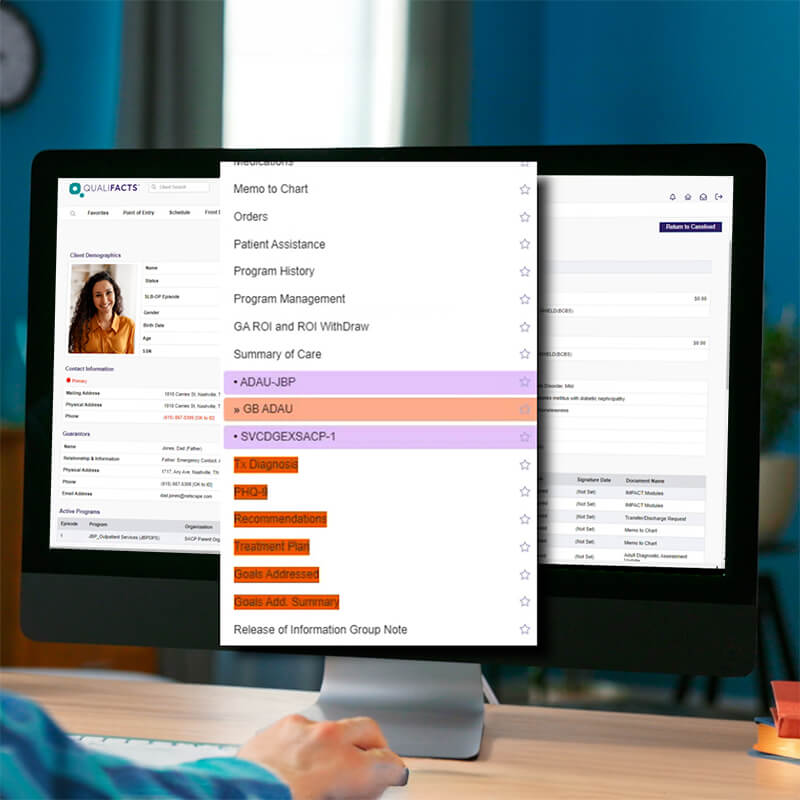
That is the practical terrain Qualifacts has occupied for 25 years. The Nashville company sells cloud software to mental-health agencies, substance-use programs, Certified Community Behavioral Health Clinics, human-services organizations, and rehabilitative practices. Its systems handle the unglamorous machinery surrounding care: intake, scheduling, treatment plans, progress notes, e-prescribing, billing, claims, state reports, analytics, secure messaging, telehealth, and now AI-generated documentation.
The company says more than 2,700 organizations use its products across all 50 states, including about one-third of the country's CCBHCs. The supplied company record estimates roughly 1,300 employees and $120.1 million in annual revenue. Because Qualifacts is private, those financial figures are estimates, not audited public results. The customer count, however, tells the strategic story: this is specialist infrastructure at national scale.
Three EHRs walk into a merger
Most software mergers arrive with a familiar promise: one platform, one roadmap, one tidy migration. Qualifacts chose the messier answer. It supports three EHRs, each angled toward a different operating reality.
Credible
Large agencies, CCBHCs, many programs, locations, and reporting regimes.
CareLogic
Configurable clinical, financial, and administrative depth for complex providers.
InSync
Small and midsize behavioral-health and rehabilitative practices that need less machinery.
Credible and CareLogic overlap at the enterprise end. Both can support multi-site agencies, complicated billing, custom forms, state-specific reporting, and multiple lines of care. InSync, acquired in 2021, opened a lane for smaller organizations and practices. The argument is that a solo or small-group provider should not have to operate the same system as a multi-state nonprofit with residential programs, crisis teams, and federal grant reporting.
The difference from competitors is therefore architectural and commercial. Netsmart is the nearest large-enterprise alternative. Kipu has deep recognition in addiction treatment. Valant, TherapyNotes, and SimplePractice chase smaller clinical practices. Qualifacts covers much of that range through separate products, then tries to share services across them through its OneQ integration layer, marketplace, AI suite, client engagement tools, and revenue-cycle offerings.
“Activities that previously took all day have been reduced to 10 minutes of work.”Stephen Hopkins, Eastern Shore CSB
The first thing to fail is usually the workflow
Qualifacts' customer stories have a pattern. The breaking point is rarely a dramatic server crash. It is slow administrative decay. Crittenton Center in Iowa had paper forms sitting beside outdated digital tools. Staff scanned documents onto a network drive, then hunted for them later. Behavioral Health Response in Missouri said changes to its previous EHR were expensive, and upkeep was expensive too. CHE Behavioral Health Services tried an outside reporting consultant, but the work took too long.
What changed those buyers' minds was not a futuristic demo. It was seeing a peer make the workday less annoying, gaining the ability to adjust forms internally, or finding a specialist who already understood where data lived. At Crittenton, a conversation with an existing CareLogic customer helped make the case. At CHE, a Qualifacts consultant built reports with the team after an earlier consulting attempt dragged. In Virginia, automated claims and documentation reportedly cut reimbursement time in half.
The roll-up behind the record
Qualifacts began in 2000, when healthcare entrepreneur and future Tennessee governor Phil Bredesen spun software out of Camelot Care. That origin matters. The product came from inside a care organization, where clinical work and reimbursement collide daily. CareLogic Enterprise arrived in 2009. By 2014 the company served more than 260 organizations and sold subscriptions monthly by user, according to contemporaneous reporting.
Then capital widened the map. Great Hill Partners took a majority position in 2014. Warburg Pincus invested in 2019 in a transaction reported at roughly $300 million. In 2020, Qualifacts merged with former competitor Credible Behavioral Health, backed by Martis Capital. InSync followed in 2021. In April 2026, Qualifacts bought MethodOne, specialized software for controlled-medication dispensing and inventory at opioid treatment programs.
The prices of the mergers and add-on acquisitions were not disclosed. That is normal for private software deals, but it means outsiders cannot cleanly measure the cost of building this portfolio. What is visible is the logic: preserve the installed bases, fill gaps by customer size or specialty, and sell common capabilities around the EHRs. MethodOne fits because medication-assisted treatment is regulated, operationally distinct, and difficult to bolt onto a general system with a casual integration.
AI enters through the note, not the moonshot
Qualifacts introduced iQ in 2024 with ambient clinical documentation. With consent and provider oversight, the system listens during in-person or telehealth sessions, drafts a structured note, and places it into the EHR for review. The current product supports custom note formats and more than 120 languages. A mobile version lets clinicians record away from a desk and sync later.
Company-reported customer results are pointed: an 80 percent reduction in note-taking time, half of providers saying they could treat more clients, and 60 percent saying they felt more connected during sessions. Those are customer reports, not a controlled clinical study. Still, they identify the right test for healthcare AI. The question is not whether the prose sounds clever. It is whether the clinician gets an accurate draft, keeps control, and finishes work earlier.
The next products are even less theatrical. iQ Assistant, released across all three EHRs in 2025 at no added license charge, answers workflow questions from a corpus of more than 3,000 support and community articles. Nearly 450 organizations had adopted it by late 2025, the company said. A scheduling agent began rolling out to Credible customers in early 2026. At NatCon26, Qualifacts previewed an agent for billing and reporting.
This is the company's best AI decision: put the tool inside the environment where the job already happens. Behavioral-health data is sensitive, workflows are configured differently by agency, and a disconnected chatbot can create one more tab to babysit. Qualifacts also says it became the first behavioral-health EHR vendor certified to ISO 42001:2023, a management-system standard for responsible AI governance. Certification does not prove every output is correct. It does indicate that the company has formalized how AI risks are managed.
The buyer's copyable playbook
The useful lessons here are smaller than “buy an EHR” and more durable than “add AI.” They are about sequencing change so the software has a fair chance.
Map one painful workflow.
Start with the all-day report, the claims queue, or the documentation backlog. Record the baseline before shopping.
Choose for operating complexity.
A small practice needs a different implementation surface than a county agency. More configuration is not automatically more value.
Keep internal ownership.
The strongest customer results came from teams that could revise forms, billing matrices, and workflows without paying for every change.
Judge AI by the handoff.
Measure the reviewed note, corrected fields, minutes saved, and work completed on time. A fluent draft is only the middle of the process.
Where the strategy can break
Three products create choice, but they also create three roadmaps, three user experiences, and a long integration agenda. OneQ and the marketplace are meant to make shared services available across the portfolio. Customers still need to verify which capability exists on which platform, in which release, and at what additional cost. The company prices by quote, so comparison requires a full estimate that includes migration, implementation, training, integrations, support, and optional services.
Configurability is leverage only when somebody owns the configuration.
This approach is a poor fit for an organization with no implementation lead, no mapped workflows, weak data governance, or a desire for a nearly zero-configuration consumer tool. It can also be excessive for an independent clinician whose needs stop at scheduling, notes, telehealth, and simple billing.
For complex behavioral-health providers, the appeal is different. General medical EHRs often treat state reporting, social services, grant programs, substance-use workflows, and measurement-based care as additions. Qualifacts treats them as the main event. Its customers are not buying a prettier patient chart. They are buying a chance to connect care, compliance, and cash flow without making clinicians translate between systems all day.
That is where Qualifacts fits in the market: below the broad hospital platforms, across the behavioral-health specialists, and deeper into administration than a simple therapy-practice app. Its portfolio is untidy by design. The next test is whether shared AI and integration services make three EHRs feel like informed choice instead of inherited complexity.