The appointment is over. The client has left. On the calendar, an hour has become a small rectangle in the past. Inside TherapyNotes, however, that rectangle has acquired a future: a task to complete the session note. A conversation has ended; a chain of administrative obligations has begun.
This is a useful place to start with a company whose name sounds almost aggressively modest. TherapyNotes sells electronic health records and practice-management software to behavioral health professionals. It connects the note to the appointment, the appointment to billing, and the practice to its clients. Its subject is the machinery surrounding care. Nobody frames an insurance claim and hangs it in the waiting room, but somebody must get it right.
- Built for behavioral health: documentation, scheduling, billing, client portal, and video visits share a system.
- Starts at $69 a month for a solo user: optional services and transaction charges add to the bill.
- AI assists with the paperwork: TherapyFuel drafts; clinicians review and sign.
- A practical buying test: follow one appointment through its note, claim, payment, and next visit.
A marriage of two kinds of expertise
TherapyNotes began with an unusually convenient division of labor. Dr. Debra Pliner was a clinical psychologist running a group practice. Her husband, Brad Pliner, was a software developer with a background in web applications and healthcare clients. She understood what a clinician needed to record. He understood how to turn a recurring problem into a system.
The company’s account of its beginnings describes software refined inside Debra’s practice before its November 2010 launch. That detail matters more than the familiar founder romance. A live practice supplies awkward appointments, unfinished records, and staff who must use what has been built. It gives software a daily examination. The founders had somewhere to discover whether an elegant idea survived an ordinary working Tuesday.
In a 2019 interview on The Practice of Therapy podcast, Brad discussed documentation, insurance, reminders, and record security. These subjects rarely lend themselves to a glamorous origin story. Together, though, they explain the company’s expertise: clinical work and the business arrangements that allow a private practice to keep doing it.
“The heart of TherapyNotes® is the notes system.”
TherapyNotes’ company description
The calendar has consequences
For most note types, TherapyNotes requires a corresponding appointment on the calendar. When a scheduled appointment occurs, a documentation item appears on the to-do list. The clinician can open the note from that list, the calendar, or the patient’s documents. Treatment plans have their own prompts following an intake.
This is the company’s revealing design choice. The system keeps unfinished work visible. A diary tells you what happened; a task list tells you what is still owed. Connecting them gives the practice a way to notice the small obligations that accumulate between sessions.
- BookCalendar + reminders
- DocumentNote + treatment plan
- BillClaim + payment
- ContinuePortal + next visit
An editorial map of the connected workflow, not a guarantee of payment.
The notes themselves combine checkboxes, dropdowns, and text fields. A history tool can retrieve material from prior notes; diagnosis search helps locate codes. The current range includes intake and progress notes, psychiatric documentation, and SOAP, DAP, and BIRP formats, alongside customization. Structure gives the writer somewhere to begin. It also means that choosing software involves choosing how a working day will be organized.
The first squeeze was physical
One of the company’s more charming growth records concerns floor space. In May 2014, TherapyNotes had reached 14 team members and needed new offices. Three years later, it had 46 employees and had consumed the available room again. In July 2017 it moved from roughly 3,000 square feet into a building of nearly 30,000.
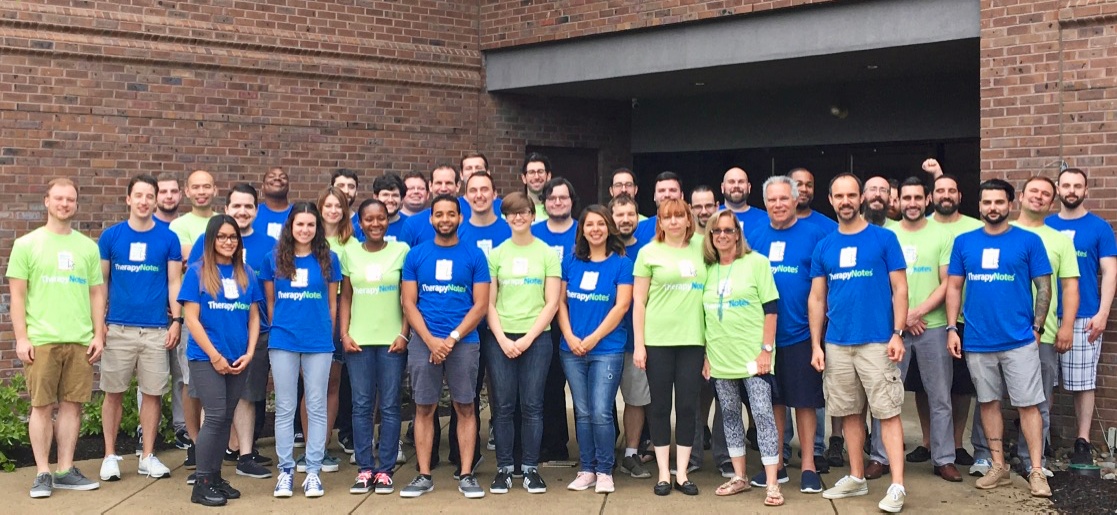
The announcement showed developers trying sit/stand desks and a support employee taking a call. There was also a virtual reality room, because apparently even the people simplifying paperwork occasionally wished to inhabit another dimension. The practical explanation was straightforward: more capacity to support customers, build features, and hire.
The company still makes support part of its offer, with live phone and email assistance around the clock. Its employer materials describe collaboration, development opportunities, and team celebrations. Those are the company’s own descriptions of culture. The office photographs supply a more concrete historical glimpse: people writing the software and people helping customers use it occupied the same expanding business.
The receipt behind the subscription
The buyers are psychologists, counselors, therapists, social workers, psychiatrists, and the staff managing their practices. TherapyNotes serves solo users and larger organizations. The economic arrangement is a subscription, supplemented by optional features and usage charges. Selling to a practice means serving both the person writing the note and the person trying to collect the payment.
The group example is $79 + four clinicians at $50 each. Base subscription only; checked October 2, 2026.
Non-clinical users are included without additional user fees on group plans. TherapyFuel costs another $40 per enabled clinician monthly, premium telehealth $15, and ePrescribe $65 per prescriber. Electronic claims, remittance processing, eligibility checks, and text or voice reminders carry usage fees. The advertised base price is therefore the opening number in a calculation.
A practical comparison starts with the work a practice actually performs. Basic video visits, a client portal, and secure messaging are included. A prescriber or a busy insurance-based group will calculate a different total from a solo clinician doing private-pay sessions. SimplePractice and TheraNest/Ensora occupy the same buying conversation. Several familiar features overlap; TherapyNotes’ distinctive combination is its behavioral health documentation, connected tasks, and support model.
There is a pleasingly uncommercial corner of the subscription menu, too: simulated classroom practices are free. Students can work through documentation without submitting insurance claims. It is a sensible way to teach the less cinematic parts of becoming a clinician.
A faster draft still needs a reader
In August 2024, TherapyNotes announced its first large-language-model feature: a summary of the Client History Form, available while preparing intake notes. The choice was restrained. Summarizing information already inside a workflow gave the company a specific place to introduce AI, with the full history still available for inspection.
Today, TherapyFuel extends to progress-note drafts from summaries or transcripts, treatment plans, dictation, and pre-session assistance. Its Scribe feature captures conversations for transcription. The attraction is obvious to anyone who has finished a day of appointments and discovered a second working day waiting in the notes queue.
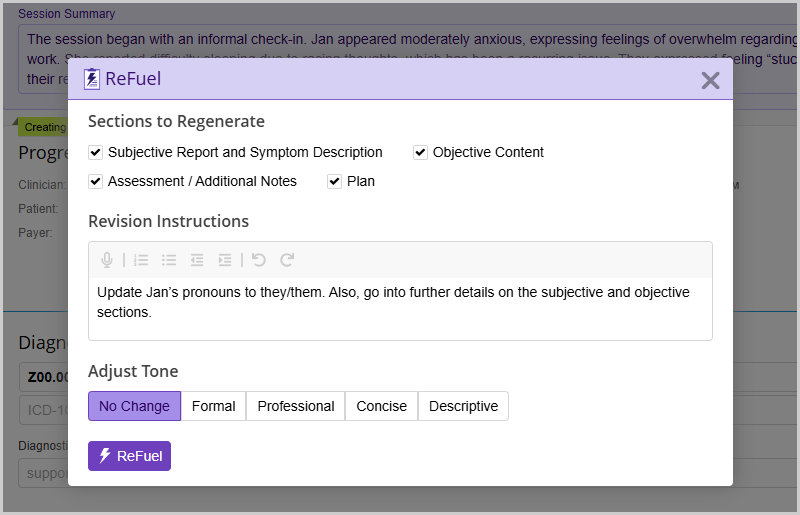
ReFuel also exposes a predictable weakness of a generated first draft: it may need different emphasis or wording. Clinicians can request changes to unsigned AI-generated notes rather than begin again. The documentation still instructs users to review and edit before signing. Group-therapy sessions remain outside TherapyFuel’s stated current scope. A fluent paragraph cannot substitute for knowledge of what actually occurred.
In April 2026, TherapyNotes announced HITRUST AI Security Certification for its AI features, separate from its existing platform certification. The distinction deserves care. HITRUST describes this assessment as addressing cybersecurity risks in AI systems. Clinical accuracy requires its own scrutiny. For a practice, both questions matter: who can access the information, and whether the finished record faithfully describes the patient.
Progress arrives in small corrections
Expansion has also meant borrowing specialist expertise. TherapyNotes announced a DrFirst prescribing partnership in May 2025, citing support for complex prescriptions, dosing calculations, and patient resources. Existing practices were to migrate in phases. The company’s explanation was a list of capabilities and future needs; a change of partner need not be dressed up as a morality play.
In January 2026 came the mobile companion app, with agendas, secure messages, telehealth access, and Scribe among its initial features. September brought a less photogenic improvement: practices could correct secondary insurance after a primary payment without removing that payment, provided no secondary payment had been posted. Anyone who has had to undo completed administrative work will recognize the attraction.
The lesson a reader can copy is to examine the handoffs. Where does a finished conversation become an unfinished record? Where does an insurance correction force somebody to repeat work? TherapyNotes has built around those seams. A practice evaluating it can use the trial to follow its own appointments through documentation and billing, and check which steps become easier.
The fit depends on the practice. Clinicians must accept the scheduling and documentation structure, price their actual usage, and keep responsibility for the records they sign. A business needing a different specialty’s workflows may find less value in this concentration. TherapyNotes’ appeal is strongest when the clinical hour and the administrative hour need to live together. The session ends. The practice still has work to finish.