Erik Cohen wanted to build a pediatric practice with time for its patients. He had worked in an urban emergency room and a suburban group practice, and he thought ordinary office care left too little room for the unexpected. His new practice would combine personal attention with clinical equipment and portable records. There was one department he did not intend to build: a computer department.
- Aprima puts medical records and practice administration in one application and database.
- Its customer stories revolve around documentation choices, mobility and fewer internal interfaces.
- Now part of CGM, the product added browser deployment in August 2026.
- Licenses, hosting and optional services belong in the buying decision together.
That last constraint made his software search unusually revealing. He wanted clinical and administrative functions to live together. A software update should not set off a negotiation between several suppliers. In CGM’s account of his decision, Cohen considered five or six companies before choosing Aprima for Next Generation Pediatrics.
It is a modest starting point for a technology story. There is no moonshot in wanting fewer things to repair. But the ambition is familiar to anyone who has watched a perfectly ordinary task become difficult at the border between two systems. A doctor finishes a visit. Somewhere else, someone still has to turn that visit into a record, a prescription, an order and a payment. The borders are where the work accumulates.
01 / The database is the plot
Aprima Medical sells software for ambulatory care: the practices where patients arrive for appointments and go home afterward. Its EHR holds the clinical record. Its practice management functions handle the business around that record. The company’s central design choice is to put both in a single application built on one database.
MedNetworx, a hosting and support partner, presents Aprima PRM to small and midsize healthcare organizations on precisely that basis. This is an architecture argument with a human consequence. Staff should spend less of their day reconciling the clinical office with the administrative office. A claim begins with care that has already been documented. Re-entering that information is an invitation to delay.
“I didn’t want to deal with multiple companies or worry about an update from one affecting all the interfaces.”Erik Cohen, Next Generation Pediatrics, in a CGM customer account
Cohen’s practice also had an unusual billing arrangement. It did not file insurance claims or receive direct insurance payments. An annual examination fee covered a package of services; staff helped patients submit reimbursement paperwork for other visits. The software had to accommodate that model. A feature checklist alone would have missed the point. The interesting question was whether the practice could remain itself after the software arrived.
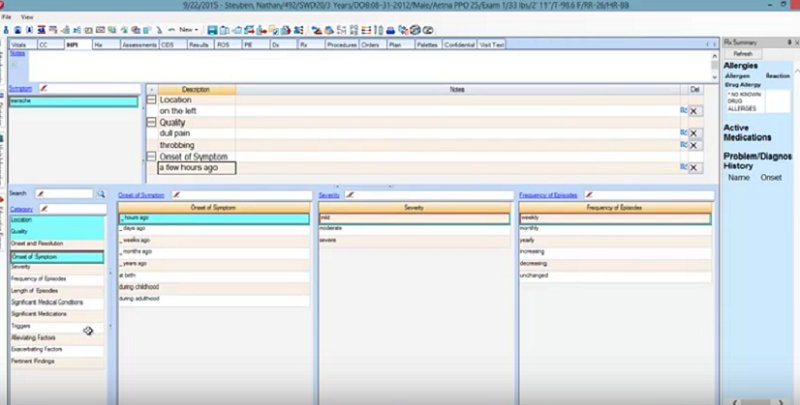
02 / Let the doctor keep a few habits
At Avenel Iselin Medical Group in New Jersey, expansion brought specialty physicians and diagnostic services into a primary care practice. Managing partner Marc Mayer led a software search, and the group went live with Aprima in 2007. The account describes providers using different methods to document encounters and tablets to retrieve and update records.
That detail is more informative than a claim that software is easy. An office contains several kinds of expertise and several kinds of preference. A clinician who likes dictation and a colleague who prefers typing may still need their notes to produce usable information for everyone else. Standardizing the destination does not necessarily require standardizing every gesture along the way.
Mayer called the software “intuitive, flexible, and responsive.” His account also connects more accurate visit documentation with better collections, without providing a numerical improvement. CGM discloses that he received referral compensation and knew he would appear in an advertisement. Treat the story as a description of one practice’s experience, with that commercial context attached.
A conceptual workflow, not a measured time-saving claim. The handoffs are the buying test.
03 / The first thing to fail was continuity
For Summersville Pediatrics, the problem was more abrupt. According to its CGM customer account, Allscripts informed the practice that MyWay would not be developed to meet forthcoming requirements. Office manager Joyce McClung had already experienced discontinued products. Another migration meant another question about which pieces of the practice’s memory would survive.
Aprima had a peculiar advantage here. MyWay incorporated source code licensed from Aprima’s predecessor, iMedica. Allscripts’ SEC filings document that relationship. The products had diverged, but they shared ancestry. The reseller ConXit showed Summersville a route to Aprima with a familiar look and feel.
The account says the practice was offered a migration without a license charge and that its records made the transition. McClung’s remaining concern had been data preservation. That changed her assessment of the switch. The offer was specific to that historical migration; it does not establish today’s price.
There is a lesson here for buyers of any system that becomes a business’s memory. Ask to see what leaves with you, what arrives intact and what has to be reconstructed. Familiarity can be worth money, but only if the information beneath the familiar screen survives.
04 / An award, then two ownership changes
Aprima adopted its name in July 2009 after operating as iMedica. A contemporary announcement cited another company’s similar mark. Even a business devoted to eliminating administrative friction had its own naming problem to settle.
By 2018 and 2019, Aprima had won Best in KLAS in the Small Practice Ambulatory EMR/PM category for practices with one to ten physicians. Its 2019 announcement reported an overall score of 84.6. Keep the category attached to the accolade. A small practice’s judgment about an EHR is useful evidence for another small practice; it is not automatically a verdict on every hospital’s requirements.
The category behind Aprima’s 2018 and 2019 Best in KLAS wins. Scale is part of the claim.
In January 2019, eMDs acquired Aprima. The announcement described the combined organization as serving more than 63,000 providers. That was a combined-company figure. In December 2020, CompuGroup Medical completed its acquisition of eMDs for approximately $240 million. That price covered eMDs overall, including its broader portfolio, rather than establishing an Aprima valuation.
The product now appears as CGM APRIMA. Its competitive neighborhood includes ambulatory systems from athenahealth, eClinicalWorks, NextGen and Greenway. Aprima’s case rests on the fit between documentation and practice operations. Whether that fit beats an alternative depends on the actual practice, its external connections and the support it receives.
05 / The browser arrives; the fax persists
In August 2026, CGM introduced Aprima v20. The release adds browser-based APRIMA+, native mobile apps, a 64-bit upgrade and a Tracking Board for following patients through the practice. It also expands optional AI capabilities. These are practical additions to a product whose reputation was built before the browser became its latest selling point.
CGM AMBI, an optional integration, listens to an encounter and drafts structured documentation. It can propose diagnoses, orders and billing codes. CGM describes a workflow in which the clinician reviews, edits or approves the result. The attraction is easy to grasp: less effort translating a conversation into a chart. The review remains part of the job.
The v20 announcement also includes improvements to optional CGM INDEX.AI for fax and document filing. There is something pleasingly honest about an AI release that must still deal with the fax. Medical software advances inside a working office, surrounded by older equipment, external organizations and habits that cannot all be replaced on launch day.
06 / Price the whole office
Aprima’s published cost disclosure describes provider licenses with annual maintenance and hosted arrangements with monthly fees. It also lists charges associated with optional capabilities, including hosting, prescribing and interfaces. It supplies fee categories rather than a universal dollar price. The business model includes recurring software revenue and services sold around the core system.
A useful budget therefore starts with a complete workflow. Which laboratory must connect? Which prescribing functions are required? Who hosts the system? What does the portal include? Which AI options are in the quote? A single internal database can reduce one kind of interface problem while the practice still depends on connections to the outside world.
Then budget the transition in attention. In his CGM customer account, solo practitioner Gervacio Diaz recommends patience and training, including accepting that learning may initially keep a doctor late. The page discloses referral compensation. His practical advice is still a sensible experiment: solve one problem at a time, then check whether the work actually improves.
Copy the selection method, too. Take an ordinary visit and follow it through the entire office during a demonstration. Test a record migration. Ask staff to try the tasks they repeat all day. A practice needing hospital-scale functions or particular external integrations should test those requirements directly. Cohen’s no-computer-department constraint worked as a filter because it described his real office. The best constraint is the one your own office will still have after the salesperson leaves.