The trouble with a growing medical practice is that success arrives with paperwork. Add a location, another specialty, a new employer account, and the work acquires more routes through the building. A chart becomes a claim. A test becomes a report. A prescription becomes a question from a patient. Somewhere in that journey, a member of staff has to make the pieces agree.
- What it does: Bizmatics connects outpatient charts, practice management, billing, and patient tools through PrognoCIS.
- Where it gets interesting: specialty workflows, especially occupational medicine and practices with several kinds of care.
- What to watch: implementation work, the full cost of ownership, and whether integration saves time in your actual workflow.
Bizmatics has made a business out of these transitions. Founded in 2002 by Vinay Deshpande and Rajiv Apte, the company develops PrognoCIS for ambulatory medical practices. That means the outpatient world of independent clinics, specialty groups, and organizations operating across locations. Its software brings clinical records and business operations together. The proposition is wonderfully unromantic: make fewer people spend their day carrying information from one place to another.
The hours hiding between screens
Consider Mountain View Pain Center. In a case study published by PrognoCIS, the practice describes a familiar growing pain: separate EHR and billing applications, manual tasks, and staff toggling between systems. The old arrangement became harder to tolerate as the business expanded. IT manager Jordan Pitchford-Farris put it plainly:
“Our previous software was tedious and very bare bones.”Jordan Pitchford-Farris · Mountain View Pain Center
The practice chose PrognoCIS to combine records, practice management, billing, reporting, prescribing, and patient engagement. Its mixture of pain-management services required flexibility across specialties. The vendor-published account reports 178% growth over five years and ten hours saved weekly at each location. Those figures describe one customer’s experience; they do not establish how much growth the software caused.
saved per week at each location, according to the published case study.
The useful lesson is the trigger for switching. A system that feels adequate in a smaller organization can become expensive in staff time as its responsibilities multiply. For a reader running any service business, that is a question worth stealing: where does your team repeatedly translate the same information?
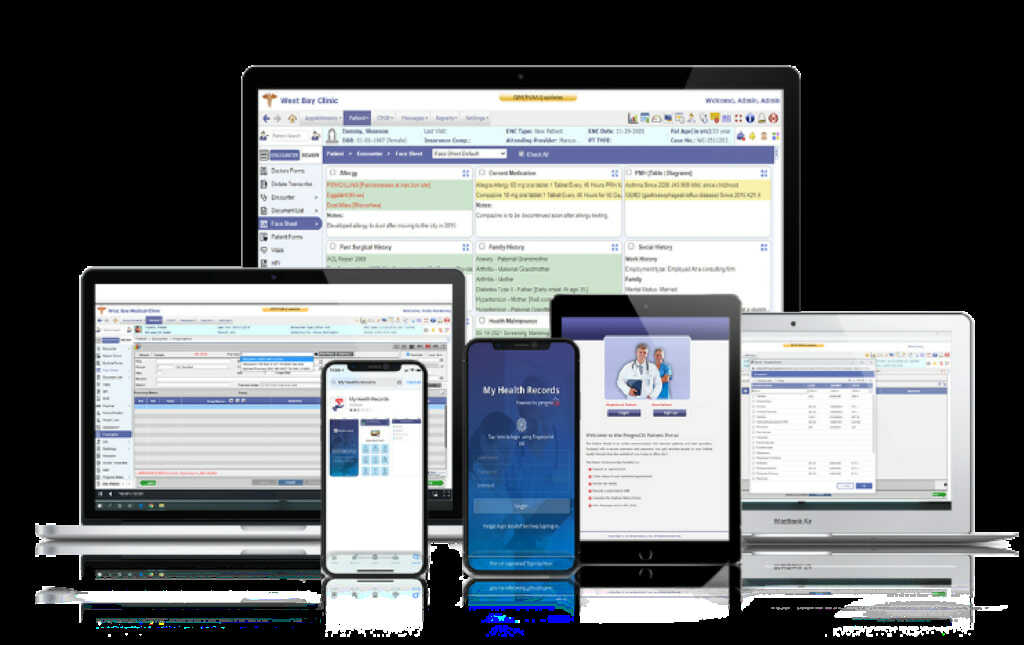
The product’s breadth makes sense in that light. Clinical documentation sits beside scheduling, registration, billing, and reporting. Specialty templates let practices adapt notes and workflows. Referral management and prior-authorization tracking attend to the work around the visit. Electronic faxing remains on the menu, a reminder that healthcare software has to converse with the office as it exists, however unfashionable its habits.
When the employer joins the appointment
Occupational medicine gives Bizmatics a particularly revealing assignment. Here, the software has to account for the employer as well as the patient. A clinic may be managing an injury case, following an employer’s testing requirements, or sending an invoice to an employer or third-party administrator. A tidy patient chart alone cannot organize that whole relationship.
PrognoCIS offers employer protocols, case management, automated employer and TPA invoicing, and drug and alcohol testing randomization. It also provides distinct portals for employers, patients, providers, adjusters, and attorneys. Those are specific tools for a specific working environment. A portal for an adjuster is unlikely to be anyone’s dream product launch; it can nevertheless be exactly what an injury-oriented practice needs.
- 01Employer
requirements - 02Patient
encounter - 03Case
documentation - 04Employer / TPA
invoice
An illustration of the connected work, not a measured customer process.
This is the company’s most persuasive distinction: the details of the workflow, rather than the mere existence of a cloud record. Its market includes general ambulatory EHRs and specialty systems. Tebra is one alternative the company explicitly compares itself with. The worthwhile comparison is what happens when a practice needs several specialties, employer relationships, or several locations to operate together.
A prescription has a second life
The integrations tell a similar story. In June 2024, Bizmatics and DrFirst announced an agreement to bring RxInform into PrognoCIS. When a provider sends an electronic prescription, the workflow can trigger a secure patient message containing prescription and pharmacy information, medication education, and opportunities to save on cost.
There is an appealing change of perspective here. The software follows the prescription past the clinician’s send button. A patient still has to understand it, afford it, and collect it. The partnership addresses that next step without asking the prescriber to conduct a separate messaging campaign. Its announced purpose is to reduce abandonment and improve adherence; that purpose should not be mistaken for a measured outcome among all PrognoCIS users.
An older relationship supplies the underlying drug knowledge. In October 2024, Bizmatics and FDB marked 21 years of collaboration. PrognoCIS integrates FDB MedKnowledge, including information used in drug-interaction screening and dosage-range checks. That is a different kind of product expertise: keeping a clinician’s everyday medication workflow connected to maintained reference data.
Patient engagement extends beyond prescriptions. The patient portal supports record access, forms, messaging, appointments, and payments. Interfaces with labs and other healthcare systems connect outside information to the practice. The practical ambition is continuity: the patient, the front desk, and the clinician should each be able to finish their part without starting the information trail again.
The starting price is an opening bid
PrognoCIS publishes a starting price of $280 per provider per month. At that rate, five providers would mean $1,400 monthly, or $16,800 annually, in starting subscription costs. That is arithmetic, not a quote for a five-provider clinic.
Illustrative base calculation. Implementation and other fees are additional.
Setup and training cost extra. Migration depends on the volume and type of data. The subscription includes hosting and support; other features depend on the plan. EPCS verification and clearinghouse charges are the customer’s responsibility. Monthly billing begins 30 days after contract signing. A practice should therefore examine the implementation timetable alongside the invoice.
The business model also reaches beyond software. Revenue-cycle management services are priced as a percentage of collected revenue. A clinic can be buying a platform, outsourced billing work, or a combination. Bizmatics also sells through referral and value-added reseller arrangements. The commercial offer is built around the practice’s operations, which makes the scope of the agreement consequential.
A permanent home, then new tools
Harris announced its acquisition of Bizmatics on February 26, 2021. Harris is an operating group of Constellation Software, and the announcement placed Bizmatics within its ambulatory healthcare portfolio. Deshpande described Harris as providing “a permanent home for Bizmatics.” The phrase offers a different picture from the familiar startup narrative of a funding round followed by another funding round.
The newer products extend the same effort to reduce work inside a practice. Bizmatics announced its forthcoming AI suite in August 2025, describing a scribe that produces a draft for clinicians to review, edit, and approve. On April 2, 2026, it announced the global launch of PrognoAI, including scribing, a clinical and coding assistant, and patient-history summaries. The launch described mobile use and support for 54 languages.
These tools are best understood as additions to an existing workflow. A draft still has to become an approved clinical note. A summary still has to help the provider understand the patient. The meaningful evaluation is the time and effort needed to reach that finished state, including review.
Then, on May 19, 2026, came PrognoPay, embedded payment processing powered by Global Payments. Announced features include automatic payment posting, text-to-pay, payment links, recurring payments, and digital wallets. The payment task moves into the same platform that manages the patient account. Once again, the company is working on a handoff.
Make the demo do a day’s work
The useful way to assess Bizmatics is to give it an ordinary, slightly awkward day. Ask the demo to follow an appointment through registration, specialty documentation, an outside result, authorization, a claim, and a payment. Bring the people who actually do those tasks. An elegant clinical screen can conceal a cumbersome morning at reception.
For occupational medicine, add an employer protocol and a case-specific invoice. For a multi-specialty practice, ask each discipline to complete its own documentation. For a migration, test representative records and interfaces before calling the job finished. This is an editorial recommendation drawn from the product’s scope, rather than a promise about implementation.
The fit weakens if the required interfaces are unavailable, the specialty workflow demands extensive manual work, or the practice cannot devote staff time to configuration and training. Customization has value only when people can use and maintain it. Bizmatics is most interesting where the coordination problem is real: several kinds of care, several parties, and too many repeated chores. Its pitch deserves to be judged at the handoff, where the hours tend to disappear.