The doctor had already bought an electronic health record. Yet somebody still had to build the allergy templates. In ModuleMD’s account of an East Coast practice, that chore helped send the customer looking for another system. A medical record was present. The shape of the medical practice was missing.
Then there was the money. By spring 2019, when ModuleMD took over managed billing, the practice was losing revenue because claims were not being submitted promptly and rejected claims were not getting the attention they needed. Care had been delivered. Payment required another chain of work, and parts of that chain were slipping.
- Specialty comes first. ModuleMD builds around allergy, immunology, pulmonology and related practice workflows.
- The record connects the jobs. Documentation, scheduling, patient communication, inventory and billing sit within its offering.
- Buying means changing habits. Its customer accounts put peer visits, testing and individual training alongside the software.
ModuleMD is a healthcare software and services company with a fairly unfashionable insight: the end of the consultation is not the end of the job. A note has to become a usable record. A procedure has to become a charge. A charge has to survive the trip to payment. The company’s appeal lies in making those transitions less dependent on someone remembering, retyping or chasing.
The template nobody wanted to build
The East Coast practice had used HealthFusion before switching. The attraction of ModuleMD’s existing allergy templates was wonderfully plain. In the company’s customer account, the physician described templates that already reflected the way allergists worked.
There is a whole buying philosophy in that sentence. A clinic does not necessarily want infinite freedom to construct its own software. It wants the usual work to be recognizable when it opens the screen. Customization is useful; compulsory invention is a less charming proposition.
The same account says billing follow-ups diminished after ModuleMD assumed the work. It is a vendor-published story, a description of one practice’s experience. Its useful detail is the mechanism: late submissions and unattended rejections had allowed completed clinical work to lose financial value. A better template and a more attentive billing process addressed different parts of the same visit.
“It was there, and it was basically what all the allergists did.”
An allergy physician, on ModuleMD’s templates
A specialty is made of small nouns
Look at ModuleMD’s allergy feature list and the nouns become unusually specific: extract orders, vial mixing, shipping labels, injection questionnaires, skin-test panels. These are clues to what “specialty software” ought to mean. The distinction has to reach further than a specialty name on a sales page.
Its immunotherapy offering connects the record of treatment with practical tasks such as vial tracking and charge capture. The company also describes lot-number tracking, beyond-use dates and compounding logs. For a practice handling allergen extracts, those details belong to everyday operations rather than an occasional administrative excursion.
- 01Test & treatSpecialty workflow
- 02DocumentClinical record
- 03Track stockVials & supplies
- 04Capture chargeBilling handoff
- 05Follow claimCollection work
The value is in the connections. Each handoff is a place to inspect during a demo.
The broader suite includes cloud electronic health records, practice management and patient engagement, with offerings for pulmonology, ENT allergy, internal medicine, and infusion and biologics. The customer is typically an ambulatory practice trying to run both a clinical service and a business. Clinicians need documentation that fits the encounter; administrators need appointments, messages and payments to keep moving.
That makes ModuleMD an instructive example of a narrow market with a wide job description. Its chosen specialties are specific. The work it takes on stretches from the patient’s arrival to the practice’s accounts receivable.
Six offices, one decision
A separate ModuleMD account describes a Midwest allergy and asthma practice with six locations, still documenting on paper. Its front and back offices were struggling without a connected record system. Before signing on, the practice visited other ModuleMD users. Seeing the system in another working practice helped persuade the group to switch.
Onboarding included opportunities to test, onsite training, workflow evaluations and web sessions. Each provider received training matched to their documentation preferences. The company reports that the practice subsequently saw fewer underpayments and denials and increased insurance revenue.
The transferable lesson is in the preparation. Ask to see another practice use the system. Bring the people who will operate it. Test the awkward encounters as well as the tidy ones. Give the doctor who documents differently a chance to learn differently.
Software is bought once and encountered repeatedly. A reference visit gives a buyer a glimpse of the repetition. Training gives staff a way to live with it. Both deserve room in the purchasing decision.
JOSH takes a note. SPOCK sends a message.
ModuleMD’s product names give its administrative world a little personality. JOSH is its AI dictation tool, announced in September 2024. The name expands to Joint Operator for Supporting Healthcare. It offers multilingual transcription, pause and resume, and a Team Pass function so a care team can share documentation work.
Pause and resume is a telling feature. Clinical work comes with interruptions; a documentation tool that assumes an uninterrupted speech is already asking the practice to accommodate it. Team Pass similarly recognizes that a nurse and a physician may contribute to the same encounter.
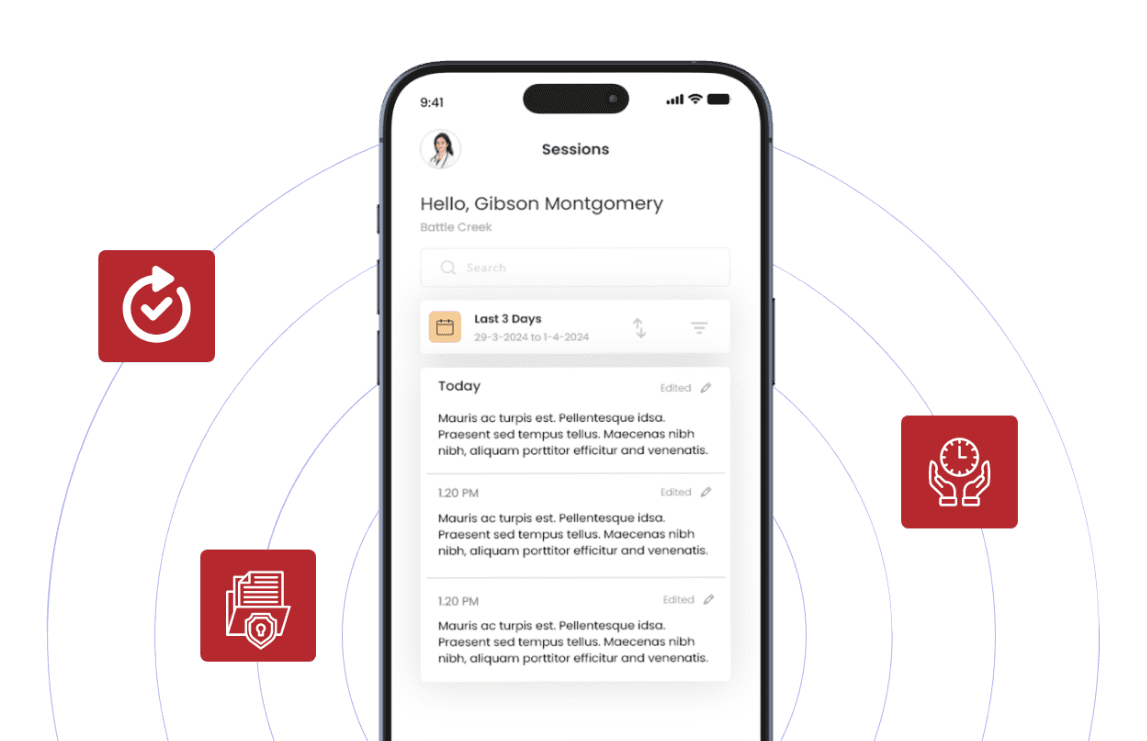
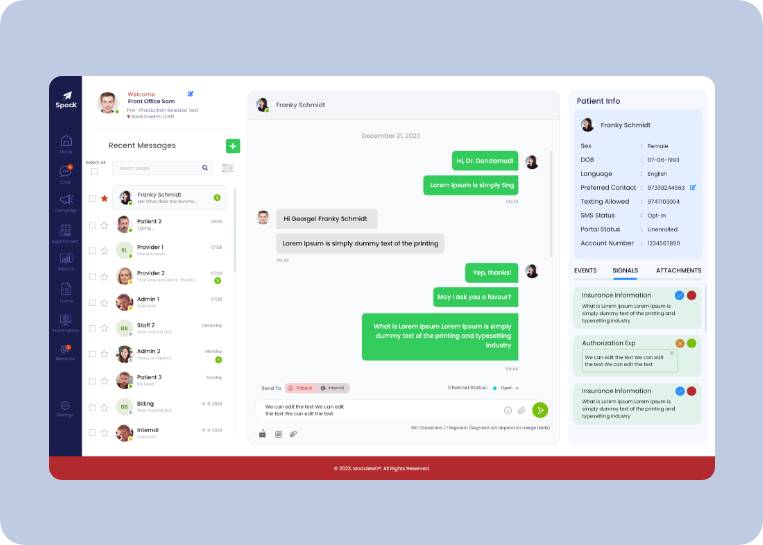
SPOCK handles another sort of interruption: the front desk’s stream of patient communication. Its tools include reminders, secure messaging, campaigns, SMS-linked forms and self-scheduling. Submitted forms feed into the EHR. Its current product FAQ says SPOCK works with ModuleMD’s EHR and is not compatible with other EHR systems, a material constraint for a practice hoping to add just the messaging layer.
InDrA covers inventory: supplies, immunotherapy vials, stock across locations, dispensing logs and expiration alerts. Hubble Health supplies a clinician app. Together, these products make the company’s integrated-platform argument tangible. Each deals with a recurring task that can otherwise become its own island of information.
The current AllerSpect AI page describes a further step: photograph a skin-test panel, measure wheal and flare reactions from the image, and send structured results into the chart. Earlier announcements used the name SkinSight AI. The company presents the workflow as a way to standardize measurement and reduce manual documentation; those are product claims, rather than a clinical outcome established by this profile.
The bill belongs in the story
ModuleMD’s business combines software subscriptions with services. Practices receive customized quotes. Its services page advertises software included with managed billing. A buyer therefore needs to understand the complete arrangement: software scope, billing fees, implementation work and the responsibilities each party retains.
The organizational history follows that logic. Silverstone Capital acquired ModuleMD in 2021. In September 2023, ModuleMD acquired Diversified Health Care Management and MedEase, bringing their staff and claims-management experience into the business. Billing expertise is part of the offering, alongside the software that records the work.
In July 2026, its revenue-cycle report argued that practice owners should examine collections on work already performed. It traced payment problems upstream to authorization, eligibility, documentation and coding issues. The useful operational question is therefore more precise than “How many claims were denied?” It is “At which step did the problem begin?”
What is one collection point worth?
On a hypothetical $5 million of collectible charges, each percentage point equals $50,000. Move the slider to see the arithmetic.
A practice can copy that habit without buying anything: trace a small sample of unpaid claims back through the original work. Find whether the first failure involved missing information, a delayed submission or an unanswered rejection. A dashboard is most useful when somebody owns the action it reveals.
The useful demo is an ordinary day
ModuleMD competes in a market where integration and specialty knowledge are increasingly expected. ModMed’s allergy platform also offers specialty documentation and immunotherapy tools through Xtract. eClinicalWorks offers a broad ambulatory suite spanning EHR, patient engagement and revenue-cycle management. “All in one” begins a comparison; it cannot settle one.
For ModuleMD, the relevant distinction is the fit of its connected workflows to a particular specialty practice. Ask vendors to follow the same ordinary visit, including the test, the note, the inventory movement, the message and the claim. Observe which steps need duplicate entry and which require an additional product or service.
Connections outside the practice matter too. ModuleMD announced an Aluna partnership in 2023 for remote lung-health monitoring and joined CommonWell Health Alliance in 2024 to support health-data exchange. A clinic’s record must remain useful when care crosses its walls.
Recognition gives the company visibility: Inc. ranked it No. 585 in 2025 and No. 4,016 in 2026. Its next advertised interface, WISE Touch, is presented on the current website as forthcoming, with an early-access list. A buyer should evaluate the available workflow and the preview on their own merits.
The choice is particularly relevant for specialty practices seeking one clinical and administrative system. A practice committed to another EHR, unwilling to retrain its staff or requiring integrations that have not been confirmed has a different calculation. The revealing demonstration is the one in which your staff can recognize Tuesday morning - and follow its work all the way to payment.