A patient arrives for an eye exam knowing that work provides vision benefits. Ask which plan, and the answer may be a shrug. Ask what the plan pays toward a pair of glasses, and the shrug becomes a small office project. Somewhere behind the counter are logins, portals, benefit tables, claim forms and the familiar question of who will actually receive the reimbursement. The clinical part of the visit has an appointment. The insurance part has a scavenger hunt.
Anagram is a San Francisco company that sells a map for that hunt. Its customers are independent optometrists, opticians, ophthalmologists and optical retailers, mostly the sort of offices where a few people may have to do everything from greeting patients to pursuing denied claims. The software checks eligibility, interprets benefits, estimates what a patient owes, and helps file claims. Its billing team can take over the work after a claim leaves the office. The interesting thing is where Anagram started: with practices that did not want every vision plan to dictate their prices or inventory.
- Anagram first made out-of-network vision benefits usable through electronic claims.
- In 2023 it added in-network eligibility and then a search across plans when patients could not name their carrier.
- A 2024 public price guide listed software from $125 or $250 monthly, and managed billing at 6% of collected payer revenue.
- Its current site reports more than 3,000 providers and more than $800 million in vision care revenue through the platform.
The wrong question at the right desk
The early product, now called Open Access, addressed a problem that sounds almost philosophical until someone has to file the form: an out-of-network patient may still have benefits, yet using them can be awkward enough to send the sale elsewhere. Anagram lets a practice check supported benefits, calculate a reimbursement estimate, explain the patient's share and submit a digital claim. That gives the practice room to choose its prices, frames and labs without asking the patient to become a claims clerk.
There is a limit to the magic. An out-of-network benefit may reimburse less than an in-network one. Coverage is plan specific, and verifying eligibility does not guarantee payment. Anagram's own support matrix separates plans that support eligibility checks from plans that support out-of-network claims. The point is practical: show the patient the arithmetic before the patient chooses the frames. A promise made at the counter and corrected by a claim weeks later is a poor way to earn a second visit.
For several years, Anagram's proposition was tied to that out-of-network choice. Its own chronology says it began helping practices with those benefits and claims in 2017. The business was then called Patch. In February 2020, it became Anagram, a name chosen, the company said, for the idea of rearranging healthcare's existing pieces. The new name was neatly literal: the letters were already on the table; someone needed to move them into a useful order.
A plan nobody can name
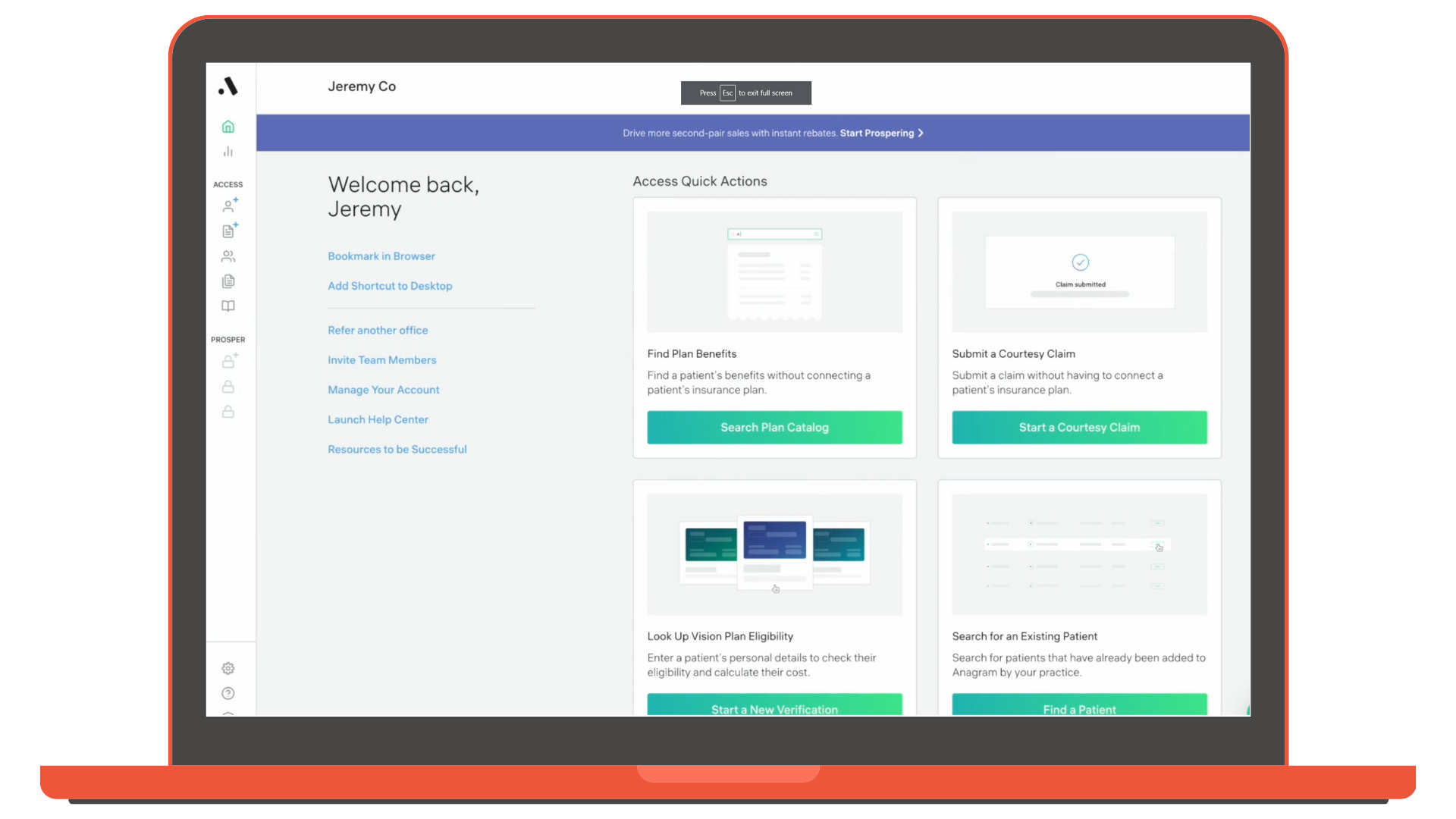
But an independent practice has in-network patients too. Staff do not sort their day into venture-backed product categories. They just need to know whether this person can use a benefit here, today. Anagram's January 2023 launch of Entry Access acknowledged that fact by bringing in-network eligibility into the same workspace. In October came Universal Search, designed for a question every receptionist knows: “I have a vision plan through work, but I don't know which one.” The company says the tool searches across supported plans using basic patient details.
Anagram's published 2024 pricing article described the old routine as visiting six portals, each with its own password, search rules and downtime. That number is more revealing than a grand claim about disruption. A front desk has to get an answer while the patient is standing there, perhaps while a phone rings and another patient asks about a copay. One search is valuable because it removes interruptions from that exact moment.
Figures reported by Anagram on its current website; they are not independently audited here.
The claim keeps going after you click send
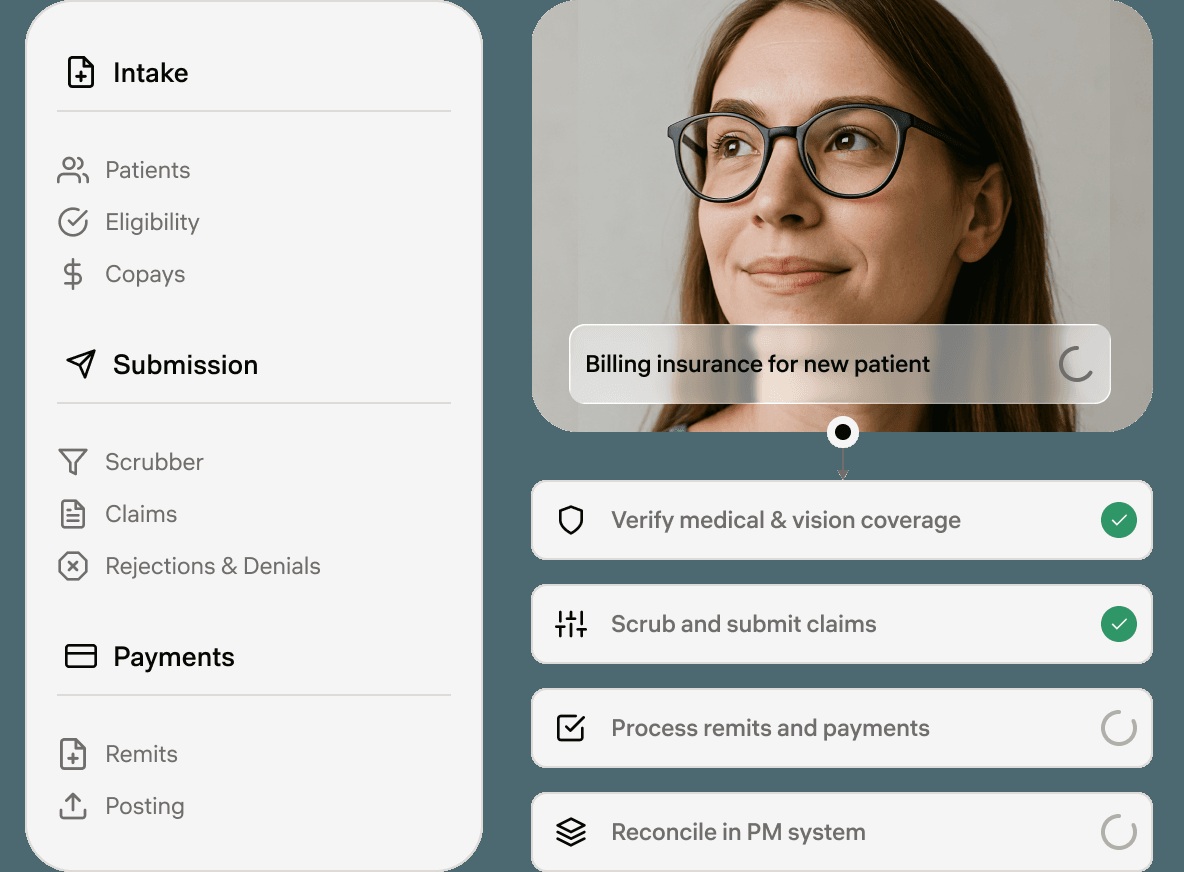
Insurance work does not end with submission. A claim can be rejected for missing information, denied on coverage grounds, paid short or paid without being matched cleanly to an invoice. Anagram's managed billing service stretches across those later stages: claim scrubbing, submission, denial work, payment posting and reconciliation for medical as well as vision insurance. The customer keeps the patient and the clinical judgment; Anagram offers to carry much of the back-office chase.
That makes the company a different sort of alternative from a plan portal or a single eligibility checker. It combines software with people who work claims. A practice can use a tool to do the task itself or pay for a service that takes the task on. The two offers suit different bottlenecks. A busy office may have enough patients but no appetite to hire another biller; another may simply want to stop switching browser tabs.
Portal by portal
Find the carrier, log in, interpret the plan, explain the patient's cost, then move to a separate claim or billing workflow.
Inside Anagram
Search supported plans in one place, calculate benefits, file eligible out-of-network claims, and hand later billing work to its team if needed.
What the convenience costs
Anagram has published unusually concrete prices for a healthcare software company. In January 2024, Entry Access was advertised from $125 per location per month; Open Access from $250 per month with a 12-month agreement. The managed billing service was priced at 6% of money collected from third-party payers. Those are historical starting prices, not a quote for a practice today; the current pricing page asks visitors to request pricing.
Entry Access per location monthly / Open Access monthly / managed billing as a share of collected third-party payer revenue.
The model has a useful logic. If the office's main trouble is finding benefits, the subscription is the entry point. If it is losing out-of-network patients to a paperwork threat, Open Access addresses that. If claims keep aging after submission, the managed service ties Anagram's fee to collections. A practice should still compare the fee with its own claim volume, staffing costs and collection performance. Software cannot make a weak benefit generous, nor can a billing service repair every bad contract.
“Think of Anagram as the managed vision care easy button.”Jeremy Bluvol, co-founder and CEO, in a 2023 product announcement
A business built around the side door
Anagram's broader ambition is visible in projects beyond claims. Prosper, introduced by 2021, offered instant eyewear rebates to help independent optical shops sell qualifying frames and lenses. Spyglass, launched in 2022, became the company's journal and event program for practitioners thinking about private-pay practices, training and patient loyalty. There were even speakeasy-style gatherings in New York and Las Vegas. That is an unusual amount of cultural effort for a company whose core screen checks eligibility.
It makes commercial sense, though. Anagram does not merely sell a faster way to use the same plan relationship. It sells the possibility that a small practice can make its own choices and still give patients an intelligible bill. To make that credible, it has to teach the language of out-of-network benefits, train a front desk to explain prices and prove that the claim really gets paid. That is why its product and its editorial work point in the same direction.
A practice considering the idea can copy the sequence without copying the company: measure how long plan lookups take; compare revenue and gross margin by plan; explain the patient's cost before the sale; track rejected claims and payments all the way through; only then decide which network relationships earn their keep. Anagram's own advice on optical metrics urges plan-by-plan comparisons. The attractive shortcut is to drop a poor contract. The useful habit is to know, in numbers, which contract is poor.
The company now reports more than 3,000 provider customers. Its website also claims more than 5 million patients helped and over $800 million in vision care revenue through its platform. Those figures belong to Anagram, and they do not by themselves establish better margins for every practice. What they do show is that the little mystery at reception is large enough to support a business. The eye doctor treats what is in front of the patient. Anagram works on what is behind the counter.