The least glamorous part of a doctor’s visit begins after the patient leaves. A claim must be assembled, scrubbed, sent, accepted, adjudicated, posted, reconciled and, if something goes sideways, chased. A patient may need an estimate or a reminder. A payer may return a message written in dialect. Every specialty has its own little traps. Anesthesia bills by time. Radiology lives at high volume. Oncology mixes drugs, infusions and authorizations. One missing field can turn clinical work into an unpaid invoice.
ImagineSoftware has spent a quarter-century inside that maze. Founded in Charlotte in 2000 by Sam F. Khashman, the company first made its reputation in radiology billing. Today it sells revenue-cycle technology to physician practices, medical billing companies and healthcare systems. The company says its software touches more than 75,000 physicians across 47-plus specialties in all 50 states.
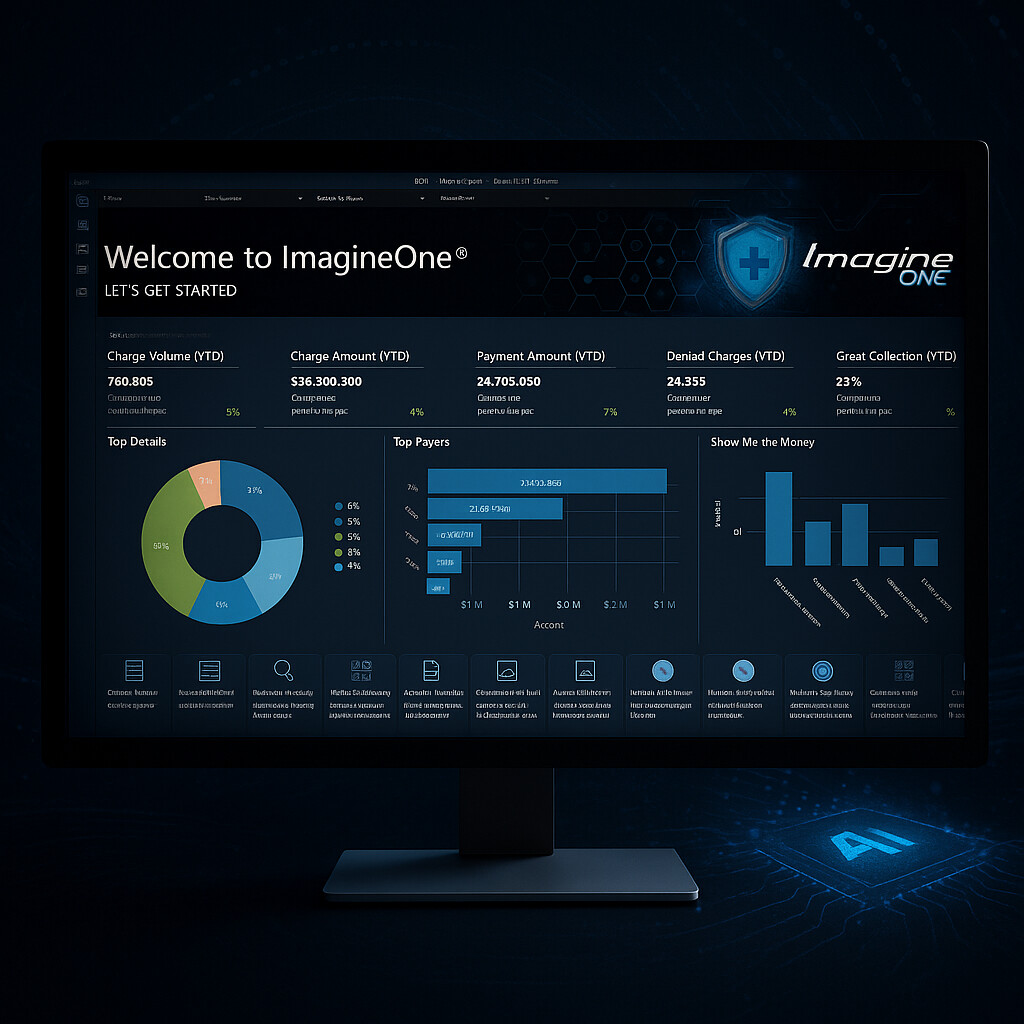
Its pitch has evolved with the vocabulary of enterprise software. What began as workflow-centric billing became automation, then a unified platform, and now “autonomous RCM.” The current flagship, ImagineOne, is meant to connect the financial journey from pre-service eligibility to a zero-balance account. ImagineApex, an AI engine announced in 2026, is the newest layer: predict problems, resolve routine exceptions, initiate approved actions and ask a human only when judgment is actually useful.
The product thesis: one operating system should carry the work across every handoff instead of making staff swivel between disconnected tools.
What did it actually do?
ImagineSoftware’s clever move was not starting broad. It learned the ugly exceptions in a narrow, high-volume market, then expanded specialty by specialty. That matters because “medical billing” is a category label, not a single workflow. Rules that work beautifully for an imaging center can be nonsense for an anesthesiology group. Configurable worklists, claim rules, interfaces and reporting became the accumulated know-how.
Then the company expanded around the claim. Provider Ally, acquired in 2019, brought clearinghouse and payment-reconciliation capabilities. Exchange EDI, acquired in 2022, added patient estimates, prior authorization and engagement workflows. Within Health arrived in 2023 with RADNAV, software that reads radiology reports for follow-up recommendations, contacts patients and care teams, and tracks whether the next appointment happens. ImagineOne, launched that same year, became the wrapper intended to make those pieces feel like one product rather than an acquisition scrapbook.
“The way we’ve grown, really, is by keeping our ear on the street and listening to our customers.”Charles Kauffman, longtime ImagineSoftware engineering leader
That sequence is the company’s most defensible difference. Competitors such as Waystar, athenahealth, R1 RCM, Experian Health, FinThrive and NextGen can each make a serious enterprise case. ImagineSoftware’s angle is the combination of specialty-specific depth, high-volume automation and a connected stack that reaches from payer transactions to patient follow-up. It is not simply selling a smarter claim form. It is selling fewer handoffs.
What failed first?
Usually, the manual layer. A pathology customer described replacing homegrown software when ICD-10 made the coding burden too complex. Other customer stories begin with slower payment posting, repetitive corrections, disconnected data or work queues that grow faster than the team. In one older radiology transition, the attraction was getting charges out and payments posted faster. The first failure is rarely a cinematic outage. It is the quiet multiplication of clicks.
That is also what changes a buyer’s mind. An organization may tolerate a patchwork when volumes are modest and the staff knows every workaround. Growth changes the equation. A new specialty, payer rule or acquired practice adds exceptions. Hiring more billers preserves the old system but worsens the cost curve. At that point, configurable automation stops looking like an IT upgrade and starts looking like capacity.
The performance figures above are company claims, not universal guarantees. A buyer should test them against its own specialty mix, payer mix, starting process and definition of “automated.”
What did it cost?
There is no checkout button. ImagineSoftware sells through demonstrations and custom quotes, which is normal for software that must connect to EHRs, clearinghouses, banks and a practice’s peculiar rulebook. The meaningful price is larger than the license: implementation, data migration, interfaces, configuration, training and process change all belong in the budget. The meaningful return is larger than headcount reduction too: faster cash, fewer denials, fewer missed follow-ups and less time spent touching a clean transaction.
Illustrative diagnostic bars, not ImagineSoftware customer results. Baseline each metric, define the target, then make the demo prove the path.
The company advertises up to 95 percent automated payment posting, productivity gains above 400 percent and labor-effort reductions of 75 percent. Its new Apex materials go further, describing up to 97 percent autonomous billing. Those numbers make excellent demo questions. Which workflow? What denominator? How many exceptions still need people? How long after go-live? The honest unit of automation is not a flashy AI conversation. It is a completed task that did not come back broken.
The part readers can steal
ImagineSoftware offers a tidy company-building lesson: expertise can be a data asset even when it does not look like one. Every specialty rule, payer edit, interface and exception handled over 25 years becomes raw material for better automation. A new entrant can buy a language model. It cannot instantly buy the scar tissue from millions of awkward transactions.
- Pick the painful wedge. Start where transaction volume is high, errors are expensive and buyers already feel the problem. Radiology was not glamorous; it was specific.
- Turn exceptions into product. Do not merely fix the same oddity for another customer. Encode it as a rule, workflow, integration or reusable service.
- Expand along broken handoffs. ImagineSoftware moved from billing into clearinghouse, payments, authorization, engagement and follow-up - adjacent jobs sharing the same data.
- Sell outcomes with denominators. Track first-pass acceptance, touches per claim, posting automation, denial rate, days in A/R and time returned to staff.
- Keep humans at the exception desk. Automation is credible when the escalation path, permissions and audit trail are as clear as the happy path.
When the playbook does not work
Good conditions
- High, repeatable transaction volume
- Stable data feeds and integration access
- Leadership willing to redesign workflows
- Clear baseline metrics and accountable owners
Bad conditions
- Dirty source data with no remediation plan
- Low volume and constantly bespoke work
- A buyer expecting instant, zero-change deployment
- No governance for AI actions or exceptions
This approach is a poor fit when the organization cannot standardize inputs, lacks permission to connect core systems or refuses to change the way staff work. Automating a confused process can make confusion travel faster. Small practices may also struggle to justify enterprise integration when transaction volume is low. And “autonomous” cannot mean unsupervised everywhere. Claims, patient communication and financial decisions need permissions, auditability and a clear human override.
A SaaS company dressed like operations
ImagineSoftware sits at the intersection of healthcare SaaS, enterprise workflow automation and healthcare fintech. Revenue comes from enterprise software relationships, modules, transaction services and the professional work needed to make a complex deployment useful. Marlin Equity Partners made an undisclosed growth investment in 2021, replacing Mountaingate Capital. The company remained founder-led, with Khashman continuing as CEO and board director. Its headcount is roughly 200-plus, and a Charlotte Business Journal listing put 2023 revenue at about $68.4 million.
The culture message is unusually operational too. The company talks about innovation, accountability, integrity and a “no-excuses attitude.” Employees describe weekly transparency about company performance. The useful interpretation is not the slogan. It is the feedback loop: billing software improves when engineers, client-success teams and operators can turn recurring customer friction into product rules.
The larger bet is that revenue-cycle software is moving from a system of record to a system of action. Yesterday’s platform displayed the work. Today’s recommends the next step. Tomorrow’s completes the routine steps and presents a human with the genuinely strange residue. ImagineSoftware has credibility because it has lived with that residue since 2000. The catch is equally old: healthcare data remains messy, payer behavior varies, and edge cases do not politely retire when the AI arrives.
So the company’s future will not be decided by whether ImagineApex can produce an impressive answer. It will be decided in billing offices, one exception at a time: Did the clean claim go out? Did the denial get prevented? Did the payment land in the right account? Did the patient get the follow-up scan? The most ambitious vision in healthcare software still ends with a wonderfully boring test - did the work get done?
Where to go next
Explore the company, the product, current thinking and three public product or customer videos.