The first RXNT product lived on a Palm Pilot. A doctor would write prescriptions for a few patients, synchronize the handheld, and the system would send the orders to a pharmacy by fax. This was 2000, when “mobile health” meant a plastic stylus and a cradle plugged into a desktop. The setup now sounds antique. The problem it attacked does not: clinicians were losing time to clerical work, pharmacies were deciphering handwriting, and sick people were waiting around for medicine.
RXNT’s founder, Randy Boldyga, had run clinical information systems at the University of Arkansas for Medical Sciences after consulting for federal agencies including the FBI. He had seen physicians fight software at the point of care. Then he read about a child who died after a pharmacy misread an illegible prescription. His response was not a grand plan to rebuild healthcare. It was one narrow question: could a computer make the prescription legible, check it against allergies and formularies, and get it to the right pharmacy?
That narrow wedge became an Annapolis company selling electronic health records, practice management, billing, scheduling, patient portals, mobile apps and AI documentation. RXNT says its software has transmitted more than 130 million prescriptions and processed over $8 billion in claims. Boldyga put 2024 revenue at about $54 million in a public interview. The company remains privately held.
The money was plain, personal and expensive
Boldyga wrote a business plan in May 1999 and collected $150,000 in small investments from friends and family. An Anne Arundel County economic-development program matched that with a $150,000 SBA-backed loan. He says he “signed my life away.” Two years later, he repeated the loan strategy. This was capital, certainly, but not venture capital. It came with repayment dates instead of a mandate to manufacture a huge exit.
The original financing loop
The bet nearly looks quaint beside the $20 million to $100 million war chests Boldyga says some competitors raised. Then the dot-com market broke. Capital disappeared, rivals folded and their customers went looking for something that already worked. RXNT did, even if five or six employees were reporting to the half-basement of Boldyga’s rented house. Later, a 1,000-license order from pharmacy-benefits giant Medco generated enough cash for him to clear the loans.
“I could either go down the venture capital path or I could do this thing debt-free.”Randy Boldyga, founder and CEO
The neat version would end there: thrift beats hype. The true version has a better warning label. In RXNT’s second year, Boldyga was running payroll manually and failed to remit payroll taxes. Notices arrived. Then the IRS took money from the company’s bank accounts. Asked years later for his biggest business lessons, he included one with no management-school varnish: “Don’t mess with the IRS.” The first important system to fail was the back office.
Doctors changed the roadmap
RXNT did not begin as an EHR company. It began with electronic prescribing because the value was immediate and visible. A physician could see medication history, check drug interactions, understand whether an insurance plan covered the prescription and send it without making the patient serve as courier. When the Surescripts network matured, RXNT moved beyond fax delivery into pharmacy systems.
Then clinicians supplied the strategy. They told RXNT the prescribing tool was useful, but they needed the complete medical record around it. The company launched EHR in 2009, practice management in 2011, an iOS app in 2012 and what it describes as the first EPCS-certified Android app in 2014. MyRXNT gave patients a mobile portal in 2022. In 2024, RXNT acquired Scalabull, a lab and radiology interface network handling more than one million test transactions a year for over 1.5 million patients.
The result is a shared-data suite for the trip from check-in to chart to claim to payment. That is also RXNT’s answer to Tebra, athenaOne, DrChrono, CharmHealth, AdvancedMD and a swarm of specialty systems. A practice can buy modules separately or take the Full Suite. The pitch is less switching between systems, fewer duplicate records and one support relationship.
That audience is broader than the word “practice” suggests. RXNT describes customers ranging from a single physician to groups with hundreds of providers, alongside billing companies, hospice organizations, urgent-care centers and behavioral-health practices. Designing for all of them is the hard part. One clinic’s clean workflow is another clinic’s bottleneck, so customization is not decoration here. It is how a general platform survives contact with specialty care.
The model is per-provider subscription software for US ambulatory care: solo doctors, multi-specialty groups, urgent-care centers, hospice teams, therapists and third-party billers. Annual prepayment earns a discount on most bundles. Standard onboarding, training, support, upgrades and an initial data import are included. Controlled-substance prescribing adds an $85 annual identity-proofing fee. The public price list matters in a market where “contact sales” often hides the first useful number.
AI arrived after the plumbing
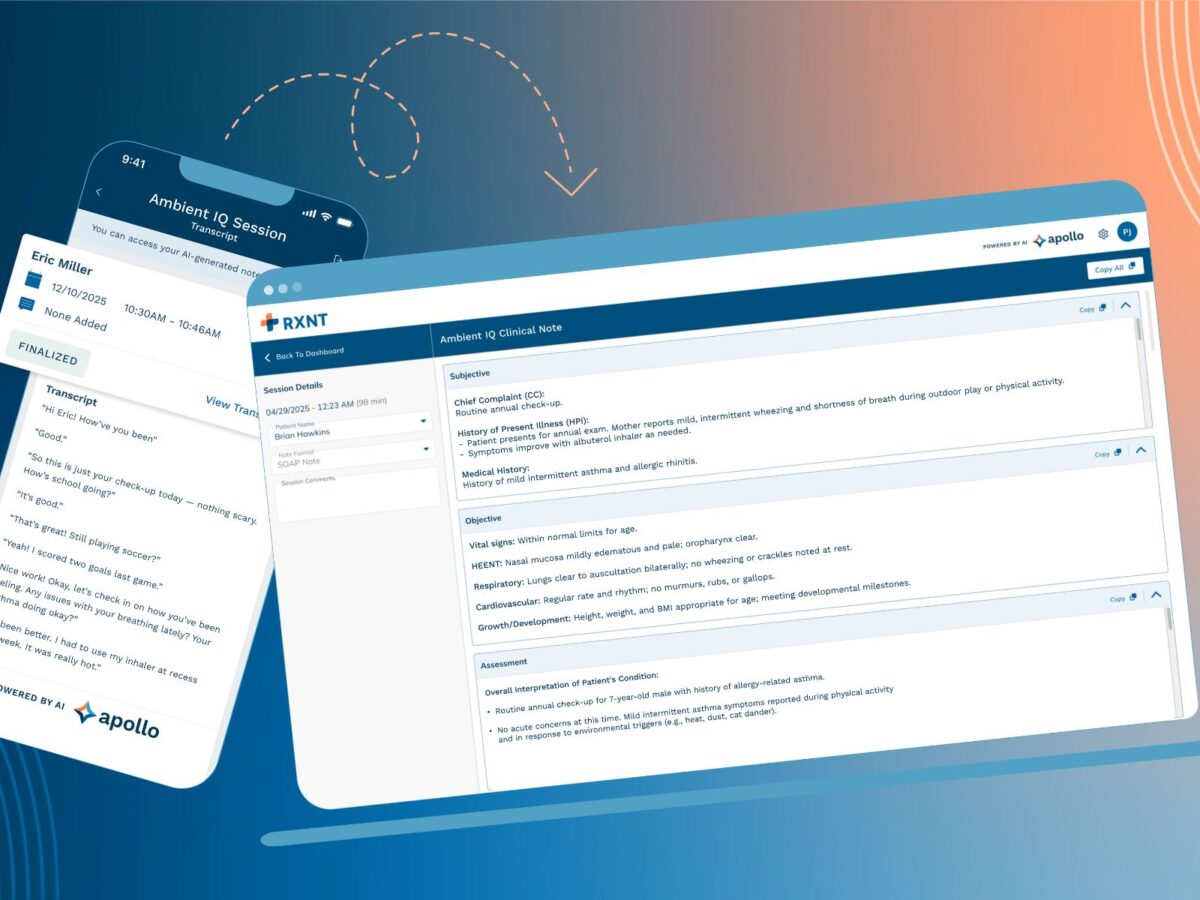
Ambient IQ is the obvious 2025 update, but its placement in the story matters. RXNT built it after decades spent on the database, security, templates and workflows surrounding a clinical encounter. A provider starts a HIPAA-compliant session on a phone, has the visit, then reviews a generated clinical note on the web. For clinicians using another EHR, the note can be copied over. For RXNT EHR and Full Suite customers, usage is included; the standalone product is listed at $75 a month after a 90-day trial with 30 notes.
RXNT says users have reported up to a 70 percent reduction in note-taking work. Treat that as a vendor claim, not a clinical guarantee. The useful design decision is more modest: the tool drafts documentation rather than pretending to make the diagnosis. Encounter Insights summarizes a patient history before the visit. Together they attack the hours clinicians spend charting after patients have gone home.
Elsewhere, RXnotify uses text messages and RxSense’s pharmacy network to send prescription updates and savings options. A Kno2 partnership is bringing TEFCA exchange into the EHR, with access to a network spanning more than 10,000 organizations and 60,000 connections. In August 2026, RXNT added two-way appointment reminders so a patient can confirm or cancel by text. These are not moonshots. They are small removals of friction from the same loop.
The playbook - and its boundary
There is a clean lesson here for software builders: begin with a painful transaction, not an impressive platform diagram. Make the benefit legible to the person who must change behavior. Let customers reveal the adjacent workflow. Price the product so a small buyer can understand the decision. Include onboarding because a subscription that never reaches routine use is churn wearing a name badge.
Sell the first painkiller
RXNT started with a prescription, earned a daily habit, then expanded into the record and the business office.
Make support part of product
Implementation, training and US-based support reduce the hidden cost of changing a clinical system.
Regulation is not a growth hack
EPCS certification, health-data exchange, security controls and clinical trust take time and specialist knowledge.
One suite cannot fit every clinic
Custom workflows help, but simple practices may prefer a lighter tool and hospital groups may demand deeper enterprise integration.
It would not work under every condition. A product with no urgent, repeated workflow cannot copy the same wedge. A company selling into acute-care hospitals faces longer procurements and a different integration burden. A founder who uses debt before product demand becomes visible may get the personal guarantee without the Medco order. And bundling turns from advantage to liability when one weak module traps customers inside the rest.
RXNT’s own evidence is strongest when it is concrete: a two-week onboarding at Three Oaks Anesthesia, 650 staff hours saved each month at Inview Imaging, accounts receivable cut 30 percent at University Family Medical Center. These are company case studies, not universal outcomes. Still, they show what buyers actually purchase. Not an EHR. Not AI. Fewer keystrokes, faster claims and a little more attention left for the patient in the room.
In 2025, TIME and Statista placed RXNT on their first World’s Top HealthTech Companies list. Inc. had already listed the company among America’s fastest-growing private businesses for four consecutive years, 2019 through 2022. The honors are nice punctuation. The sentence is longer: a working product survived a crash, customers kept writing the roadmap, and the founder kept the company independent long enough for “boring” infrastructure to become an advantage.