The trouble at East Adams Rural Healthcare was a matter of proportion. The Washington provider had an electronic health record built for a larger enterprise. Its own needs were more particular: a family-practice clinic, a round-the-clock emergency room, an ambulance service, a therapy center. The software, according to the organization’s account, brought more complexity and cost than this collection of services could justify. A powerful machine had become an awkward fit.
- The customer: rural hospitals, clinics, and independent or specialty practices.
- The offer: cloud records, billing, practice management, and patient tools connected in one platform.
- The bet: fewer technical chores and a vendor that understands small teams.
- The lesson: choose software by rehearsing your real work, including the work after dark.
In September 2026, East Adams selected Azalea Health. Implementation was underway when the announcement appeared. The decision, rather than a completed transformation, is what makes the story interesting. Leadership wanted a system suited to a rural emergency hospital and its attached clinics, along with support that answered promptly. Being small had become a purchasing criterion.
01 / The laboratory before the cloud
Azalea’s early history begins with people who had seen healthcare software from an unglamorous vantage point: a medical laboratory. Baha Zeidan, Douglas Swords, and Daniel Henry worked at Doctors Laboratory in southern Georgia. They observed cumbersome records systems and started working on a business plan in 2007. Zeidan later described the sequence in a public declaration: incorporation in 2007, launch in April 2008, and an initial cloud-based healthcare management and medical billing product.
The team also entered a local business-plan competition. The Valdosta-Lowndes County Chamber of Commerce awarded them $15,000, with legal and other services attached. It was an admirably practical beginning. Before there were institutional investors, there was a prize large enough to help an idea acquire an address and some paperwork. Azalea launched in Valdosta, the “Azalea City.” The name did not have to travel far.

Today, Azalea describes its mission as helping underserved providers improve patient care and profitability. That last word belongs in the sentence. Healthcare software has to help record treatment, but it also has to help an organization sustain the work. A beautifully documented encounter that never becomes a payable claim leaves a rather expensive gap.
02 / A patient takes two journeys
Think of a visit as two journeys happening together. The clinical journey includes the record, notes, orders, and communication. The financial journey includes registration, charges, claims, and payments. Azalea sells tools for both, aiming to reduce the handoffs between them. The appeal is easy to understand: fewer places to re-enter information, fewer separate systems to tend, and fewer administrative errands disguised as medicine.
Scheduling
Patient record
Follow-up
Telehealth
The ambulatory EHR serves independent and specialty practices and rural clinics. The hospital offering addresses rural hospital care and patient accounting. Practice management handles scheduling and billing; analytics supplies financial, clinical, and operational reporting. Credentialing and consulting add professional help around the software. This is a business-to-business platform bought by healthcare organizations, rather than a consumer app patients choose for themselves.
There is another choice inside the purchase: who does the billing? Azalea’s revenue cycle management service supplies U.S.-based billing specialists. A practice can buy technology and also contract for people to operate part of its financial machinery. That is an important distinction in a market where a vacant billing role can matter as much as a missing button.
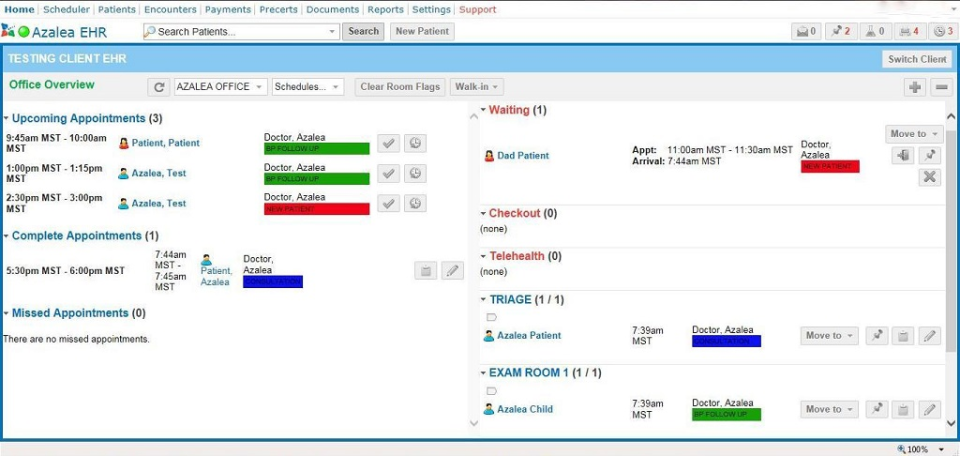
Patients encounter a different face of the system. The portal and telehealth tools support access to records, appointment scheduling, bill payment, prescription refill requests, and messaging. Remote visits can be documented within the platform. For a rural provider, that gives communication a route beyond the building without requiring the visit and its record to live in separate worlds.
03 / The night shift gets a vote
Reeves Memorial Medical Center, a critical access hospital with a rural clinic in Bernice, Louisiana, offers a useful second perspective. Its concern was continuity. In Azalea’s customer account, CEO David Caston described two implementation goals: keep seeing patients and keep billing. Reeves chose Azalea for predictable costs and integration between its hospital and clinic.
“Change is scary for a CEO.”
David Caston, Reeves Memorial Medical Center
The implementation included a custom data migration and two weeks of onsite support covering day and night shifts. The case study reports continued claims processing and patient care through the change. It also describes ongoing visits and check-ins afterward. These are reported results from one customer, not a promise that every migration will behave the same way.
The detail worth borrowing is the night shift. A demonstration can succeed in a conference room while a rollout struggles at midnight. Reeves’ approach gives a buyer something concrete to request: show how training reaches the people who are working when the project meeting is over. Its later use of a custom daily census report also points to a good question for any reporting demo: can the system produce the information this organization actually uses?
04 / Buying the missing pieces
Azalea grew through capital and acquisitions as well as product development. A 2014 merger with simplifyMD preceded a $10.5 million Series B in 2016, led by Kayne Partners with Intersouth Partners participating. LLR Partners invested in 2021. That year, Azalea also acquired dashboardMD, adding business intelligence and healthcare analytics capabilities.
Equity and a credit facility are different instruments. These announcements are milestones, not a running total of cash raised.
CIBC announced a $30 million credit facility in October 2021 to support the analytics acquisition. In December 2022, it led a $45 million syndicated debt facility. The amounts should retain their financial labels; a credit facility is not a valuation. The strategic direction is easier to read: build a platform that can tell customers what is happening to their work and money, alongside recording the work itself.
Partnerships extend that approach. A 2023 agreement with Particle Health targeted health-data exchange and rural care coordination. Phreesia is a preferred patient-intake integration partner. The platform’s ambition depends partly on connections outside its own walls. “One patient, one record” is an organizing idea, and making it useful requires other organizations to participate.
05 / The note, the claim, and the human
In March 2025, Azalea announced Clinical Assistant and Billing Assistant. Their jobs are specific. Clinical Assistant, powered by Suki, captures provider-patient conversations and generates structured notes. Billing Assistant flags potential coding problems and helps with claim follow-up. One tackles documentation; the other tackles administrative errors that can obstruct payment.
The clinical product includes review, editing, and sign-off by the provider. That matters more than the elegance of the transcription. A draft is useful when it becomes an accurate record without imposing another chore on the person responsible for it. For a buyer, the sensible demonstration is an ordinary encounter followed by corrections and approval, rather than a perfectly cooperative sample conversation.
Azalea is competing in a busy market. athenaOne also combines ambulatory records, billing, practice management, and patient engagement. MEDITECH serves rural hospitals with Expanse. Integration and AI alone do not distinguish Azalea. Its more pointed argument is about fit: a platform and support relationship designed around smaller providers’ staffing, workflows, and budgets.
06 / Ask for the working version
Azalea operates as cloud SaaS with recurring software subscriptions and optional services. Buyers should evaluate the complete scope. Its published cost disclosures describe setup and maintenance charges for some interfaces. They also identify dependencies: an immunization registry or public health agency must agree to work on a connection. Buying software cannot, by itself, compel the other end of an interface to cooperate.
The practical lesson is to rehearse the whole purchase. Bring a real patient journey, a billing exception, an essential external connection, and the staffing schedule. Ask what each requires, who will do it, and which costs belong in the agreement. A provider that needs a connection an external party will not support has a different problem from a provider that simply needs better charting.
East Adams’ decision makes that discipline visible. It identified the organization it was, then sought technology that matched. Azalea’s opportunity lies in taking those specifications seriously. The small hospital has plenty to do already. Its software should be able to read the room.