A doctor changing software is changing the place where yesterday’s symptoms, today’s appointments and tomorrow’s bills meet. The old program may be maddening. It is also familiar. Replacing it requires someone to keep the clinic functioning while everyone learns where the buttons went. In this business, a better screen can lose to a reliable Tuesday.
QHR understood the Tuesday problem. The Canadian healthcare software company built its electronic medical records business partly by acquiring older systems and moving their customers toward Accuro. The interesting detail was the timetable. In a 2013 interview, founder Al Hildebrandt described giving acquired clients three to five years to transition. A buyer of software businesses had made patience part of the deal.
The story in four points
- The business: clinic software for charts, billing, scheduling and patient communication.
- The method: buy legacy EMRs, support their customers, then migrate toward one platform.
- The owner: Loblaw acquired QHR through Shoppers Drug Mart in 2016.
- The next test: whether integrated AI removes enough work to justify a paid subscription.
01 / THE LONG WAY ROUNDThe acquisition was only the beginning
Hildebrandt’s explanation was admirably practical. Some acquired vendors had exhausted their technology or their finances. QHR’s first task was to stabilize the customer: keep supporting the existing system, retain people from the acquired organization and earn enough confidence to make migration possible. He acknowledged that integration still needed improvement. The schedule was a strategy, rather than a victory lap.
QHR’s 2015 management discussion described the destination clearly: convert acquired customers to Accuro and retire the legacy platforms. That reduced duplicate development. A customer base scattered across several programs could eventually share one product’s improvements. Read as a business model, the approach joined acquisition economics to the ordinary reluctance of people who cannot afford a disrupted working day.
- Keep the lights onSupport the existing system and stabilize the relationship.
- Make the move possibleGive the clinic time to prepare for migration.
- Develop one destinationMove customers toward Accuro and retire legacy platforms.
02 / MONEY AND SUBTRACTIONThe price of choosing a lane
QHR had begun with hospital payroll, HR and staff scheduling. It acquired Accuro in 2004. In 2013, it sold the hospital administration operations to Logibec for C$20 million in gross proceeds, concentrating on the faster-growing EMR business. Growth involved deciding what to stop owning.
Medeo, acquired in November 2014, cost approximately C$3.305 million in recorded consideration: C$2.25 million in cash plus shares. It added virtual-care technology to the clinical record. The company could sell another service through an existing provider relationship.
The American billing detour went less well. QHR sold its U.S. revenue-cycle assets to MTBC in July 2015. Its accounts recorded a C$2.613 million impairment and said sale proceeds were not expected to be material. The assets’ carrying value could no longer be supported. Those numbers make the subsequent Canadian focus easier to understand.
In 2016, Loblaw offered approximately C$170 million, or C$3.10 per share, for QHR. At announcement, QHR served 7,700 providers. Completion followed in October through Shoppers Drug Mart. For the pharmacy group, clinic software offered a complementary position in healthcare’s daily transactions.
03 / WHERE THE WORK LIVESInside the clinic’s working day
Accuro’s roots explain its attention to specialists. The company’s origin account places computer science students Mike Checkley, Brian Ellis and Lisa St. Laurent in a Kelowna urology clinic facing a six-inch stack of referral letters. Their early software joined scheduling, billing and clinical notes. Consult letters and waitlists mattered because those were the problems in front of them.
“We made no decisions without seeing it in action.”
Mike Checkley · Accuro co-founder and President · October 2025 retrospective

The present product carries much more of a clinic’s day. Patient charts organize medical information; the document inbox handles incoming records; Traffic Manager tracks movement through the clinic; waitlist tools follow referrals and requisitions. Query Builder supports reporting. Taken together, these functions describe an operational system as much as an electronic filing cabinet.
QHR’s particular pitch is a configurable platform that can accommodate different practices. A specialist’s consult letter and a family physician’s recurring follow-up are different jobs. An implementation team helps configure the system around those routines. Cloud hosting keeps data in Canada and includes automatic backups and multi-factor authentication. The clinic trades local server management for a hosted service requiring internet access.
Appointment-drag actions each week, according to Accuro’s review of its 2025 improvements.
Company-reported activity, published March 2026. It measures use of a feature, not independently verified time savings.Drag-and-drop rescheduling is an unusually good example of this market’s stakes. Moving an appointment sounds trivial until you watch someone do it repeatedly between telephone calls. The same review described a panel for dragging chart information into notes, favourite templates and pinnable documents. These changes address the small motions that occupy a large portion of a working day.
04 / THE OTHER END OF THE CONNECTIONYour clinic, in your pocket
Medeo is the patient-facing side of the arrangement. Its current website says patients need an email invitation from their clinic to begin. That detail explains the service: the app extends a participating clinic’s relationship with its patients. It offers secure messages, file sharing, online booking and video visits when the provider makes them available.
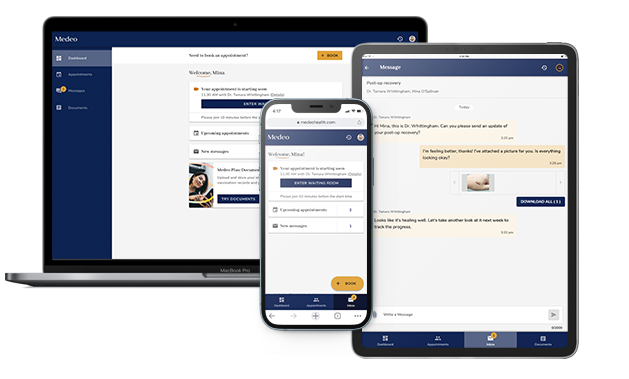
My Care Circle lets patients invite family, friends or caregivers into health activities. The practical appeal is easy to see: managing care often involves someone besides the person in the appointment. Booking, messages and shared documents can become a family coordination job. The product’s usefulness depends on a willing clinic, registered participants and the services that clinic offers.
There is also a lighter administrative option. Accuro Admin provides scheduling, billing and messaging without storing electronic medical records. That gives buyers a choice about how much of the clinical workflow to put inside the system, rather than requiring every customer to buy the whole record-management proposition.
05 / KEEPING THE CUSTOMERThe unglamorous work that earns the renewal
Historically, QHR sold EMRs through monthly and annual subscriptions tied to the number of health professionals using them. Implementation, integration and training supplied additional services. Today, the company quotes pricing according to the clinic. The buying decision therefore includes the recurring service and the practical work of getting started.
Training remains a substantial part of that work. Accuro’s March 2026 update reported 5,720 Performance Training course completions and 1,852 new Learning Academy users as of September 2025. Scheduling and patient demographics led the learning paths; billing sessions attracted demand. A sophisticated product still has to teach someone how to reconcile a rejected claim.

The company describes its culture through authenticity, trust and connections, using Loblaw’s Blue Culture framework. Its product philosophy emphasizes listening to users. Training demand makes that philosophy concrete: the customer may want an easier billing workflow long before wanting a grand new feature.
Accuro competes with Canadian clinic systems including TELUS Health’s PS Suite and Med Access, WELLSTAR’s OSCAR Professional and Juno, and EMR Advantage. A useful comparison begins with provincial availability, specialty needs and integrations. Accuro’s FAQ lists six provinces. A national footprint still requires a local fit.
06 / THE NEXT RENEWALWhen the subsidy runs out
The newer proposition is Accuro AI Scribe, powered by Heidi. It drafts documentation inside the EMR; the clinician reviews, edits and approves the result. The integration requires a qualifying paid subscription. Accuro also lists outside AI and automation vendors, including Tali and Empathia, in its tools library. One clinical platform can host several approaches to reducing work.
In July 2026, as funded AI-scribe terms began expiring, Accuro advised clinics to examine what had changed before signing another contract. Did notes finish sooner? Did editing erase the benefit? Did some visits suit the tool better than others? This is the useful question for any automation buyer: count the work left over after the machine has done its part.
Try the economics
What would a saved minute cost?
Illustrative inputs, not Accuro prices or promised savings. Use the monthly subscription cost, actual scribed visits and minutes saved after reviewing and editing.
The calculation has conditions. Net time must be positive, the tool must suit the clinic’s visits and staff must be able to use it consistently. No saved minute automatically becomes extra revenue. Clinician review remains part of the workflow. The subscription buys an opportunity to reduce documentation work; the clinic has to test whether that opportunity materializes.
07 / A FAMILIAR NAMEOne name, fewer clicks
In March 2026, QHR announced it would begin operating as Accuro, aligning the company name with its flagship product. It said the legal identity remained QHR Technologies and existing agreements needed no change. Even the rebrand was designed to spare the customer another administrative task.
The lesson a software buyer can copy is specific: ask for the transition plan alongside the feature list. Test an ordinary day, including the awkward parts. Count editing, training and repeated actions. QHR’s history suggests that the durable advantage in clinic software comes from understanding how difficult it is to change while continuing to care for people. Patience, in that setting, has a perfectly respectable commercial purpose.
Take a closer look
- Accuro company website
- Explore Accuro EMR / request a demo
- Medeo patient app
- Tech Talks / product news and clinic guidance
Watch the workflow
- Accuro EMR / recent product updates
- Mike Checkley / a few words about Accuro
- Patient Messaging / how it works
Stay connected