A modern med spa can inject a wrinkle relaxer, prescribe a weight-loss drug, sell a monthly membership, photograph a result, process a card and ask for a Google review before lunch. The patient experiences one visit. The software can experience six different databases. PatientNow exists to make those two versions of reality look more alike.
The Greenwood Village, Colorado, company sells an operating system for aesthetic medicine and elective care. Electronic records sit beside appointment books. Intake forms feed the chart. Treatment photos attach to that same record. Checkout, deposits and recurring memberships live nearby. Marketing campaigns and review requests pick up where the appointment ends. PatientNow says more than 5,000 active locations now run on the platform.
This is vertical software in its most literal form: the product follows the customer all the way down the workflow. A generic clinic system sees an appointment and a note. PatientNow sees a lead that must be answered, a face that must be photographed at the same angle twice, a consent that controls whether the image can be marketed, a package balance, an injector's inventory and a patient who may be due back in three months.
Start with the chart. Follow the money.
Founder Jerry Jacobson started PatientNow in 2004 after more than two years developing the product with a board-certified plastic surgeon. The initial thesis was narrower than today's product map: bring electronic medical records and practice management to an industry whose workflows did not fit comfortably inside software made for hospitals or family doctors.
That focus mattered. Aesthetic medicine sits in a peculiar commercial zone. It has the privacy, consent and documentation obligations of healthcare, but much of it is cash-pay. It also borrows habits from retail and hospitality: online booking, memberships, promotions, visual merchandising and obsessive attention to the customer experience. The clinic is clinical. The business model often is not.
The first thing that failed was not a dramatic PatientNow product. It was the industry's patchwork. The company has described practices relying on separate tools for marketing, payment facilitation and patient photos, with too little API connectivity to make them behave like one system. Its response was expansion. PatientNow moved outward from the record into every handoff that touched the record.
PatientNow's value is not that each box is impossible to buy separately. It is that the patient and the data do not have to be reintroduced at every arrow.
The camera is more strategic than it looks
RxPhoto may be the sharpest expression of the strategy. In aesthetic medicine, a before-and-after image is simultaneously a clinical record, a consultation aid and potential marketing material. It also has to be consistent. A patient's progress is difficult to judge when the second photo uses a kinder light, a higher camera or a different turn of the head.
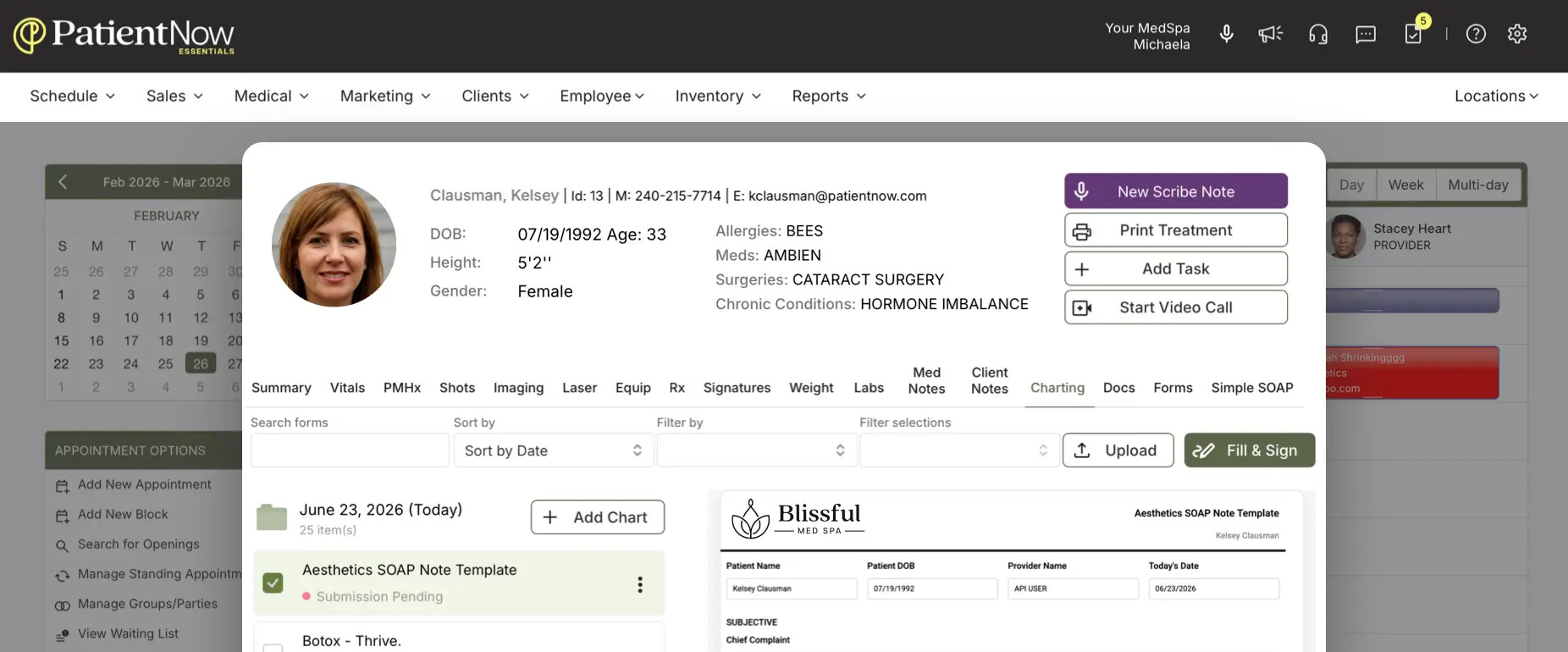
The app uses positioning guides and a ghosted overlay of the earlier photograph to help staff reproduce angle, framing and distance. Providers can draw treatment sites on the image, connect notes and consent, compare results and, when authorized, send approved images into galleries or social-design workflows. This is the sort of job that sounds tiny to a horizontal software company and looks foundational to a specialist.
“The photo ghosting feature lets us shadow the before photo to capture a perfect after - every time.”Donna Potter / Southeastern Vein Specialists
The same logic applies across the platform. Essentials targets aesthetic and cash-pay practices. Pro adds deeper medical machinery such as e-prescribing, labs and insurance workflows. Scheduling handles groups, deposits and online booking. Payments covers checkout, packages and recurring memberships. The patient-engagement layer sends reminders, texts and campaigns. Insights Hub watches revenue, retention and provider performance.
PatientNow sells all of this through quote-based pricing. Its public page promises no contract, free onboarding and a quick setup, but no dollar figure. Buyers choose between Essentials and Pro, then confront an add-on menu that can include labs, e-prescribing, reputation management, telehealth, insurance processing, QuickBooks, API access, AI features and a custom client app. The practical price is therefore not a sticker. It is a negotiated architecture.
The consolidation dividend
One record, fewer duplicate entries, fewer brittle handoffs, one permissions model and reporting that can connect marketing to bookings and payments.
The platform tax
More dependence on one vendor, a harder migration, quote-based economics and the chance that a specialist point tool will outperform one module.
The missed call changed the product map
By 2025, PatientNow was no longer trying only to record what happened in a practice. It wanted to cause the next useful thing to happen. Keri Gohman, a veteran of Xero, Capital One, Intuit, Bain Capital Ventures and legal-software operator CARET, became chief executive in April. Six months later, PatientNow acquired Recura, an AI voice-and-text system built to answer inquiries, qualify leads and book or reschedule appointments around the clock.
The acquisition followed an obvious leak. A prospective patient calls after closing, fills a form, then keeps shopping. By the time a person follows up two days later, the appointment belongs to someone else. PatientNow says Recura cut one practice's follow-up from 48 hours to 30 seconds; another practice attributed $10,000 in incremental monthly revenue to capturing missed and after-hours calls. These are company-selected examples, not a promise to every buyer, but they explain the changed mind: the record is valuable, yet response time can be more valuable in the moment.
The 2026 release cadence extended that “system of action” idea. Treatment Hub joined charting, photos, telehealth, labs and prescriptions in one view. A KPI dashboard replaced scattered reports. Automated deposits reached web, desktop, iOS and Recura booking flows. AI Analytics began answering questions about practice data. AI Scribe started turning conversations into editable SOAP notes, with PatientNow claiming documentation-time savings of up to 25 percent.
The front desk and the treatment room are opposite ends of the same automation bet: answer sooner, document faster, keep the human at the decision point.
That last condition matters. An AI receptionist can handle a booking rule; it should not improvise medical advice. A scribe can draft a note; the provider still reviews, edits and signs it. PatientNow's own subprocessors disclose the modern complexity under the hood, including cloud infrastructure and third-party communications, prescription, lab and generative-AI providers. “All in one” describes the customer experience, not a magical absence of dependencies.
Where the product sits
Illustrative, not a product score. PatientNow aims for high clinical depth and broad workflow coverage. A generic CRM lives at the other end; consumer-first platforms may trade some clinical depth for front-of-house polish.
All-in-one works only when the “all” is yours
PatientNow competes with Aesthetic Record, AestheticsPro, Pabau, Boulevard, Nextech, Symplast, Mindbody, Zenoti and Remedly, among others. It also competes with combinations: an EMR plus HubSpot, a booking tool plus a payment processor, or a photo app beside a general practice system. The relevant comparison is rarely a feature checklist. It is the cost of seams.
The product works best when a practice uses the whole patient journey, especially clinical photography, memberships, repeat visits, retention marketing and multi-location reporting. A plastic-surgery group that mixes surgical and non-surgical care has more to gain from a shared record than a solo provider who needs only a calendar and basic notes. A weight-loss clinic benefits from longitudinal measurements, labs, recurring programs and visual progress. A small shop with a favorite payment processor and a simple workflow may not.
It also fails when organizational habits remain fragmented. Buying one platform does not standardize sloppy photography, clean duplicate data or persuade staff to complete intake before the visit. The buyer still has to define roles, migrate records, train the front desk, test integrations and decide which metrics matter. Software can remove a handoff. It cannot remove management.
Public reviews make the risk concrete. Many customers praise the breadth, photography and ability to follow the patient journey. Others complain about glitches, restrictive payments, onboarding or support. That split is familiar in broad vertical platforms: the more jobs a product performs, the more ways one weak module or rough implementation can color the entire relationship. A buyer should test its hardest workflow, read cancellation language and obtain integration, data-export and support commitments in writing.
A playbook hiding inside a patient chart
The copyable PatientNow lesson is not “add AI.” It is to map one customer's repeated journey and own the ugly transitions. Start with the system of record, where the durable data lives. Find a workflow generic products misunderstand. For PatientNow, before-and-after photography was an excellent one. Then expand only where shared context changes the outcome: the appointment informs the chart, the chart informs checkout, the result informs follow-up.
Next, watch where time destroys value. In this market it is the unanswered lead and the unfinished note. Recura attacks the first; AI Scribe attacks the second. Both are easier to make useful because PatientNow already knows the practice's schedule, services, patients and documentation format. Context, not the model, is the moat.
Build an EMR and practice manager around aesthetic medicine.
Partner with Modernizing Medicine and the American Society of Plastic Surgeons.
Take growth backing from Blue Star Innovation Partners and PSG.
Make the Inc. 5000 twice and pass 5,000 customer locations.
Buy Recura, change CEOs and push AI into lead response, analytics and documentation.
The conditions for failure are equally portable. Do not bundle unrelated features merely to inflate a suite. Do not assume switching costs excuse poor support. Do not hide so much of the economics that small buyers cannot model their risk. And do not automate a clinical decision because the surrounding administrative task looks similar.
PatientNow's bet is that the aesthetic practice will keep behaving like a medical office, a retailer and a subscription business all at once. If that remains true, the company has a rich map of adjacent problems to solve. The next test is less glamorous than the AI pitch: can it make a 22-year accumulation of features feel like one calm workday?