A physical therapist can tell when software has overstayed its welcome. The patient is waiting, the exercise bands are ready, and the clinician is still pecking at a note written for a billing rule rather than a human reader. Raintree Systems has built a business around that awkward pause. Its electronic health record connects the parts of a rehabilitation practice that usually behave like feuding relatives: scheduling, clinical documentation, patient messages, claims, collections and management reporting.
The company is old enough to remember when “data migration” meant Richard Welty working in the back of a client office while his wife and co-founder, Lorraine, trained the staff out front. They started Raintree in 1983. Four decades later, the privately held company is based in Chandler, Arizona, employs a few hundred people and says its software manages more than 50 million patient visits a year across more than 8,500 therapy clinics.
Its customers are not generic doctor’s offices. They are physical, occupational and speech-therapy groups, pediatric providers, applied-behavior-analysis practices and sprawling multidisciplinary organizations. That narrowness is the point. A therapist may treat multiple episodes of care, document functional outcomes, track authorized visits, coordinate a referral and satisfy payer-specific rules before anyone gets paid. A general-purpose record can store the facts. Raintree’s wager is that a therapy-specific platform can understand the sequence.
The product is the handoff
Raintree sells an enterprise software platform, not a single clever feature. A referral can become an intake form and scheduled appointment. The clinician can document the encounter. That record can flow into coding, eligibility, billing and claim follow-up. Leaders can watch visits, denials, collections, referral conversion and appointment volatility through business-intelligence dashboards. Patients get reminders, secure texts, surveys, statements, self-scheduling and a portal through the Connect suite.
That connected trip is Raintree’s main distinction from tools assembled module by module. A billing-aware clinical record can catch missing information before a claim leaves. An appointment reminder can affect the schedule and the revenue forecast. A manager can compare the same underlying activity across locations. Large organizations get standardized workflows without pretending every specialty or payer behaves identically.
This is also why a buyer should expect a serious implementation. Raintree uses custom quotes based on size, locations, modules and services; it does not advertise a tidy monthly price. Data conversion, configuration, training and workflow decisions are part of the real cost. For a solo provider seeking a credit card signup and a minimalist calendar, that weight may be a warning. For a 100-location group trying to stop clinical, front-office and financial data from drifting apart, it may be the purchase.
What failed first was paper
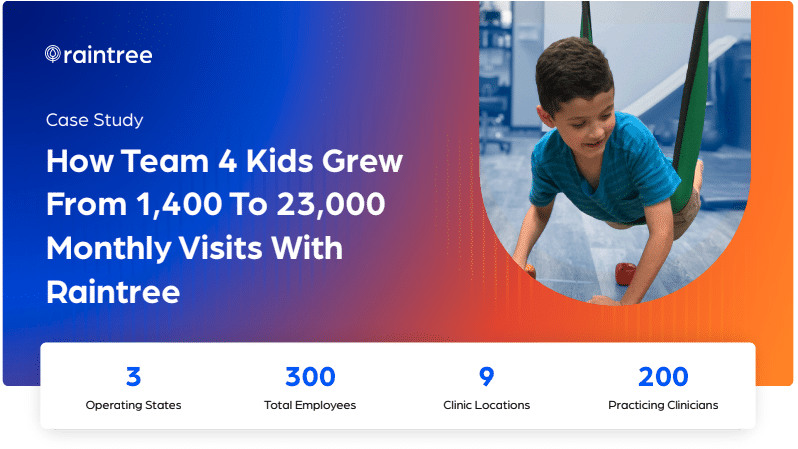
The strongest case for the platform comes from customers describing what broke before they bought it. Team 4 Kids began as one clinic with 13 employees, then ran into manual charts, separate clinical and administrative processes and an 82 percent arrival rate. The practice evaluated vendors and chose Raintree to consolidate documentation, revenue-cycle work and patient engagement. Reporting moved managers from reaction to forecasting; automated communication gave patients a consistent experience without requiring overhead to rise at the same speed.
The reported result is unusually concrete. Team 4 Kids grew from 1,400 to 23,000 monthly visits and from one site to nine. Its arrival rate reached 95 percent, which it says produced an additional $200,000 in revenue during the first year. Manual chart pulling and claim entry disappeared. The organization even linked the resulting efficiency to a charity car show that funds therapy scholarships - a wonderfully specific destination for better database plumbing.
Cypress Health Partners offers a second test. It unified clinical, operational and financial workflows, configured the system around its requirements and used automation plus clinic-level reporting. Cypress reported collections per visit increasing 7 percent, revenue-cycle cost per visit falling 30 percent and arrival rates improving 2.5 percent. The first thing that failed there was not care. It was the expensive administrative process around care - denials, follow-up and fragmented information.
“The goal is to make the technology fade into the background so clinicians can stay focused on patient care.”Raintree’s product thesis
Why the old company changed its mind
Raintree took an undisclosed growth investment from Serent Capital in December 2021. Nick Hedges arrived as chief executive in 2022, and the company sharpened its focus on enterprise therapy providers. The change was not a rejection of the original niche. It was a decision to go deeper: rebuild the data infrastructure, invest in an AI center of excellence and turn the record from a place people enter information into a system that completes work.
In January 2025, Raintree acquired Yoomi Health, a specialist in rehabilitation AI. The deal supplied technology and talent for ScribeIQ, an ambient scribe designed inside the therapy workflow. Ivy Rehab later rolled it across its adult portfolio. The practical promise is that a therapist can talk naturally during a visit while the software drafts structured documentation, rather than completing the encounter twice - once with the patient and again with the keyboard.
Then Raintree went after the telephone. Its July 2026 acquisition of Spike Technologies added voice agents for eligibility checks, prior authorization, payer calls, claim follow-up and patient outreach. Financial terms were not disclosed. The company’s argument is that a scripted bot fails when a call leaves the happy path. An agent working inside the EMR can use scheduling, clinical and financial context to make decisions across several steps, then bring a human into exceptions.
This is the “invisible EMR”: Agentic PX at the front desk, Agentic RCM around payment and ScribeIQ in the treatment room. It is a good slogan because it gives the company a harsh test. If staff still copy information between screens, wait on hold and finish notes at night, the EMR remains painfully visible. If the system handles routine work and surfaces only consequential choices, it begins to disappear.
The platform does not attempt every adjacent job alone. Raintree’s partner directory includes Kno2 for health-data exchange, Limber Health for remote therapeutic monitoring, Waystar and TriZetto in revenue-cycle technology, Availity for administrative workflows, Jopari and OccuPro for workers’ compensation, and Medbridge, Wibbi and Physitrack for home exercise. That ecosystem matters because “all in one” can become a dangerous promise in healthcare. Large groups need one operational spine, but they also need specialist tools to connect without trapping the data.
The reinvention reaches the workforce, too. Raintree is remote-first, with people across the United States and Estonia, and employees cheerfully refer to themselves as “Rainees.” Built In named it among the best remote workplaces in 2025 and 2026. Hedges has said he wants the company to be a career-defining event for as many employees as possible. Awards do not settle a culture question, but the language reveals the internal job: persuade a distributed team at a mature software company to behave like builders of the next system, not custodians of the last one.
Where it wins - and where it will not
Multi-location therapy groups with complex payer rules, several specialties, enterprise reporting needs and enough scale to justify implementation.
Small practices that value instant setup, simple workflows and transparent low pricing more than deep configuration or managed RCM.
Raintree sits between rehab-focused rivals such as WebPT, Prompt, Net Health, TheraOffice and Clinicient, and broad medical platforms such as Epic. Its advantage is accumulated therapy detail plus a unified financial model. Its risk is the same one faced by every mature enterprise platform: configuration can become complexity, breadth can become clutter, and an AI roadmap can outrun evidence. Public user discussions are mixed, particularly on usability, learning curve and price. That makes pilots, reference calls and contract scrutiny essential.
A buyer can copy Raintree’s customer playbook without buying Raintree. Map the patient journey from first inquiry to final payment. Find the first manual handoff where information is lost. Baseline arrival rate, note time, denial rate, collections per visit, days in accounts receivable and administrative cost per visit. Change one connected workflow, train the people who live inside it, then measure again. The software matters; the before-and-after instrumentation is what makes the result believable.
The playbook will not work when workflows are inconsistent, leaders cannot agree on definitions, data is too dirty to compare or staff see automation as something done to them. Nor does an agent deserve autonomy merely because it can speak. Payer disputes, clinical judgment and unusual patient circumstances need escalation rules, audit trails and accountable humans. The best condition for “invisible” software is unusually visible governance.
Raintree’s story is therefore less about artificial intelligence replacing therapists than about software finally accepting the clerical chores it created. The company spent 43 years learning the shape of rehabilitation work. Now it must prove that this knowledge can turn a record-keeping machine into a quiet operator - one that writes, checks, calls and follows up while the clinician returns to the person in the room.
Keep exploring
See the platform, customer results, company updates and conversations with rehabilitation leaders.