The revealing detail in BreezeMed’s account of its old electronic medical record is the work happening between systems. Staff were entering information by hand. Clinical information was slipping between disconnected tools. Documentation was consuming time that could have belonged to a patient. The Florida urgent care’s problem, as described in a case study published by UrgentIQ, was a collection of small interruptions with a surprisingly large appetite.
This is the territory UrgentIQ has chosen. Founded in 2022 by Nat Gibbs and Eric Slater, it sells software for a particular kind of medical encounter: the walk-in visit. Its premise is that the receptionist, clinician and biller should be working on successive parts of the same process. A chart should travel better than a game of telephone.
- One platform connects intake, clinical records, practice management and payments.
- Customers include independent urgent cares and multi-site operators such as CommunityMed.
- A $15 million September 2026 investment funds further clinical and financial automation.
The trouble started between the screens
BreezeMed’s case study describes cumbersome charting, repeated data entry, missed revenue and staff burnout. These problems were linked. If intake information was entered incorrectly, the consequences could emerge much later, when someone tried to collect payment. A busy waiting room could make tomorrow’s billing work harder before the clinician had opened a chart.
The clinic adopted UrgentIQ’s EMR, urgent care templates and integrated prescribing, laboratory and fax functions. Optical character recognition helped capture intake information; validation checks helped catch errors. Scheduling accommodated both appointments and walk-ins. The intervention covered several jobs that had previously been divided among tools.
After three months, BreezeMed reported 30% less documentation time, 40% less manual data entry and 30% lower operational costs from removing redundant tools. Those are vendor-published customer results, not independently audited findings. Their useful lesson is the mechanism: simplifying the movement of information can affect both the clinical workload and the software bill.
The receptionist is part of the revenue story
UrgentIQ’s product follows the visit through three connected areas. Patient engagement handles registration, insurance verification, digital check-in, messaging and scheduling. The EMR handles charting and clinical work. Practice management handles claims, receivables and payment. The customer buys a system for running the clinic; the individual users encounter the parts needed for their jobs.
Some features are pleasingly unromantic. There is a queue-based scheduler. There is a smart pharmacy search. There are tools for occupational medicine and workers’ compensation information. These details matter because walk-in care does not proceed like a neatly booked afternoon of identical appointments. Software earns its keep by accommodating the awkward parts.
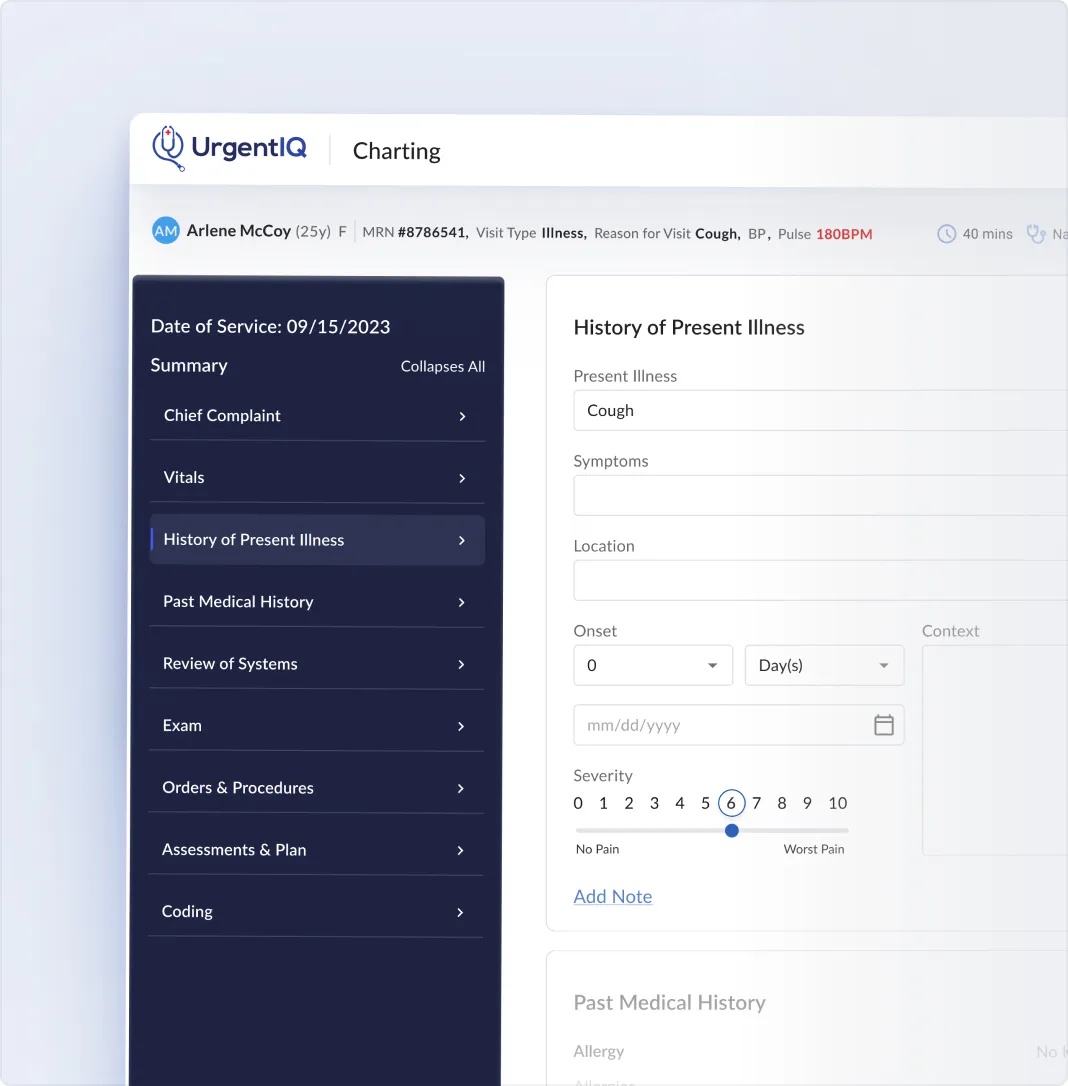
The clinical toolkit includes templates, voice dictation, AI-assisted documentation, chart review and computer-assisted coding. Billing tools include claim tracking, denial management and an AI-powered claim scrubber. The competitive question is how effectively these pieces cooperate. Experity also sells urgent-care-specific EMR, practice management and revenue cycle products. Specialization alone does not settle the contest.
- 01 / ARRIVEIntake + eligibility
- 02 / TREATChart + orders
- 03 / COLLECTCode + claim + pay
A workflow map, not a measured timing comparison.
Sixteen clinics make a different kind of test
CommunityMed’s published Q&A describes adopting UrgentIQ across 16 locations in the greater Dallas-Fort Worth area. Founder and CEO Birken Olson points to ease of charting, intuitive design and the company’s willingness to work on integrations as reasons for considering a change. A network needs consistent information across locations as well as a usable screen inside each one.
Olson describes collaborative implementation, two-way feedback, training resources and prompt support. In the first 90 days, he reported better documentation with equal or less effort and more accessible information during visits. This account makes customer service part of the product story. Migration and configuration determine whether an attractive demonstration becomes a workable Monday morning.
BreezeMed’s staff similarly describe responsive troubleshooting and requests for features. That suggests a customer-facing habit of adjusting the software around clinic work. It also gives prospective buyers something concrete to examine: how the vendor responds when an integration or an unusual workflow refuses to behave.
The bill behind the promise
UrgentIQ sells browser-based SaaS under negotiated order forms. Its FAQ says pricing depends on users, features and operating scale. Standard terms provide for monthly billing unless the order form says otherwise. Implementation and training can be covered by professional services agreements. The buying decision therefore includes both the software and the transition.
Its May 2026 revenue cycle management addendum supplies some harder numbers: card processing is listed at 3% plus $0.30 per transaction, and ongoing credentialing maintenance at $75 per provider per month. The collections-based RCM percentage is set in the order form. These are specific service charges, not a quoted price for the entire platform.
On September 11, 2026, UrgentIQ announced a $15 million Series A led by Five Elms Capital. The announcement identifies native billing, advanced AI diagnosis and coding capabilities, live insurance verification and an AI checkout agent as development priorities. The direction is clear: bring more of the financial journey inside the system. Roadmap ambitions still need to be distinguished from what a clinic can deploy today.
“We believe urgent care deserves its own operating system”Nat Gibbs · founder and CEO · September 2026
Borrow the sequence, measure the result
The practical idea to copy is to evaluate the entire visit. Ask a vendor to demonstrate registration, charting, orders, coding, a rejected claim and eventual payment using one example. Then examine the exceptions: missing insurance details, imported records, an unfamiliar pharmacy. A polished charting screen tells only part of the story.
The gains depend on the clinic’s integrations, training and data quality. Moving flawed information faster merely delivers the problem sooner. Compare documentation time, repeat entry and collection work before and after a switch. UrgentIQ’s case is most persuasive where the clinic can identify the interruptions it wants to remove. The patient’s journey ends at discharge; the operator’s continues until the visit is paid.