At Northern Illinois Foot & Ankle, the problem was capacity. A nine-person call center had to manage scheduling, insurance questions and the unpredictable arrival of the next ringing telephone. An attempt to add offshore agents had failed because patients refused to engage, according to the practice’s published customer story. Hiring more people meant adding expense while reimbursements were under pressure. Prosper AI entered through this thoroughly ordinary predicament.
- Patient calls: book visits, collect intake details and explain balances.
- Insurer calls: verify benefits, follow authorizations and chase claims.
- The connecting tissue: write results into existing systems and hand exceptions to staff.
The company builds voice agents for healthcare administration. Its buyers are medical groups, health systems, billing companies and healthcare software platforms. The attraction is easy to understand: a patient wants something done, and a practice wants that request completed without another callback. A charming conversation is pleasant. An appointment in the right record is useful.
The appointment is only the beginning
Consider the distance between finding an available slot and being ready for the visit. Someone must establish which insurance plan applies, whether the clinician participates, what benefits cover and whether authorization is required. The telephone conversation can cross several departments before the patient has an answer. This is where Prosper has chosen to compete.
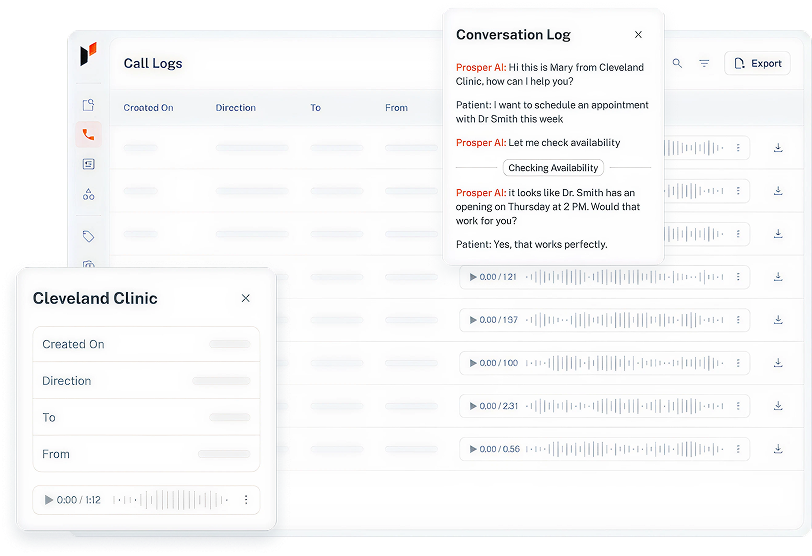
Its platform combines scheduling, benefits verification and patient billing. When an electronic eligibility check leaves a question unresolved, an agent can call the payer, navigate its phone tree, wait and speak with a representative. On the patient side, agents handle intake, appointment changes, balance questions and reminders. They can also collect payments. The desired outcome is a completed administrative task with its result recorded.
- 01BookFind a slot and collect details
- 02VerifyCheck benefits; call the payer if needed
- 03SettleExplain the balance and collect payment
Prosper advertises integrations with more than 80 electronic health record systems, including athenahealth, ModMed, Epic and eClinicalWorks. API connections and file exchange provide several routes into an organization’s existing tools. Read-and-write access matters: a transcript that leaves someone to re-enter the appointment merely changes the shape of the work.
The market has other capable contestants. Assort Health addresses patient phone workflows; Infinitus works on healthcare administrative automation, including insurer interactions. Prosper’s stated distinction is the breadth of patient and payer work in one platform. That is a claim about scope. Its practical value depends on the workflows a particular customer needs finished.
Two founders who knew the other end of the line
Xavier de Gracia and Josep Mingot founded Prosper in 2023 and joined Y Combinator’s summer batch that year. They say they met in Boston while at Harvard and MIT. De Gracia grew up around his family’s medical practice and later ran large contact-center operations at Handy. Mingot brought MIT computer-vision research and product leadership at CoverWallet, the insurance software business acquired by Aon.

Their backgrounds help explain the product’s preoccupations. Insurance has exceptions. Contact centers have queues. Healthcare combines both, then asks a receptionist to make the combination look effortless. Prosper’s manifesto argues that improving the patient-facing conversation must extend into the back office. A faster answer does little good if the insurance question returns tomorrow.
The unglamorous work that makes the demo useful
Northern Illinois’s rollout involved scheduling, billing and insurance staff. Daily fifteen-minute reviews let the teams revise workflows as real calls arrived. The practice changed its mind about routing decisions; Prosper adjusted the logic. When transferred calls went unanswered, the practice changed its phone-system settings that day. Software had revealed a problem that required an operational repair.
“We held daily 15-minute calls with Prosper to refine every detail.”
Tammy Timm · COO, Northern Illinois Foot & Ankle
The customer story reports roughly half of patient calls resolved without human intervention and approximately $350,000 in annual savings. It describes twenty days from the first live call to round-the-clock coverage, following preparation and internal testing. Those are reported customer outcomes, with a particular staffing model behind them. They are useful evidence, rather than a forecast for every buyer.
Northeast OB/GYN offers another instructive deployment. The Texas group started with two hours of daily live calls, expanded to business hours, then added continuous coverage. Its ModMed integration supported scheduling and benefits checks. Prosper’s case study reports 50% call containment, 40% lower operational costs and 12% more appointments scheduled.
The method is portable: define the appointment rules, decide which calls require a person, test a limited slice of traffic and review the exceptions before expanding. It needs someone on the receiving end. Urgent or ambiguous requests still require competent staff, and an inaccessible record cannot be updated by good intentions. Prosper says failed or uncertain calls are flagged with transcripts and confidence scores.
A $35 million bet on finished work
Distribution gives this business another route to growth. ImagineSoftware selected Prosper in 2026 after evaluating approximately eighteen vendors, according to its customer story. The established revenue-cycle platform serves more than 100,000 physicians. Its first production use centered on patient billing, opening a route through existing customer relationships rather than selling to every practice separately.
A $5 million seed announcement in September 2025 preceded a $30 million Series A led by Andreessen Horowitz in June 2026. At that announcement, Prosper reported fivefold revenue growth over six months and reach across more than 150,000 providers. Provider reach counts a different thing from paying customers; the reported $1.3 billion in supported patient care measures neither software revenue nor funding.
Prosper prices on usage, offers custom high-volume terms and says charges begin at go-live. The buying decision also includes the staff time spent mapping rules and fixing handoffs. The most useful question for a practice is precise: which recurring calls consume time, what would count as completion, and can the result reach the right system? That is where a voice agent earns its place.
Follow the conversation
Explore the platform, customer deployments and the people building it.