At Complete Health, the difficulty began before the doctor entered the room. The primary care group was growing, and its telephone arrangements had acquired the charm of a drawer full of incompatible chargers: eight phone systems, front desks answering calls while scheduling visits, patients spilling into voicemail. A practice could be open for business and still be surprisingly hard to reach.
- What Relatient sells: Dash, software that connects healthcare scheduling, communication, intake, and call automation.
- Who buys it: health systems, medical groups, specialty practices, and community health centers.
- The interesting bit: the same scheduling rules can govern staff bookings, patient self-service, and voice AI.
- The lesson to borrow: organize the work before asking automation to do it.
Erin Sandoval, Complete Health’s senior director of support services, described the arrangement plainly: “We had our front desk still scheduling and answering calls.” The problem was coordination. The person standing at reception and the person waiting on the telephone were competing for the same pair of hands.
Relatient’s business lives in that competition. Its Dash platform helps healthcare organizations decide which patient can book which appointment, communicate about the visit, and get the administrative work moving. There is a great deal of technology involved. The underlying question is wonderfully ordinary: why is making an appointment so much work?
01 A calendar with a memory
An open appointment is a conditional invitation. A provider has preferences. A visit has a type. A location has availability. The patient may need a particular sequence of appointments. A box on a calendar cannot explain all that by itself.
Dash’s scheduling engine translates those conditions into booking rules. Contact center staff get a guided way to match patients with providers. Patients can book online against the same logic. Real-time connections to electronic health records and practice management systems keep appointment information moving between the access platform and the office’s existing software.
Complete Health’s published case study gives the abstraction a number: 115 provider preferences that schedulers no longer needed to memorize. The organization centralized scheduling and added online self-service. Its reported results included 80% provider utilization, a 4.7% no-show rate, and 30% of self-scheduled appointments seen within three days. These are customer case-study outcomes, with their own operating context, rather than promises for the next buyer.
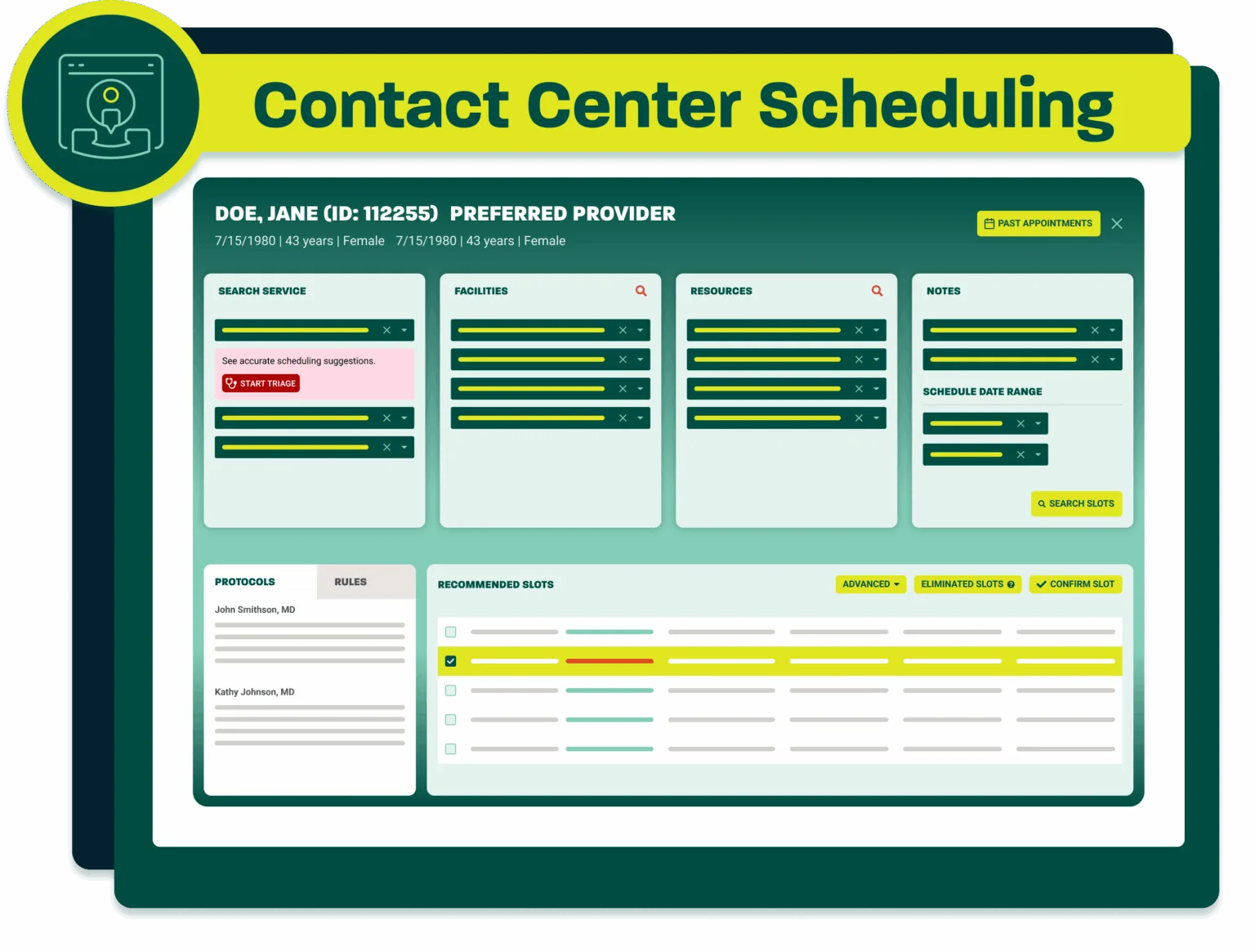
The appeal becomes clearer in a specialty group. Georgia Urology’s case study describes replacing Excel as the main reference for scheduling rules with centralized Dash workflows. It reported provider utilization above 88%. Just as consequential was consistency: a patient coming through a referring organization or a self-scheduling link could encounter the same booking preferences.
That is a more precise proposition than “put appointments online.” A web form can relocate confusion from the telephone to the browser. Relatient’s wager is that the instructions must travel with the appointment.
A simplified view of Dash’s access model.
02 The reminder grows up
Relatient began in 2012. An early financing announcement in January 2014 named its co-founders, Sam Johnson and Kevin Montgomery, and described automated outreach and patient relationship technology. Johnson was named president and CEO; Montgomery continued leading software development. The original business already recognized that the interval between medical visits was full of communication work.
By 2018, the company had announced a self-scheduling and waitlist product. The decisive enlargement came in 2021, when Relatient announced an agreement to merge with Radix Health and more than $100 million in additional growth equity from Brighton Park Capital and its affiliates. Radix contributed patient-provider matching, scheduling optimization, referral automation, and patient self-service technology.
The pandemic sharpened the case for the change. In a 2021 account, then-CEO Michele Perry described accelerated demand for text communication and patient access tools as organizations dealt with changing procedures and a backlog of delayed care. Sending a reminder was useful; helping patients find capacity had become urgent.
The combination made commercial sense: reaching a patient and finding an appropriate appointment are adjacent jobs. Connecting them lets an outreach message lead somewhere useful. The funding figure describes growth capital raised alongside the transaction; it is not a published price for buying Radix. Jeff Gartland became Relatient’s CEO that September.

The company now sells a broader patient access offering. Scheduling sits alongside personalized reminders and outreach, website chat, digital registration, and financial clearance, including mobile payments. A patient can confirm or change a visit through communication tools, complete forms, and deal with administrative requirements without making every step a separate telephone project.
The expertise is in the connections: provider rules, booking workflows, data exchange, and the tasks around an appointment. Relatient reports serving more than 50,000 providers and managing approximately 150 million appointments annually. Its customers use Dash alongside existing clinical systems. The business is B2B SaaS; the patient encounters the service through the healthcare organization that buys it.
03 Before the robot, the routing
Return to Complete Health. The organization did not begin its overhaul by giving a machine eight telephone systems and wishing it luck. It centralized scheduling, selected locations deliberately, and introduced automation in stages. In a December 2025 account, Sandoval reported that AI autonomously handled 56% of calls.
Complete Health’s reported experience, December 2025. A customer result, not a platform-wide average.
The order matters. Centralizing the work gives automation a coherent process to execute. A shared rules engine gives it instructions. Human staff can then concentrate on requests that need judgment or a longer conversation. The useful lesson is procedural: identify where requests stall, make the rules explicit, and expand after watching what happens.
Dash Voice AI answers calls, identifies the request, and can book or modify appointments using provider rules. It also routes requests to people when needed. In July 2026, Relatient added clinical request automation: the voice agent captures questions or requests about medication, billing, and other matters, then creates a task for the appropriate care team in workflow tools such as an EHR.
That last step deserves attention. A pleasantly answered telephone can still produce a forgotten request. Turning the conversation into work that appears where the team already works addresses the next handoff. It does not mean the software has supplied medical judgment; the care team still has a request to resolve.
04 The bill includes the explanation
For a buyer, Relatient belongs in a comparison that includes existing EHR scheduling, patient engagement platforms, and standalone services such as Kyruus Health, blockit, Solv, and Zocdoc. KLAS’s 2024 self-scheduling research distinguishes these approaches. The decision starts with how complicated the scheduling actually is and whether the existing system can express it.
Relatient won Best in KLAS for patient self-scheduling in 2024. In the accompanying research, customers highlighted its rules engine and described choosing it when their EHR lacked sufficient depth. Some also reported occasional glitches, substantial initial setup work, and difficulties with support time zones. An award is useful evidence. Those implementation details are useful evidence too.
The rules have to live somewhere. Moving them into software still requires someone to explain them.The operational lesson
The cost calculation should therefore include staff time to document preferences, validate booking scenarios, test integrations, and train users. Relatient sells through a customized demonstration process. A sensible procurement discussion asks for an itemized proposal and then measures outcomes that matter locally: incorrect bookings, abandoned calls, unfilled slots, no-shows, and staff time per request.
There are clear limits. If a group has simple scheduling and its existing EHR already handles it well, another platform may add little. If nobody owns the rules, software can reproduce conflicting instructions faster. If the true constraint is a shortage of clinicians, a booking engine cannot create extra clinical hours. Faster access requires usable capacity as well as a better route to it.
05 A new appointment with complexity
Relatient’s April 2026 designation as an athenahealth Preferred Solution Partner strengthened an existing relationship of more than a decade. The integration exchanges scheduling and patient information in both directions. Partnership is part of the distribution model as well as the product: the access layer has to fit into the systems practices already use.
September brought two further developments. Relatient announced Dash’s HITRUST i1 recertification, following its initial certification in 2022. It also expanded scheduling tools for behavioral health. In that announcement, BlueSky Telepsych, operating with more than 68 licensed providers across 13 states, reported that 60% of self-scheduled appointments came from new patients and 47% of booked appointments were seen within three days.
Those figures describe one deployment. The broader test is whether patients can reach an appropriate provider while the complexity of specialties, locations, and workflows stays manageable behind the screen. Behavioral health makes the question especially pointed: the willingness to ask for care should not have to survive an unnecessarily difficult booking process.
Relatient’s most transferable idea is to treat scheduling knowledge as something an organization can share, maintain, and test. An appointment slot becomes useful when the patient, provider, and instructions finally meet. The calendar was waiting for an explanation all along.