A hospital can record almost everything and still leave people waiting. A prescription needs checking. A patient is ready to leave. Another team needs to know. Nervecentre Software has built its business around the distance between recording that information and doing something with it. Now the British company is being asked to make that approach work across entire hospitals, with contracts that run for a decade.
In April 2026, Liverpool University Hospitals announced Nervecentre as its electronic patient record supplier. The agreement, described by the company as worth £53 million over ten years, covers a planned shared record for Aintree, Broadgreen and Royal Liverpool hospitals. It is a sizeable commitment to a company whose original proposition fitted into a clinician’s hand. The purchase makes the central question unusually concrete: how much better can a hospital work when its people use the same record?
A useful place to start: beside the patient
Founder and chief executive Paul Volkaerts started Nervecentre in 2010. His account of the opportunity is refreshingly practical. Healthcare technology was good at collecting information, but collaboration and the sequence of clinical work deserved more attention. Mobile devices offered a way to put that information where a decision was being made, rather than leaving it at a workstation somewhere else.
The company developed applications for observations, handover, clinical tasks and patient flow. These are unglamorous categories until someone needs them. A task needs an owner; an observation may need a response; a handover needs to carry the relevant information into the next shift. The NHS Innovation Accelerator’s October 2025 profile described Nervecentre as supporting tens of thousands of staff daily.
That history explains its position in the market. Nervecentre grew through individual clinical functions before expanding into the core electronic patient record, or EPR. KLAS Research dates its first selection for full EPR functionality to 2019. Selling a useful module creates a relationship with a hospital. Becoming its main record expands both the commercial opportunity and the consequences of getting the software wrong.
The medicine round is the demonstration
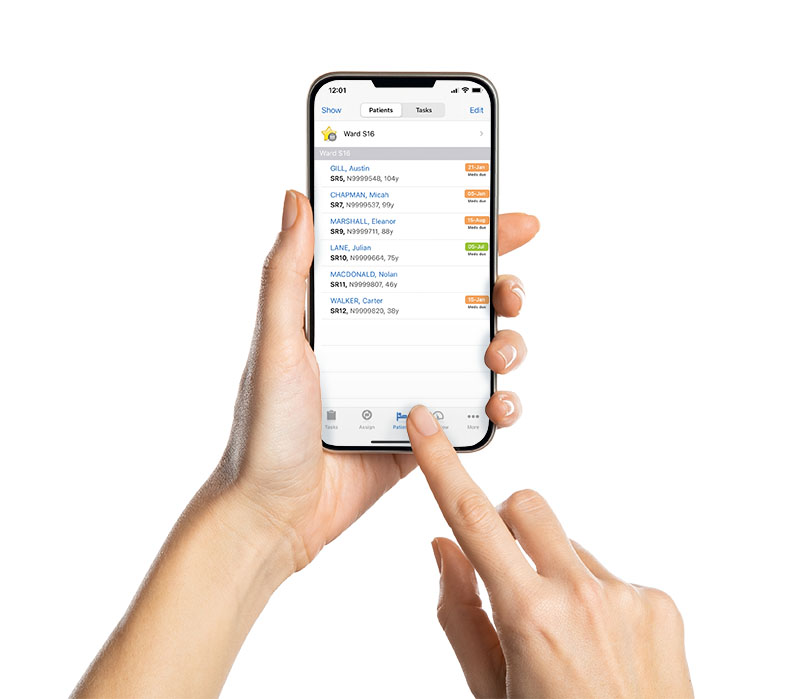
Consider EPMA, electronic prescribing and medicines administration. Nervecentre lets clinicians prescribe on handheld devices, check for allergies and drug interactions, and consult relevant clinical information. A device’s camera can scan medicine barcodes. Pharmacy teams can follow discharge prescriptions, while configured alerts flag particular medicines or overdue administration. Each function belongs to a sequence of work, with different people responsible at different stages.
The company’s Leicester material reports a reduction in medicine order processing from ten hours to two, alongside a 22% reduction in non-administered doses for critical medicines. These are reported local results, not a promise that every buyer will reproduce them. They do, however, make the product easier to understand than the usual catalogue of software features. Waiting for a prescription has a duration. That duration can be measured.
Medicine order processing time in Nervecentre’s published EPMA material. A customer result, not a universal benchmark.
The wider EPR extends into clinical documentation, patient administration, investigations and operational management. Patientcentre adds another participant: the patient. Its apps can support appointment changes, questionnaires and the recording of observations or medication use. Those contributions enter the clinical workflow, rather than stopping in an unrelated inbox. Availability depends on what the hospital has implemented and enabled.
For patients, that distinction matters. Nervecentre is primarily purchased by healthcare organisations; it is not a subscription a person buys to replace their hospital’s systems. Patientcentre complements the NHS App, according to the company. The practical benefit is participation in a care provider’s existing processes, including managing appointments under that clinic’s rules and sharing information with the team looking after them.
One record, several competing clocks
Nottingham’s discharge work shows why information alone is insufficient. In a company-published case study, hospital and community partners had been working with different measures and disputing one another’s data. NUH introduced a shared definition of discharge readiness, then developed information about why patients remained in hospital. Dashboards divided people by discharge pathway and assigned responsibility for progress.
The study compares 285 discharge-ready patients occupying beds overnight on September 29, 2022, with 109 two years later. That change belonged to a wider programme involving hospital, community and social-care teams. It should not be read as a software-only effect. The useful lesson is procedural: agree the meaning of the measure, make the obstacle visible and give someone responsibility for the next action.
- 01CaptureRecord the patient’s current status.
- 02CoordinateShare the obstacle and assign responsibility.
- 03ActResolve the task and update the record.
A shared platform makes this kind of coordination plausible across organisations. Nervecentre describes an architecture that streams changes to users and allows providers to control record sharing through policies. It also advertises upgrades without downtime for most upgrades and customers. That qualification matters. A software architecture describes capabilities; a working hospital adds networks, devices, configuration and human decisions.
What the contract buys - and what the number means
The Liverpool award is published at £53.63 million for a term beginning March 23, 2026, and ending March 22, 2036. That gives buyers a concrete reference point, but not a universal price. The scope, duration and implementation context belong to that agreement. Dividing the total by beds or clinicians would produce a neat number while concealing the differences between programmes.
Nervecentre’s business is enterprise software sold to healthcare organisations, with cloud service delivery, implementation work and continuing support. Its founder reported £250 million of contracts secured during 2024. Separately, the NHS Innovation Accelerator reported £20 million turnover in October 2025. The two figures describe different things. A contract book stretches into future years; turnover measures business recognised over a reporting period.
Public support also appears in the company’s development history. SBRI Healthcare lists £415,690 for its Electronic CUR patient-flow project under the August 2016 competition. That is project funding, not evidence of a venture-capital round. For readers trying to copy the commercial approach, the more revealing detail may be Volkaerts’ involvement in the NHS Innovation Accelerator: he credits the programme with access to people and a better understanding of NHS procurement.
The ward does not pause for installation
There is a hard edge to the expansion story. Nottingham University Hospitals launched its expanded EPR over the weekend of October 31 to November 2, 2025. Subsequent performance problems and downtime compounded existing pressures involving demand, staffing and discharge. The trust declared a critical incident on November 4; Digital Health reported that it stood the incident down on November 6. The software difficulties were part of a wider operational situation.
Harrogate’s December 2025 governors’ papers provide a useful comparison. The trust said its team had shared learning with Nottingham and Nervecentre, while emphasising that its own deployment used modules introduced over several months. The distinction is about the scale and sequence of change. It does not establish that every phased implementation will succeed, but it shows a hospital treating another organisation’s experience as information to use.
Pressure can also change the timetable before launch. Digital Health reported in March 2026 that Sherwood Forest had deferred its planned emergency-department introduction because of sustained service pressure, while progressing a module at Newark’s urgent treatment centre. The same report said Nottingham’s performance issues had been resolved. A decision to delay can reflect hospital readiness as well as the state of the technology.
For an NHS buyer, the implication is specific: judge the implementation plan alongside the product demonstration. Staff need time to learn, local workflows need configuring and continuity arrangements need rehearsing. Nervecentre’s user documentation describes a backup mechanism using scheduled patient-information PDFs. Even a cloud service has to accommodate the ordinary, stubborn requirement that care continues when the main system is unavailable.
A growing supplier has to stay close
The competitive field includes Epic, Oracle Health, System C, Altera, MEDITECH and InterSystems. Nervecentre’s case rests on its NHS workflow experience, mobile approach and shared cloud platform. An independent snapshot adds texture: KLAS’s 2024 report found that three interviewed Nervecentre respondents valued intuitive, locally suited workflows and supplier engagement, while also describing significant work to develop and adopt functionality. It was a small sample at an earlier stage of the product’s expansion.
Keeping that engagement becomes a management problem as the company grows. In Deloitte’s 2016 profile, Volkaerts described slowing recruitment until existing staff had reached the necessary level, and favouring internal development for senior roles. The firm had 32 employees then. Its April 2026 Liverpool office announcement described a UK workforce of more than 200. The new base in The Spine was explicitly linked to supporting the Liverpool programme.
“We are very protective about our culture.”
Paul Volkaerts / Deloitte profile, 2016
Current recruitment material gives that culture a practical shape: clinical experience, troubleshooting, documentation and collaboration between clinical and technical teams. Some roles are hybrid or remote; others involve travel to hospitals. The product is software, but delivering it depends on people who understand what happens when a ward has a question and needs an answer.
The next page is already being written
In May 2026, Nervecentre announced a major deployment phase across York and Scarborough’s hospital and community sites. The account described digital champions, floorwalkers and coordinated oversight, with two further phases still to come. In August, Northampton added patient administration, outpatients and investigations to earlier clinical functions. These are concrete additions to the company’s responsibilities, rather than evidence that the work is finished.
The approach is most useful where teams can agree how they will work together. A dashboard cannot supply a missing care placement, create staff time or settle every disagreement between organisations. It can show who is waiting and why. For another software company, the part worth copying is the attention to a real task, the person doing it and the next person in the chain. For a hospital, the test is whether the shared record changes what happens next.