The patient came in with back pain. In Ubie’s account of its beginnings, she had also experienced bloody stools for two years. By the time physician Yoshinori Abe saw her, she had advanced colon cancer. The detail that stayed with him was the delay: something had happened between noticing a symptom and getting help. That interval would become the problem his company tried to shrink.
- For patients: free questions about symptoms, possible causes, and care options.
- For providers: intake, documentation, call handling, and scheduling tools.
- For businesses: paid software and healthcare advertising fund the operation.
Abe’s co-founder, Kota Kubo, had approached medicine from the other end. An engineer, he began researching disease-prediction algorithms at university in 2013. The two were high-school classmates in Osaka. They founded Ubie in May 2017, bringing together a doctor’s experience of delayed care and an engineer’s interest in turning symptoms into useful questions.

01 A better question, then another
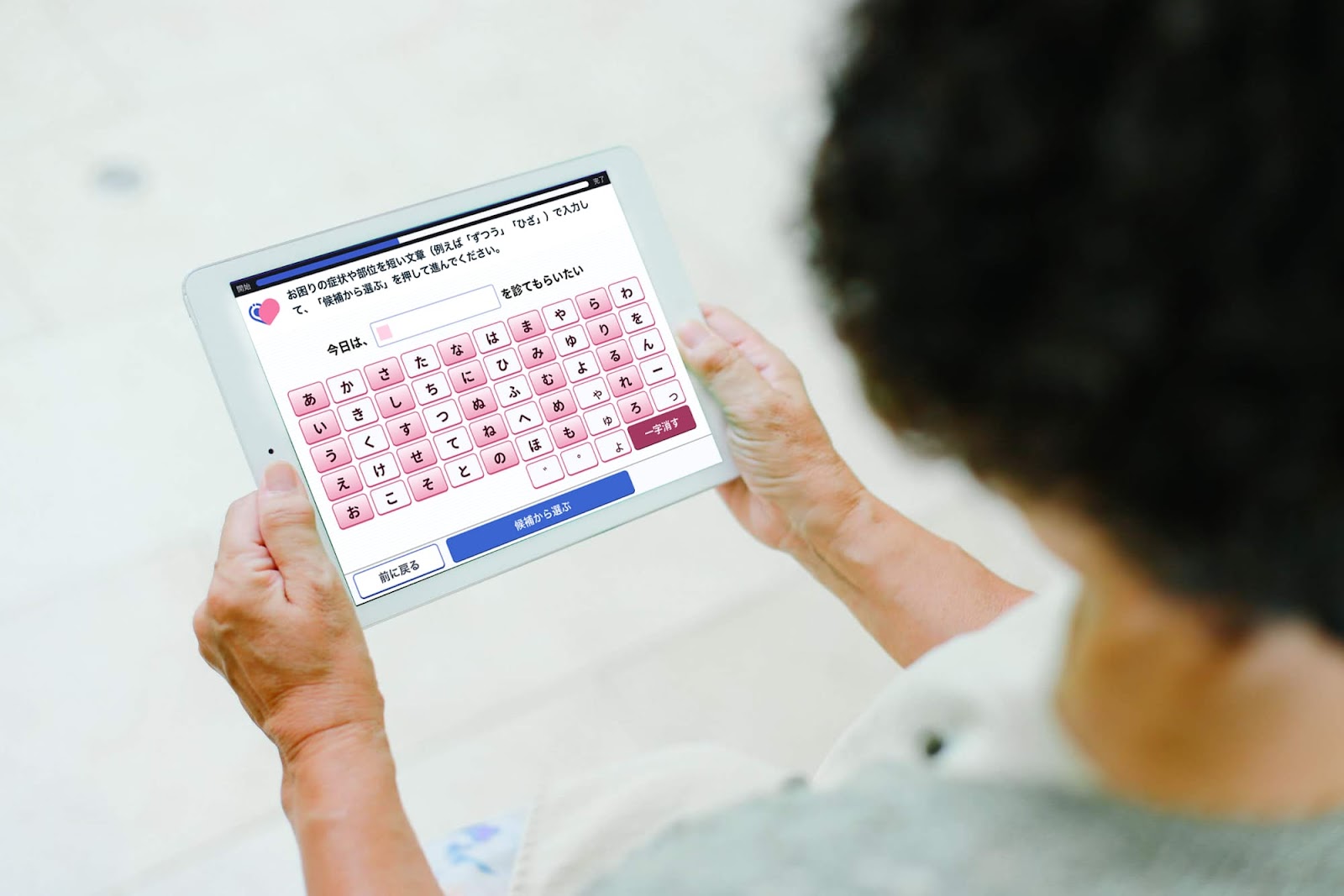
The consumer product is refreshingly specific. You answer a questionnaire, advertised as taking about three minutes. Questions adjust to your symptoms and personal circumstances, including age and medical history. The resulting report suggests possible causes and when to seek care. It gives a worried person somewhere to begin.
There is an appealing small joke in the name. Kubo told JETRO that Ubie refers to the Japanese word for finger: access to healthcare through the fingers answering questions. The ambition is enormous; the physical action is tiny. Tap, answer, keep going.
The expertise behind that exchange combines medical review with software that reasons about relationships between symptoms and diseases. Ubie’s hospital products use related capabilities to gather information before a consultation and prepare it for the clinician. Patients supply the story once; software helps put it into a usable form.
Ubie also introduced Consult formally in April 2026, giving people a conversational way to ask health questions. This broadens the interface beyond a structured checklist. It creates another design problem, too: a conversation can feel authoritative even when a person still needs clinical assessment. The useful distinction for a reader is between getting an explanation and getting a diagnosis.
02 The first obstacle was adoption
A revealing constraint appeared when Ubie moved beyond larger hospitals. Its usual introduction involved detailed visits from sales staff. That approach became awkward for a market of roughly 100,000 smaller Japanese clinics. Staff were already busy. A new tool looked suspiciously like another task.
“It looks complicated.”A clinic director’s first impression, recorded by IDEO
Research with doctors, nurses, and receptionists changed the approach. Working with IDEO and D4V, Ubie developed a two-minute animation and separate guidebooks for different roles. The explanation showed where the tool fitted into daily work. The lesson is portable: show each person what changes during their shift. A product demonstration can leave that question unanswered.
03 Follow the money through the waiting room
The checker is free. Ubie’s commercial customers include medical providers buying software and pharmaceutical businesses buying patient-engagement and advertising services. Japan’s Medical Navi package spans intake and generative AI tools. In the United States, Smart Support offers another entry point: the telephone.
Published pricing starts at $850 a month, including 15 talk-hours, with additional minutes charged separately. A $1,900 plan includes 65 hours. Enterprise contracts are priced individually. Those numbers make the purchasing question concrete: how much useful work can the system remove from an overstretched front desk?
$0.60 / extra minute
$0.50 / extra minute
Enterprise: custom pricing. Included hours are talk time, not staff hours saved.
In June 2026, Ubie added Self-Serve advertising, launched with budgets starting at $100 a day. Healthcare media buyers can target symptom and disease contexts. It is a recognizable advertising model in an unusually sensitive setting. Commercial relevance and patient trust have to coexist inside the same experience.
04 The answer still needs an appointment
Smart Support extends the company’s argument. Understanding a symptom helps only so far if the next step means voicemail, another portal, or an appointment with the wrong specialty. In February 2026, Ubie announced a Mayo Clinic collaboration to develop a unified chat-and-voice access product following a 30-week accelerator pilot.
By August, Smart Support had become a qualified solution on Mayo Clinic Platform. It assesses urgency, specialty, and visit type across calls, chat, and portal messages. Enterprise engagements begin with one high-volume workflow. Qualification is a defined evaluation milestone; Mayo explicitly says it does not endorse or warrant third-party products.
- 01DescribeSymptoms & context
- 02AssessUrgency & specialty
- 03ConnectRoute or book
Illustrative workflow, not a measured patient outcome.
The sequence fits a strategy Kubo described to JETRO back in 2023: build a consumer audience in the United States, establish use cases, then reach out to healthcare providers. A patient-facing service can reveal where people struggle before a provider buys the next piece of software. That is a different starting point from selling an institution another administrative system.
05 Scale is a different kind of test
Ubie reported more than $125 million in cumulative financing in June 2025, with Google among its investors. Its August 2026 announcement put usage above 18 million people monthly worldwide and provider adoption above 1,800 Japanese healthcare organizations. Those are company figures; reach alone cannot establish better clinical outcomes.
The less glamorous economics matter too. A Google Cloud case study reports a 20% infrastructure cost reduction after Ubie adopted GKE Autopilot, alongside fewer maintenance tasks. Its public culture materials describe decentralized decisions and frequent user interviews. Both point toward an organization trying to keep improvements moving through a complicated service.
Ada and Buoy also help people assess symptoms and find care. Ubie’s positioning rests on linking consumer questions, provider workflows, and pharmaceutical engagement. That combination brings several routes to revenue, along with several obligations to people whose interests will not always align.
For another founder, the copyable move is to follow a piece of work across organizational boundaries. Who enters the information? Who reads it? Who acts next? Ubie’s story suggests that the gap between those people deserves as much attention as the model answering the questions. Each additional handoff is a chance for the original intention to disappear.
The practical limits are plain. A questionnaire cannot replace an examination. A booking tool needs reliable integrations and somewhere appropriate to send the patient. Human escalation must work. The patient must still be able to act. Ubie’s opportunity lives in these ordinary connections: the question answered, the call picked up, the information arriving before the patient does.