Michael O’Neil was 28 when treatment for non-Hodgkin’s lymphoma gave him an unwelcome education in hospital life. The clinical care was excellent. The experience of being a patient was another matter: waiting, wondering, and feeling that care was happening to him rather than with him. Recovery left him with a business question. Could a hospital give the person in the bed a more useful role?
- The job: help patients understand their care and give teams a way to follow up.
- The toolkit: bedside screens, digital care plans, automated messages and human navigators.
- The buyers: hospitals, health systems, health plans and government healthcare.
- The next chapter: Get Well combined with RhythmX AI in November 2025, joining patient engagement with clinician-facing AI.
He founded GetWellNetwork in 2000. Today, the business known as Get Well occupies a peculiarly consequential corner of healthcare: the distance between what a care team intends and what a patient understands, remembers and manages to do. A care plan can be medically sound and practically baffling. Get Well sells organizations tools for closing that distance.
The television had a second job
Its bedside proposition is pleasantly ordinary. Patients can find educational material, see care information, request services and enjoy entertainment through hospital technology. A screen that offers a movie can also offer a lesson about medication. A patient can review information without waiting for the next visit from a busy member of staff.
The product’s ambition lies behind the glass. Get Well’s point-of-care tools connect with electronic health records and clinical workflows. Education can be assigned, feedback collected and discharge questions answered. The useful unit is the completed task: a lesson reviewed, a concern noticed, a request sent to somebody who can act on it.
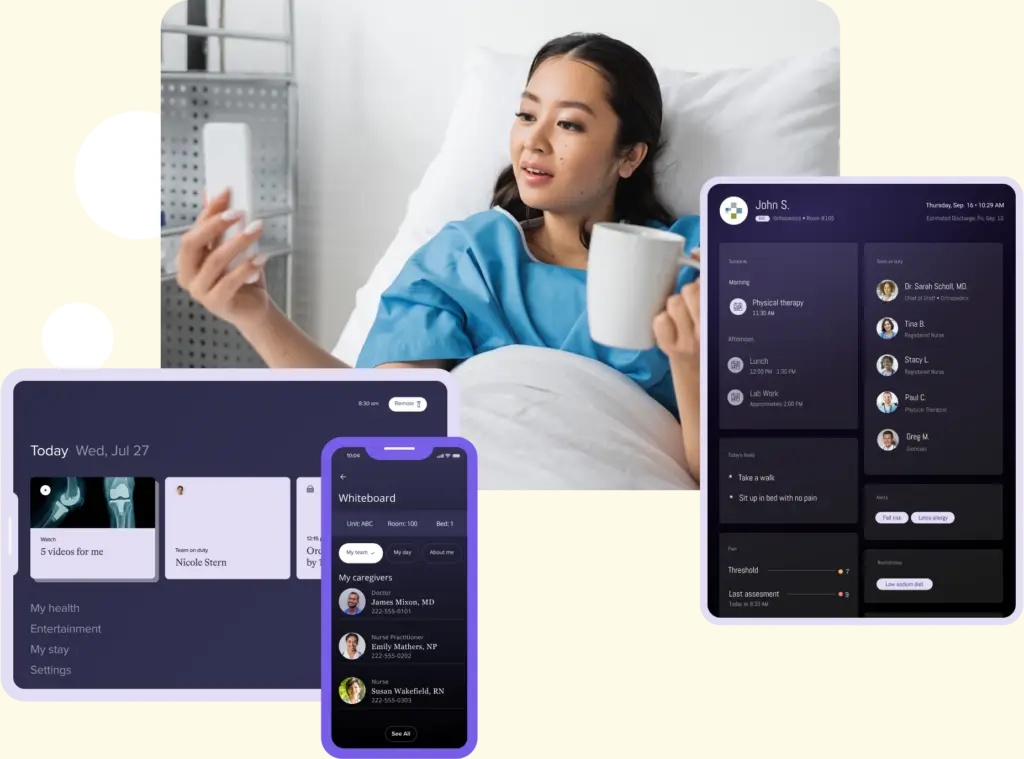
Consider a Southeast VA Medical Center described in a January 2026 case study. Veterans wanted clearer discharge explanations; nurses faced time constraints. The response was to assign medication teaching and discharge-readiness pathways automatically on admission. Families could revisit digestible material. Staff could see progress on dashboards and direct help toward people who had not finished.
Get Well reported 3,777 nursing hours saved through standardized digital education. That is an estimated time saving, with the case citing five minutes per video, rather than proof of an equivalent reduction in payroll. The more portable lesson is the workflow: begin early, let people repeat the material, and make unfinished work visible. Discharge day is a poor moment to discover that yesterday’s explanation did not stick.
Leaving hospital did not end the conversation
In November 2018, GetWellNetwork bought HealthLoop, which used automated daily check-ins to support patients before and after admission. The planned integrated product, GetWell Loop, joined digital care pathways with remote check-ins and monitoring capabilities. In 2021, the acquisition of Docent Health added enterprise consumer engagement technology and a wider route into personalized care coordination.
Read together, these purchases describe an expansion of the company’s field of view. The bedside was one part of a longer journey. Current transitions-of-care products offer multilingual care plans without an app download, patient-reported outcome collection, follow-up support and escalation. Get Well also supplies navigators to help with outreach and triage.
- 01PrepareCare plans before treatment
- 02UnderstandEducation during the stay
- 03Check inQuestions during recovery
- 04ReconnectNavigation to follow-up
OSF HealthCare supplies a concrete example. Its relationship began in 2017 with orthopedic, spine and cardiology programs, then expanded into general discharge, pregnancy and postpartum care, and pediatric RSV. GetWell Loop was embedded in OSF’s Epic experience, letting clinicians manage and message multiple patients within an existing workflow.
A company-published April 2023 case reported a 10% reduction in readmissions among high-risk general discharge patients and one nurse supporting every 400 patients coming through that discharge program. The ratio describes this particular digital workflow; it is no prescription for bedside staffing. It shows why asynchronous contact interests care teams: routine check-ins can reach many people while replies help identify who needs attention.
A message cannot supply a bus
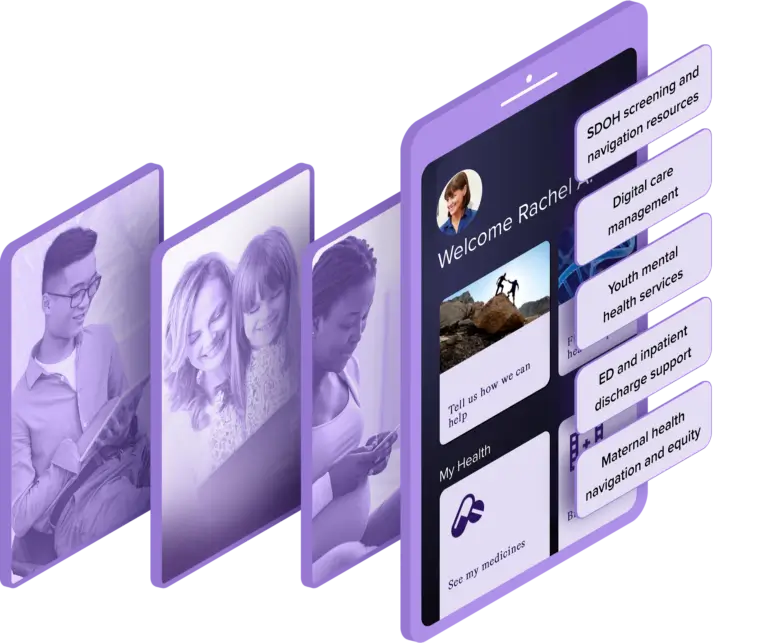
Some barriers yield to a better explanation. Others need a ride, a meal or somewhere safe to sleep. Get Well’s population health offering combines social-needs screening with navigation to community organizations, including a Findhelp integration. Its maternal health programs add screening, education and two-way contact with multilingual navigators.
In April 2025, Priority Health announced plans to send Get Well text surveys to more than 250,000 Medicaid members. The surveys would identify needs such as food insecurity, transportation difficulties and unstable housing, followed by information about available community resources. The partnership makes the distinction between collecting an answer and helping someone use it unusually clear.
The operational implication is straightforward: a referral is useful only when the resource can be reached and can help. Digital screening creates a route to assistance. The destination still has to exist. A successful program needs both a communication system and people or organizations capable of responding.
The spreadsheet meets the balance sheet
Get Well is an enterprise software and services business. Healthcare organizations buy it; patients and caregivers encounter it through participating programs. The Get Well 360 umbrella brings together activation, bedside engagement, transitions and population health. Its expertise combines patient-facing design with integrations, education workflows and navigation.
That makes patient engagement a financial proposition as well as a clinical one. In a May 2024 case study, Get Well attributed $120 million in realized patient revenue over 29 months to its Adventist Health work. The case also reported 1.5 million patients served, 20.2 million digital touchpoints and 431,000 personalized navigator interactions. Outreach helped reconnect patients with services and supported follow-up.
Patient revenue attributed to Get Well in the Adventist Health case over 29 months. Revenue is not profit; attribution alone does not establish causation.
These are implementation results reported by the vendor, with their own populations and measurement methods. They give buyers questions to ask. Which appointments were completed? Which calls disappeared? Which staff minutes became available? Evaluating cost means putting software, integration, devices where needed, training and response coverage against those outcomes. The case’s revenue figure cannot answer that accounting exercise by itself.
Hospitals have alternatives. Oneview Healthcare offers bedside education, entertainment and self-service tools; SONIFI Health combines interactive televisions, digital whiteboards and integrations. Get Well’s argument is the breadth of its offering across care settings and its combination of automation with human navigation. A fair buying decision turns on the required workflow and the existing technology stack.
Opal enters a much older argument
SAIGroup acquired Get Well in July 2024, setting out plans to add predictive and generative AI. In May 2025, Get Well unveiled Opal, an AI patient assistant designed for hospital guidance and post-discharge support. Announced capabilities included care-plan education, appointment reminders, caregiver updates and discharge-progress tracking, without an app download.
November brought a larger corporate change. Get Well and RhythmX AI announced their combination as GW RhythmX, backed by SymphonyAI Group. Deepthi Bathina became CEO of the combined company; O’Neil moved to vice chair. Patient-facing engagement and clinician-facing precision-care tools would now sit within one company.
The distinction matters when reading later announcements. UCI Health’s January 2026 news concerned GetWell Stay at its new Irvine hospital, with GetWell Loop also planned. Presbyterian Healthcare Services’ February expansion to 200 primary-care clinicians concerned the RhythmX AI platform. Both belong to the combined company, but they solve different parts of the care experience.
“We have patients who drive two hours for a 30-minute visit, and so we have to make every minute count.”
Lori Walker, Chief Medical Information Officer, Presbyterian Healthcare Services · February 2026
Trust also has a technical dimension. In January 2026, Get Well announced HITRUST r2 certification and SOC 2 Type II attestation covering specified solutions. Those assurances concern security controls. Judging patient-facing AI also requires examining whether its guidance is appropriate, whether the patient understands it and how a concern reaches a responsible professional.
Give the reply somewhere to go
The practice another organization can borrow is modest enough to be useful: send information when it can be acted on, make it easy to revisit, and give somebody ownership of the response. That conclusion follows from the documented workflows, rather than a claim that the same outcomes will appear everywhere.
It depends on reachable patients, accessible language and interfaces, working integrations, and staff able to handle the exceptions. Under those conditions, Get Well offers a way to keep the care plan in conversation with the person expected to follow it. O’Neil’s original question survives every change of screen and owner: has the patient been let in on the plan?