In the summer of 2014, a doctor could come to your Manhattan apartment for $199. At night, the price was $299. Pager had put an old-fashioned house call inside a smartphone: request help, wait for the physician, answer the door. Among its early promoters was Apple Core Hotels, recommending the service to guests. A visitor with a fever had rather better things to do than learn the geography of New York’s waiting rooms.
- Pager moved from delivering house calls to connecting patients with existing healthcare services.
- Its customers buy navigation, wellness and care-team software that can carry their own brands.
- The useful question is whether a conversation ends with the right care and a completed next step.
The proposition was wonderfully legible. Someone was ill; someone qualified would arrive. But it contained a stubborn constraint. A doctor travelling across a city spends time travelling across a city. An elegant interface does not make the journey shorter.
By June 2016, Pager was expanding into telemedicine and pursuing hospital and insurer relationships. The ambition had shifted toward becoming a technology layer across existing medical services. The interesting part of Pager Health’s story begins there: with the realization that bringing care closer could mean helping people use what was already available.
The doctor could stay put
Pager’s founders were Gaspard de Dreuzy, Philip Eytan and Oscar Salazar, an early Uber technologist. That pedigree made the original idea easy to explain. Medicine would become something a person could summon. Healthcare, however, brought a payment system and clinical responsibilities of its own.
In April 2016, the service offered a first doctor visit for $50, subsequent visits for $200 and nurse telephone consultations for $25. It required credit-card payments and did not then accept insurance. These were consumer prices for a particular period, not the price list for today’s enterprise platform.
“Going in-network allows us to play within the pay structure that health care has built.”
Andrew Chomer, speaking to Fast Company in 2016
That sentence explains a good deal of the pivot. Pager was learning to work with healthcare’s institutions, payment arrangements and existing capacity. Fast Company’s contemporary account pointed to the expense of house calls and the difficulty of expanding them to other cities. The first constraint to surface was scalability. The appeal of convenient care survived; the method of providing it changed.
By 2019, Cambia Health Solutions had announced a navigation partnership with Pager. In Colombia, a deployment with Seguros SURA began that December. SURA’s annual report recorded more than 10,000 chat interactions in the first month. A service conceived around a New York doorstep was becoming something an insurer could put inside its own experience.
Four questions hiding in one complaint
A person seeking care can face several questions at once. What sort of help is appropriate? Who offers it? Does the plan cover it? Is there a program already included in the benefits package? Each question can belong to a different department. From the member’s side, they are all part of the same unfinished task.
Pager Health Navigator, launched in June 2025, combines clinical, provider, benefits and program navigation. It supports symptom assessment, provider search and scheduling assistance, benefit explanations and routing to digital health programs. Nurse-led support provides an escalation path. Members can reach the service through several channels rather than being required to begin in one particular app.
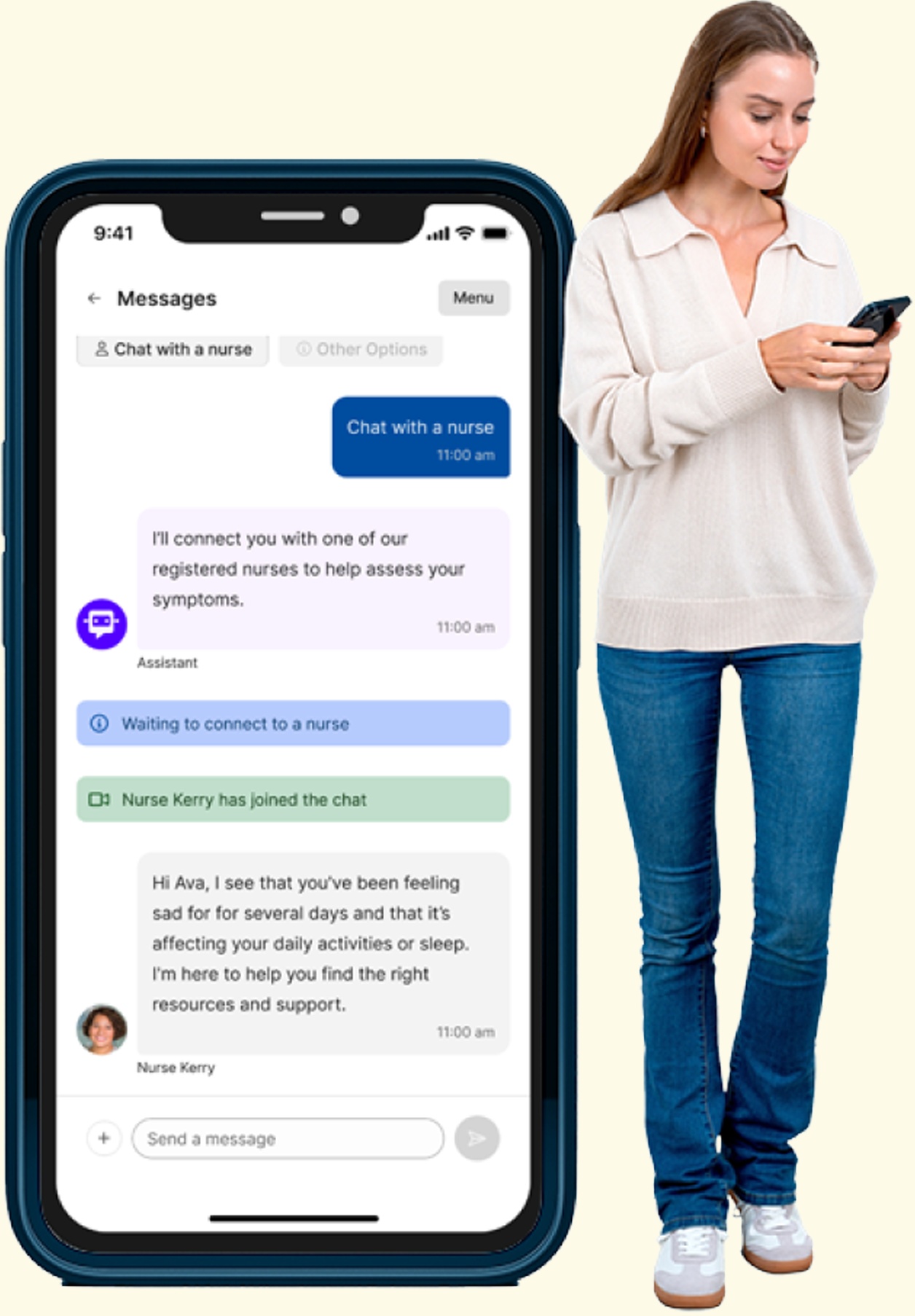
The company’s market position sits between familiar categories. A virtual consultation supplies an encounter. A directory supplies names. A benefits help desk supplies information about coverage. Pager Health aims to connect those functions and help the member act on the answer. Buyers can also assemble these services themselves; integration is a central part of what Pager sells.
Its white-label model makes that distinction commercially useful. A health plan can offer the experience under its own name, with Pager working behind it. The customer gains a more coherent service without asking members to establish another vendor relationship. Pager gains access through an organization that already has members and their benefit arrangements.
A business built backstage
Pager Health is a B2B software and services company. It markets to health plans, providers and employer populations, and its current website addresses brokers and self-funded employers. An August 2025 announcement specified that its ASO solution was sold through contracted health-plan partners. ASO means Administrative Services Only: the employer generally funds claims while the plan supplies administration and related services.
For that buyer, an unnecessary high-cost visit is an expense with a very direct owner. A useful navigation service must therefore do more than produce a pleasant conversation. It must help people use appropriate care, find available in-network support and follow through.
Pager’s financing reflects the resources behind that ambition. It announced $33 million in equity and debt in March 2020. A September 2021 financing added $70 million through Series C equity and debt, led on the equity side by Susquehanna Private Equity Investments, with participation from a Horizon Healthcare Services affiliate. Silicon Valley Bank supplied debt. The announcement put cumulative financing above $120 million.
Those figures describe capital raised. They do not reveal the cost of implementing Pager for a health plan. Nor do they make a savings estimate a subscription price.
Members represented by Pager Health’s healthcare partners in the US and Latin America, according to the company. Partner reach is different from active platform use.
Enterprise 360 supplies the backstage machinery: shared patient context, task management, communication and handoffs among care teams. It is designed to connect with existing systems. In March 2026, Pager announced an engagement with a national employer-focused care management organization, describing a deployment that would enhance existing records, customer relationship and care management tools.
The distinction matters. A well-designed member interface still depends on people knowing who owns the next action. Coordination software becomes useful when the referral, reminder or follow-up reaches someone who can actually complete it.
The months between appointments
Pager acquired Onlife Health in October 2022. In June 2024, the combined business adopted the Pager Health brand. ReallyWell followed in October, extending the proposition into wellbeing: assessments, coaching, personalized recommendations and ongoing engagement between episodes of care.
ReallyWell uses member information to shape recommendations and next steps, with connections to clinical support when needed. Administrators can configure programs rather than commissioning every change as a software project. The practical ambition is continuity. A wellness program and a clinical service should be able to share a useful understanding of the person they are helping.
In September 2026, Pager announced its sixth consecutive NCQA Wellness & Health Promotion accreditation, extending through July 2029. That review addresses program standards, including privacy, engagement and coaching. It gives buyers a different kind of evidence from a vendor’s outcome claims: an assessment of how the program is organized and governed.
AI with an exit door
Pager’s Google Cloud collaboration has produced applications for summarizing chats, answering benefits questions and examining sentiment. In its April 2024 announcement, the company said summarization could save care teams an average of 10 to 15 minutes per encounter. The attraction is ordinary enough: less repetitive documentation, more time for the person asking for help.
- 01 / EngageConversational AI collects information.
- 02 / AssessDeterministic protocols guide escalation.
- 03 / DecideA licensed clinician makes the clinical call.
Its current governance materials separate the conversation from the clinical decision. AI handles intake; deterministic protocols drive clinical assessment and escalation; a licensed clinician reviews and decides. That division is worth inspecting during procurement. The quality of the experience depends on the context that survives the transfer and the speed at which human support becomes available.
Pager also says it works as a remote-first organization. Its published values emphasize execution and measurable outcomes. The personnel behind the software include clinical and technical roles; a handoff needs both the system that carries it and the professional who receives it.

Copy the question, then test the answer
The lesson other organizations can borrow is to examine the spaces between services. List the decisions a member must make, the information each decision needs and the person responsible for the next step. Then measure whether the journey finishes. An answered message and a completed appointment are different events.
Navigation also has material limits. Accurate coverage information, usable provider data, available appointments and functioning integrations are necessary conditions. A routing system cannot manufacture local clinical capacity. Buyers should check accessibility across channels and assess savings against a defined population and baseline, with human escalation treated as an operating commitment.
Pager’s November 2025 partnership with FCamara illustrates the implementation work: the Brazilian partner handles local market support, integrations and technical delivery. Expanding a platform requires more than translating the interface.
The original house call solved a visible inconvenience. Pager Health’s later business addresses an inconvenience that is harder to photograph: the patient left to join the services together. Its bet is that someone should take responsibility for that journey. The test is what happens after the conversation ends.