“How are you?” is the sort of question that can disappear into the wallpaper of ordinary life. It is also the first move in a Cass conversation. No elaborate avatar, no appointment to book, no new language to learn. A person sends a text and the software writes back. That small design choice is the heart of Cass AI, a San Francisco company trying to make behavioral health support feel as available as the phone already in your hand.
The question contains a trap, of course. An answer might call for a breathing exercise. It might call for a food pantry, a counselor or a crisis professional. The company has spent more than a decade building systems to tell the difference. Its record includes an encouraging early trial, ambitious claims about reach, and a very public example of what happens when a bot gets the context wrong.
- Cass sells configurable conversation and care-navigation tools to health plans, providers, employers and community groups.
- Its best-known route into a conversation is SMS: an ordinary text, with no app download or account creation.
- A published trial of its earlier Tess bot involved 74 college students. Useful evidence, but a small test in a specific group.
- A partner's Tessa chatbot was suspended in 2023 after harmful eating-disorder advice, underscoring the need for narrow boundaries and human review.
A founder heard an echo
Founder and CEO Michiel Rauws has described a period of depression and the psychologist who helped him through it. Later, when he spoke with friends, he noticed himself repeating parts of those conversations. Could a machine learn to offer a useful first exchange to people who had no psychologist to call? That question became X2AI, founded in 2014 and later renamed Cass AI. It is a personal origin for a company whose eventual buyers would be institutions.
The commercial logic is plain. A health plan may have excellent benefits that members cannot find. A provider can have open appointments yet lose someone who is too anxious to fill in the form. A community group can spend money getting people to a website and still watch them leave when the choices become confusing. Cass's current home page calls the product a resource-navigation assistant: it talks to visitors, points them toward services, signs them up and checks whether they received help.
That is a more specific job than “AI therapist.” Cass offers chat-based coaching and self-guided exercises, but its business pitch now gives equal weight to finding the next step. Cass Engage handles outreach and triage. Cass Copilot offers a bridge to live staff. Cass Signals gives organizations a view of what people are asking for. The buyers are mainly organizations; the conversations are with the people those organizations serve. Public prices are absent, so no honest per-person cost can be calculated from the available record.
The clever part is almost boring
A downloadable app can be powerful. It also asks an exhausted person to download, register and remember a password. Cass chose text messaging, a channel people already use. Its product materials say the coaching engine covers 800 topics and more than three million possible conversation variations. A sample exchange moves from a check-in to a short self-assessment, then to coping suggestions or a resource referral. On its face, it is less like a therapist's room than a well-designed front desk that never closes.
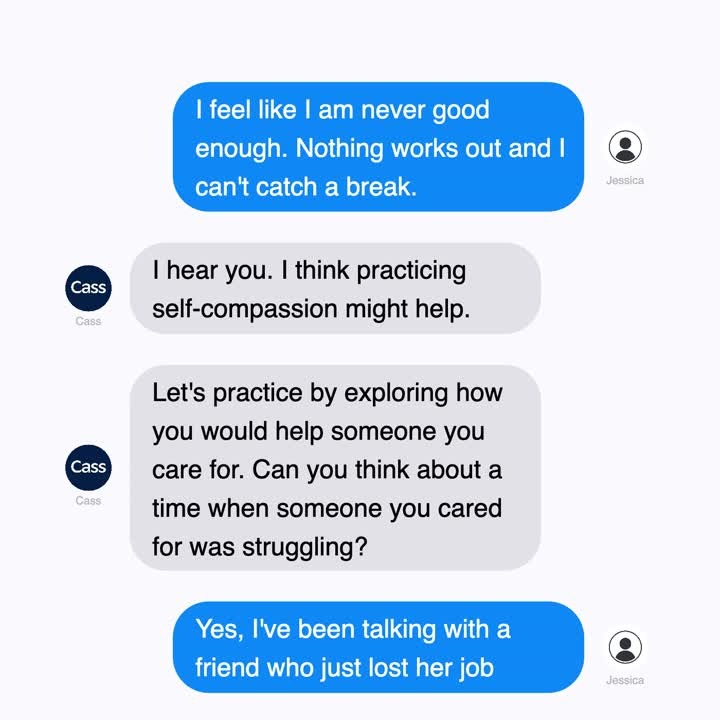
The difference matters in a crowded market. Other digital health businesses sell therapist access, employer benefits or standalone guided-chat experiences. Cass can be placed inside an organization's existing channels and pointed toward that organization's own resources. A hospital may want patients matched to care. A plan may want members to use a benefit. A nonprofit may want the right person to reach a food, housing or counseling service. The chat is the interface; the handoff is the product.
What the evidence says, and what it does not
In 2018, researchers published a randomized trial of Tess, Cass's predecessor chatbot. Seventy-five students from 15 US universities enrolled and 74 completed the study. Two groups could chat with Tess for two or four weeks; a comparison group received a government information booklet. The researchers found significant improvements in some depression and anxiety measures for the chatbot groups against the comparison. That is a meaningful early signal. It is not proof that the same intervention works for every diagnosis, age group, language or deployment.
Cass says its programs cover more than 30 million people globally. “Covered” is a reach claim, not a count of people who opened a conversation or got better. Its impact page separately reports more than one million people receiving coaching chats and an 89 percent satisfaction score from 30,000 surveys. Those company figures point to scale, but they answer different questions from a controlled study. The distinction is easy to blur and essential to keep.
The company's foundation has extended the format beyond the US market. Its site describes Arabic-language support for Syrian refugees and aid workers in Lebanon, a program for new mothers in Kenya, and pandemic support that was revised after early chats revealed domestic violence as a recurring need. There is a useful operating idea here: ship a reachable channel, learn what people actually bring to it, then change the support material. The price of getting the material wrong, however, rises with the number of conversations.
The answer that should not have been given
In May 2023, the National Eating Disorders Association took its Tessa chatbot offline after users reported weight-loss and calorie advice. For someone seeking help with an eating disorder, seemingly routine wellness advice can be dangerous. Tessa had begun as a tightly scripted prevention tool developed with researchers. A later enhanced answer feature became a point of dispute: Cass's Rauws said it was included in the contract, while NEDA said it had not been told of the change. Rauws also disputed whether the troubling wording came from that feature. The cause was contested; the suspension was not.
“How are you?” is an opening, not a diagnosis.The design problem at the center of Cass
The episode is more instructive than a generic warning about chatbots. The original prevention script was built for a particular audience. New answer behavior, added to a sensitive setting, needed to be judged against that audience's vulnerabilities. For any organization copying Cass's approach, the practical checklist is specific: test the actual deployed version, test with the intended population, log unexpected responses, and make escalation to a qualified person easy. A broad claim about empathy does none of that work.
What a text can carry
Cass's present pitch puts navigation and human connection near the center. That does not erase its coaching history or the Tessa failure. It does make the company's strongest claim more concrete: a conversation can keep someone from being lost between wanting help and finding it. The method is worth copying where an organization has trusted resources to offer, a clear route to human care, and the discipline to measure whether people actually reach that care.
It will be weaker where texting is inaccessible, where local services do not exist, or where an open-ended bot is treated as a substitute for clinical judgment. The first question may be easy. What matters is whether the next answer leads somewhere safe.