The first version of Vi had to fit in your ears. It was a pair of biosensing headphones, sold for $249, with an artificial intelligence coach that offered advice while you ran. The proposition was wonderfully intimate: a machine would notice your habits, whisper something useful, and help you keep going. Today, Vi sells to health enterprises. The headphones have left the story; the problem of getting people to follow through has stayed.
- The customer changed. Vi moved from consumer fitness to healthcare, life sciences, and wellness enterprises.
- The job became practical. Find the right people, reach them sooner, and move the work along.
- The platform has four applications. Activate, Engage, Operate, and Pulse sit above existing systems.
- The claim needs a comparison. Vi sells an outcomes-based proposition; buyers need an agreed baseline.
Consider the rather unglamorous interval between a recommendation and an appointment. A person qualifies for a program. Someone has to reach them. Questions have to be answered. A slot has to exist. Every handoff offers another chance for nothing to happen. Vi has chosen this interval as a business opportunity. In healthcare, doing the obvious thing at the right time can be surprisingly difficult.
The coach meets the cost of a customer
Founder and CEO Omri Yoffe came to the problem through aerospace and biometric technology. Vi’s own origin story points to the death of an Air Force pilot friend after a silent systems failure. Its recurring metaphor is radar: detect a consequential signal before it disappears into the noise. The consumer headphones translated that ambition into heart-rate sensing and spoken fitness advice.
Reviewers found an appealing product with limits. Tom’s Guide tested it over nearly 40 miles and wanted more coaching. Wareable liked the heart-rate tracking but found voice recognition uneven. A friendly voice could encourage a runner; replacing the judgment of a trainer was a taller order. The early trouble was visible in ordinary use, long before today’s language of autonomous agents became fashionable.
Then came a different problem: distribution. A Red Axe write-up of Yoffe’s 2026 interview recounts roughly $6 million in profitable consumer sales, followed by rising acquisition costs as Apple and Google’s health ecosystems squeezed the opportunity. In that account, the team shrank from 53 people to three as the company reset around business customers. It is Yoffe’s recollection, and a sobering one. A product could find buyers and still face an unattractive cost of finding the next buyer.

Someone else already had the audience
By November 2020, Vi was announcing expanded use of its adaptive coaching in Nautilus’s JRNY platform across Bowflex cardio equipment. The technology could now travel inside another company’s customer relationship. Vi supplied personalized audio guidance that changed with the user’s activity and goals. The equipment maker supplied the setting in which that guidance was useful.
The next documented expansion reached beyond the workout. In December 2022, Vi acquired Motus Consumer Insights, a business working on member acquisition analytics, site selection, and marketing intelligence. Motus brought household-level prospect analysis; Vi brought engagement and retention. The combination joined the work of finding a customer to the work of keeping that customer active. Selling more headphones would have been a narrower ambition.
This is the strategic thread worth following. The company changed the buyer, the distribution route, and the span of the problem it addressed. A gym chain, a health plan, and a pharmaceutical company have different obligations, but each can lose time and money when eligible people fail to take the next step. That shared mechanics helps explain Vi’s position across wellness and health.
Four verbs, one loop
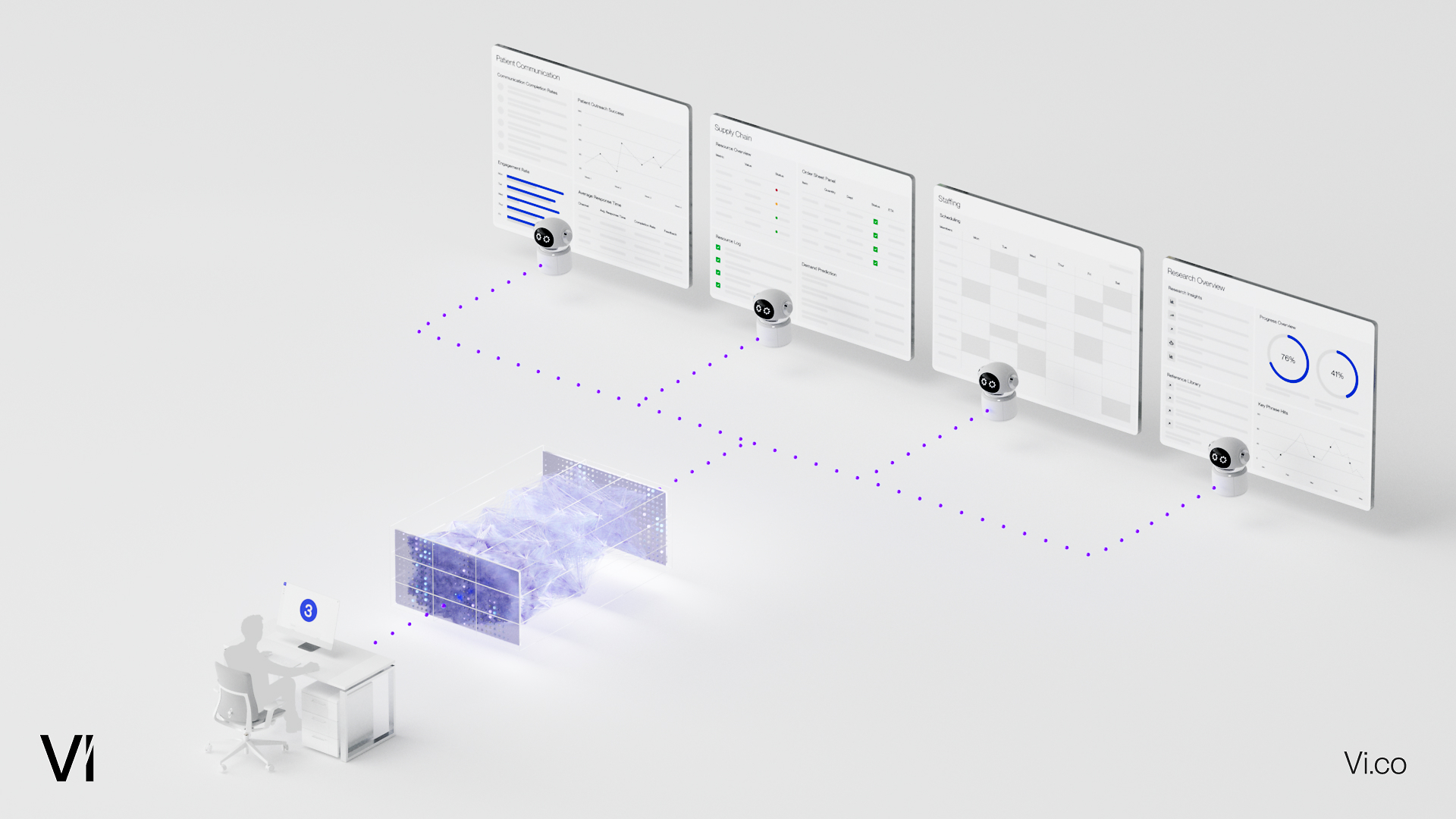
Vi now describes itself as an AI execution layer above an enterprise’s existing systems of record. Its buyers include health systems, payers, biopharma organizations, multi-site wellness operators, and connected-fitness businesses. It aims to connect records to decisions and decisions to work: a targeted invitation, a preventive-care reminder, an enrollment conversation, a staffing adjustment.
Activate handles targeting. Vi describes combining enterprise information with signals such as search, web visitation, and mobility to identify patients or members with a higher propensity to respond. In clinical trials, the application aims to improve recruitment. In wellness, it can inform geographically specific acquisition campaigns. A behavioral signal can guide outreach; eligibility still requires the appropriate screening.
Engage works on the timing and form of the interaction. Its published method includes multi-armed bandit algorithms, which test different outreach strategies while directing more activity toward promising ones. The variables include channel, content, and timing. Vi says the models retrain weekly. The practical question is whether a person gets a useful nudge while they are still persuadable, rather than a farewell message after they have disengaged.
Operate extends the platform into enrollment, scheduling, patient communication, staffing, supply chains, and research. Its product description includes a digital twin, a connected representation of the enterprise used to examine operational opportunities. Pulse supplies the interface for querying data and following ROI. Operators need to see what an intervention did, as well as decide what should happen next.
The missing patient and the late spreadsheet
Vi’s underlying Data Web combines enterprise information with licensed consumer and behavioral data. The company reports more than 190 million de-identified patient records and coverage of 96% of U.S. households. Those are different measures: records describe the data resource; household coverage describes its breadth. Neither is a count of paying subscribers. Vi also describes private client models and a mix of predictive techniques and language models.
The ClearView Healthcare Partners collaboration gives this machinery a named use. The life-sciences consultancy describes connecting strategic advice to execution through Vi, including identifying patient populations and informing provider outreach. Rare disease makes the challenge especially clear: small, scattered populations may be poorly represented in conventional claims-based analysis. A team can have an excellent launch strategy and still struggle to locate the people it is meant to help.
“Our recommendations don’t just stop there. With Vi, they connect directly to execution - with ROI we can prove.”
Ryan Tubman, Partner, ClearView Healthcare Partners
Vi’s anonymous operational cases are more prosaic, which is part of their appeal. One describes a mental-health clinic chain using an enrollment and scheduling agent to answer questions and coordinate appointments through voice and digital channels. Vi reports $28 million in new revenue from that deployment. Treat it as a vendor-reported case result, dependent on that organization’s circumstances, rather than a forecast for the next clinic.
A return with a denominator
In May 2026, Vi announced a $145 million transaction at a $1.64 billion valuation. It included both primary capital and secondary share transactions. The whole sum therefore cannot be read as fresh operating cash. The company also reported more than 100 enterprise customers. In June, it promoted Spencer Honeyman to President, Global Growth, with international expansion among his responsibilities.
Vi’s advertised ROI commitment, with 1× downside protection and control-group benchmarking. A contractual proposition, not a forecast.
The enterprise business is sold through a sales conversation. Vi markets a 4X return commitment and 1X downside protection. For a buyer, the interesting negotiation concerns the denominator: software, implementation, outreach spending, internal labor, and the period over which benefits are counted. Equally consequential is the counterfactual. Would those patients have enrolled anyway? Would another campaign have produced the same result?
Vi’s competitive claim rests on connecting specialized health models, its data resource, and workflow execution. A generic language model alone does not provide that combination. The alternative may be an internal team stitching together analytics, CRM campaigns, and automation tools. Vi’s offer is to supply the connective work as a product. Its expertise lies in predictive targeting, experimentation, data integration, and operational orchestration.
Start with the appointment, then buy the machinery
The useful lesson for an operator is to begin with a bottleneck small enough to measure. Pick one population, one action, and a credible comparison group. Measure completed enrollment or attendance, alongside cost and patient experience. Agree who approves outreach and who handles exceptions. Vi’s wellness description explicitly leaves the decision about what goes out with the customer’s team.
This approach depends on usable data, permission to contact people, available service capacity, and a workflow that can carry out the recommendation. Better targeting cannot create an appointment slot that does not exist. A faster enrollment conversation cannot make an ineligible patient eligible. Those are practical boundaries to establish before buying any execution platform.
Vi’s ambition is “health abundance”: more precise, predictive, accessible, affordable care. Its careers page describes feedback, shared responsibility for wins and failures, and an international team. The commercial test will arrive in less lofty language. Did someone get reached? Did the appointment happen? Did the cost fall? The company that once whispered encouragement to runners now has to answer those questions for institutions.