The first thing IntelePeer sold was not artificial intelligence. It was the privilege of making an internet phone call without the call turning into underwater radio. The company launched as VoEX in 2003, when “cloud” mostly described weather and large businesses still treated voice as a stack of specialized hardware. Its job was carrier-grade plumbing: move voice over IP, connect networks, keep quality intact.
That origin matters because IntelePeer’s modern pitch - software agents answering calls, booking appointments, collecting balances and reading the mood of a conversation - can sound like another application hastily wrapped around a large language model. It is not. The company reached AI by moving one layer at a time: core VoIP, enterprise voice, cloud communications, contact-center software, programmable workflows, conversational AI and, eventually, agents that can take an action.
In July 2026, the journey acquired a new signpost. IntelePeer launched Aqurio, a separate company carrying its agentic-AI technology, vertical expertise, customer relationships, proprietary interaction data and enterprise infrastructure. Aqurio says it serves more than 75 enterprise organizations across 17 segments. IntelePeer, meanwhile, continues the CPaaS and voice-services business. It was less a costume change than a careful separation of the brain from the phone lines that taught it how to listen.
The product is the handoff
IntelePeer’s customer is not someone looking for a chatbot to decorate a website. It is an insurer watching call volume climb 200 percent a year, a dental group with phones ringing across dozens of offices, a utility bracing for an outage, or a financial-services operation paying trained agents to recite balances. These organizations already own phone systems, contact-center software, CRMs, scheduling tools and databases. The problem is not a shortage of software. It is that the software does not finish the work.
SmartAgent handles inbound voice, text and digital requests. SmartEngage runs outbound campaigns such as recalls, reminders and collections. SmartAnalytics measures interactions and surfaces outcomes. SmartOffice connects communications to the smaller workflows scattered through regional and local locations. Managed Solutions supplies the implementation and continuing tuning. Under Aqurio, those AI products are now presented as one governed system; IntelePeer remains part of the integration and communications foundation.
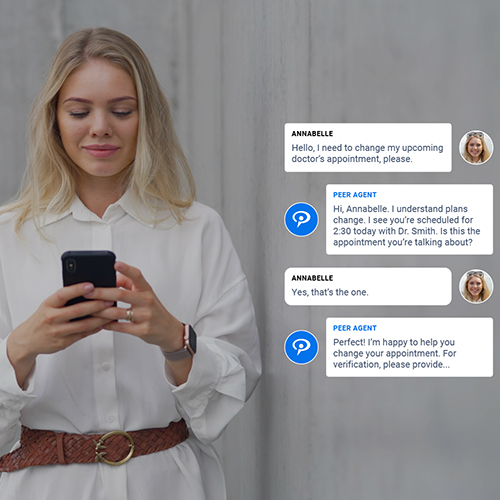
The useful distinction is not “AI versus human.” It is a designed handoff. A voice agent can confirm identity, look up an appointment, update the practice system and send a text. If the caller asks something outside policy or becomes upset, the workflow should transfer both the person and the context to an employee. This is where two decades of telecom operations become relevant: latency, call routing, uptime and escalation are not glamorous, but a smart answer delivered two seconds late still feels broken.
The stack behind one completed call
What it cost - and what failed first
There is no public menu with a price beside every bot. Enterprise work is scoped around traffic, integrations and managed services. But IntelePeer’s case material offers useful anchors. An education company facing seasonal demand signed a $540,000 annual deal. A financial-services SmartAgent deployment carried a $1 million total contract value. The company has also advertised a customer-interaction intent study valued at $40,000. Buyers should treat those as examples, not rate-card promises.
The return side is more legible. One insurance provider moved payment reminders to automated SMS and reported a 24 percent increase in self-service payments, $2.3 million in additional fees collected and a 22 percent decline in agent calls. A fitness chain turned 30 percent of qualified leads into scheduled visits without staff involvement. Benevis, a dental operator, reported containing more than half of calls and expected $1.15 million in return. Another healthcare company said it collected roughly $2 million in additional cash from automated receivables.
What failed first was usually not the customer’s willingness to automate. It was the old mechanism. The insurance provider’s portal was hard to navigate, so customers kept calling. A finserv company’s previous automation capped call containment at 60 percent and left payment processing manual. A health insurer had more than 7,000 agents across five outsourcers and five contact-center environments. In each case, the trigger was operational embarrassment made measurable: abandoned calls, slow collections, staffing pressure or a ceiling the existing system could not cross.
“The technology almost never fails on its own. The partnership fails.”Alleen Delpierre, VP of Alliances
That observation is refreshingly inconvenient. A company can buy the correct model and still get a bad result because nobody owns the workflow, defines success, cleans the knowledge base or negotiates access to the system of record. IntelePeer’s answer has been a mixture of prebuilt vertical templates and managed implementation. Dental modules cover scheduling, reminders, billing inquiries and waitlists; healthcare integrations connect to systems such as Epic, Cerner, athenahealth and Dentrix. The pitch is “no rip and replace,” but there is still work. Integration is work. Policy design is work. Teaching an automated agent when to stop is work.
Why healthcare changed the company’s mind
IntelePeer entered conversational AI in 2017 with SmartFlows, then added generative AI in 2023. By 2024, an outside analyst profile estimated AI had grown to more than 60 percent of company revenue. Healthcare sharpened the argument. A missed retail call may lose a sale; a missed medical call can also delay care, strand a referral or leave a receivable untouched. The workflows are repetitive enough to automate, valuable enough to measure and regulated enough to punish shortcuts.
The company leaned hard into that wedge. SmartAgent for dental service organizations arrived in 2025 with templates for the front desk. A partnership with Unio Health Partners targeted inbound calls, scheduling and no-shows. A 2026 partnership with Your Social Smile connected treatment visualization to booking and payment. IntelePeer added TX-RAMP Level 2 certification, complementing its existing security and compliance posture, and collected awards for patient communication and low-latency voice AI.
Then came Aqurio. Nancy Scott, the chief marketing officer, was unusually direct: “This isn’t a rebrand. It’s not a marketing exercise. It’s a new company.” The split acknowledges two different buying stories. Carrier voice and CPaaS are infrastructure. Agentic AI is operational labor delivered as software, judged by recovered revenue, shorter queues and completed tasks. Giving the second story its own company lets the old pipes remain useful without making them carry every new promise.
The part an operator can steal
The copyable idea is not to buy the whole platform. It is to find one queue where frequency, frustration and value overlap. Payment reminders work because the event is common, the action is bounded and the result lands in a ledger. Appointment rescheduling works because the caller’s intent is clear, the calendar can answer, and success means a changed slot plus a confirmation. “Answer anything” is not a workflow. “Move an existing appointment within policy” is.
A practical 90-day pilot
- Count one repetitive interaction and attach a real cost to it.
- Choose a bounded action with a clean system of record.
- Write the human handoff before writing the happy path.
- Measure completion, containment, errors and customer sentiment.
- Expand only after the first workflow pays for the next one.
This approach also explains IntelePeer’s differentiation. Twilio and Bandwidth can provide communications primitives. Genesys, NICE, Five9, Cisco and Talkdesk can own the contact-center layer. Healthcare AI specialists can arrive with tighter clinical language. IntelePeer’s position sits across those categories: a vendor-neutral automation layer, a communications network underneath, vertical templates above and people who help stitch it together. The advantage is strongest when an enterprise has legacy systems it cannot replace and enough transaction volume to justify the stitching.
It will not work well when call volume is low, the underlying records are unreliable, the workflow changes every week, no one owns escalation, or regulation and policy require a person to make every decision. Automation can amplify a clean process. It can also put a pleasant voice on a dirty one.
The cultural clue is hidden in IntelePeer’s DELIGHT values. The acronym includes both “Have fun while learning and growing” and “Time is of the essence,” which sounds like a family picnic organized by a network engineer. That mix - cheerful presentation, impatient operations - fits the product. Calls happen in real time. Patients do not care which model answered. Executives care whether the appointment was booked, the payment arrived and the human employee had enough context to handle the exception.
IntelePeer is now a useful test of whether an infrastructure company can turn accumulated operational scar tissue into an AI advantage. Aqurio gives that wager a clean cap table story, a vertical identity and a sharper mission. IntelePeer keeps the less photogenic asset: the network. If the next era of enterprise AI belongs to agents that reliably complete work, the old phone plumbing may turn out to be the part nobody should have laughed at.