A merchant with a payment terminal that will not cooperate has little use for a charming conversation. The merchant needs to take the next payment. This is the sort of unglamorous urgency around which Haptik has built its enterprise business: a question arrives, some company system holds the answer, and a customer would rather resolve the matter than admire the technology.
- Haptik began with a consumer concierge, then shifted toward enterprises in 2017.
- Contakt combines AI support with tools for human agents; Interakt serves smaller businesses.
- Its practical value lies in connecting conversations to working business processes.
- Successful automation needs a defined task, useful data and a clean human handoff.
The interesting thing about Haptik is that it did not begin with this customer. Aakrit Vaish and Swapan Rajdev founded it in 2013 around a chat-based virtual concierge. The bet was that messaging could become a way to get things done. That belief survived. The identity of the buyer changed.
The concierge had a buyer problem
For a while, the consumer idea looked persuasive. Haptik raised a $1 million seed round from Kalaari Capital in 2014. Times Internet supplied $11.2 million in 2016. Money arrived before the enterprise pivot; investors were backing a mobile concierge proposition.
In a 2019 interview, Vaish described how the team had become absorbed in marketing, transactions and active-user numbers. By 2017, it paused to ask whether the app was necessary or merely pleasant. He said the team had concluded there was no market for what it was pursuing.
“We needed to return to the drawing board.”
Aakrit Vaish, on the 2017 reassessment
The response was to sell conversational technology to companies that already had customers. The founders could retain their conviction about messaging while giving it a different commercial job. An enterprise with a support queue had a reason to buy that a curious app user did not.


The current company names Ahshad Jussawala as CEO and Saumil Shah as CTO. Its careers page prizes ownership, agility and getting work shipped. Those are stated ambitions, but they fit a history in which the product has been reconsidered more than once.
The $100 million headline had two parts
In April 2019, Reliance announced a majority transaction through Reliance Jio Digital Services. The announcement estimated the total at INR 700 crore, approximately $100 million, including investment for growth and expansion. INR 230 crore was consideration for the initial business transfer. Reliance would hold about 87% on a fully diluted basis.
Initial business transferINR 470 crore
Balance of the package*
Calling the whole amount a purchase price obscures the distinction. The deal also connected Haptik to an operator with reasons to invest in chat, voice and regional languages. Jio’s customers and services offered an environment in which conversational technology could do actual work.
Haptik added further expertise that year. It brought on the founding team of Los Angeles-based Convrg, then acquired Mumbai’s Buzzo.ai, whose conversational commerce technology aimed to act like a shopping adviser. Support and shopping were becoming neighboring problems: understand what someone wants, then help them complete it.
A pleasant answer must lead somewhere
Today, Haptik markets agents for customer service, sales, bookings and lead qualification. Businesses can use their documents and websites to build an agent, connect it to company systems, and deploy it through channels such as web chat, WhatsApp, Instagram or voice. Haptik advertises more than 500 enterprise customers or deployments across its public materials.
The integration is where the proposition becomes concrete. A policy page can explain a refund rule. An order system can establish whether a particular refund has happened. Customer experience depends on joining those two kinds of knowledge without making the customer shuttle between them.
- 01 / ASKA customer sends a message.
- 02 / CONNECTThe agent retrieves approved information or calls a business API.
- 03 / RESOLVEComplete the allowed workflow, or transfer with context.
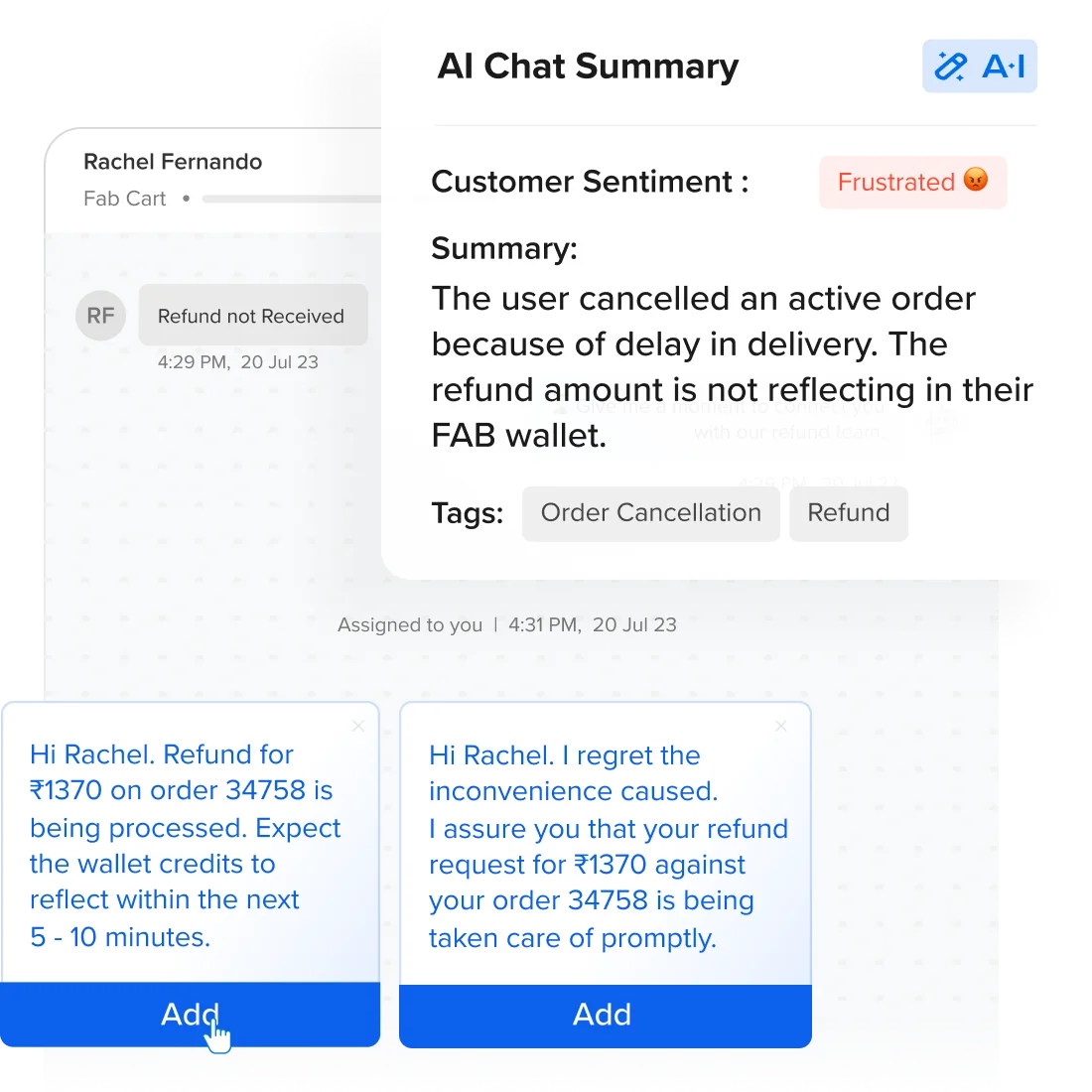
Contakt packages the enterprise support work. Introduced in December 2023, it combined a generative AI assistant, an agent co-pilot and analytics. The co-pilot supplies summaries and suggested replies to human representatives. Analytics lets teams inspect bot and agent performance.
Its launch contained an unusually useful admission: earlier chatbots were rigid, struggled outside their scripts and made customers repeat themselves. Haptik said it had rebuilt its product to be language-model-first. The new technology addressed a conversation problem; integrations and human agents still had to address the service problem.
The payment terminal is the better demo
Pine Labs’ case study puts Haptik in a merchant’s working day. The listed tasks include payments, payouts, settlements, troubleshooting and ordering paper rolls. That last item is a useful antidote to extravagant talk about AI. Someone has to keep the receipt printer fed.
The same case study reports more than 27,000 monthly conversations across web, app and WhatsApp. Routine support became self-service, leaving human agents to handle more complex matters. The result belongs to that implementation, with its particular tasks and users.
Jio’s published example goes further into the customer lifecycle. Its chatbot supports recharge reminders, acquisition and customer care, with more than 900 intents and 7,000 variations. The case study reports more than 34 million conversations. Here messaging is also a sales and retention channel, rather than a little help window attached to a website.
These cases locate Haptik in the enterprise conversational AI market. Buyers can also consider Yellow.ai, Gupshup and Freshworks, all named in Haptik’s comparison materials, or assemble their own systems. Haptik’s case rests on deployment experience, workflow integration and a mix of AI and human service. A brand name alone settles none of those comparisons.
At scale, even a blue tick has a cost
The MyGov Corona Helpdesk supplied a different kind of test. Haptik’s engineering account says the service was built in five days in March 2020. By its March 2022 report, it had reached more than 70 million users and supported vaccination appointments and certificate downloads.
The revealing details concern traffic. The team found that splitting an answer into several messages added API calls and network load. Read receipts added another call. It monitored incoming and outgoing traffic and could delay replies slightly when inbound demand was high. Small interface choices had infrastructure consequences.
This is a historical account of a particular WhatsApp architecture. Its transferable lesson is to measure the burden of each interaction. A cheerful burst of five messages may feel conversational in a prototype and become expensive when millions of people arrive. The reader can copy the habit of measuring, then simplifying.
Language matters, too. In February 2024, Haptik reported more than 15 billion cumulative two-way interactions, separately from more than 10 billion one-way notifications. It said 23% of those conversations had been in non-English languages. These are company-reported cumulative volumes, not counts of individual customers.
The bill extends beyond the subscription
Haptik’s enterprise sales process begins with a demo. Interakt gives smaller businesses a more visible buying route: subscriptions, shared inboxes, campaigns, sales CRM and automation across WhatsApp and Instagram. It brings similar conversational ambitions to shops and service businesses with smaller teams.
At the time of this profile, Interakt’s pricing page listed its AI-agent monthly subscription at INR 2,499 plus taxes, including 100 AI messages, with additional AI messages at INR 0.50 each. WhatsApp activation required a Growth or Advanced plan. The page also displayed other add-on figures, so a buyer should confirm the applicable bundle.
For an enterprise, the practical cost includes preparing data, connecting systems and operating the service. Haptik offers consulting from proof of concept to production. The investment question is whether the completed workflow removes enough work, improves enough service or generates enough business to justify that bill.
The useful agent knows whom to call
Haptik’s recent voice AI material gives humans an explicit place in the design. It describes warm transfers that pass summaries, sentiment history and intent classifications to a representative. A customer should be able to reach a person without delivering the entire opening speech again.
That approach also defines the conditions for useful automation. Repetitive requests with reliable information and permitted actions make plausible starting points. Ambiguous, emotionally charged or consequential matters require different handling. Outdated policies, missing integrations and unavailable human support can defeat an otherwise fluent agent.
In its January 2026 review of 2025, Haptik described an “AI for All” initiative through Interakt for service businesses, plus partnerships including Jumbo Group and Evergrow Digital in the Middle East. The ambition now spans both enterprise complexity and smaller-business access.
The lesson from Haptik’s early pivot remains practical: find the person with a costly problem, put the conversation where that person’s customers already are, and connect it to a task that can actually be finished. The receipt printer is waiting.
Explore the conversations
Haptik · Contakt · Interakt · Company blog · News · MyGov engineering account
LinkedIn · X · Instagram · Facebook · GitHub
Haptik on YouTube · Inside Haptik’s AI Voice Agents: use cases and live demo