At a checkout counter, success is wonderfully boring. A customer taps. A small machine chirps. The queue advances. Pine Labs has spent nearly three decades engineering that uneventful moment - and then asking how many other jobs can be performed while everybody is already standing there.
The answer became much larger than card acceptance. Pine Labs can help a shop take UPI or a card, let a shopper split a refrigerator into installments, apply a brand discount, redeem loyalty points, reconcile the sale and send useful data back to the merchant. Online, it offers a payment gateway, subscriptions, payouts, payment links and split settlements. Deeper in the stack, it processes prepaid programs and gives banks and fintechs infrastructure for issuing, acquiring, identity and account aggregation.
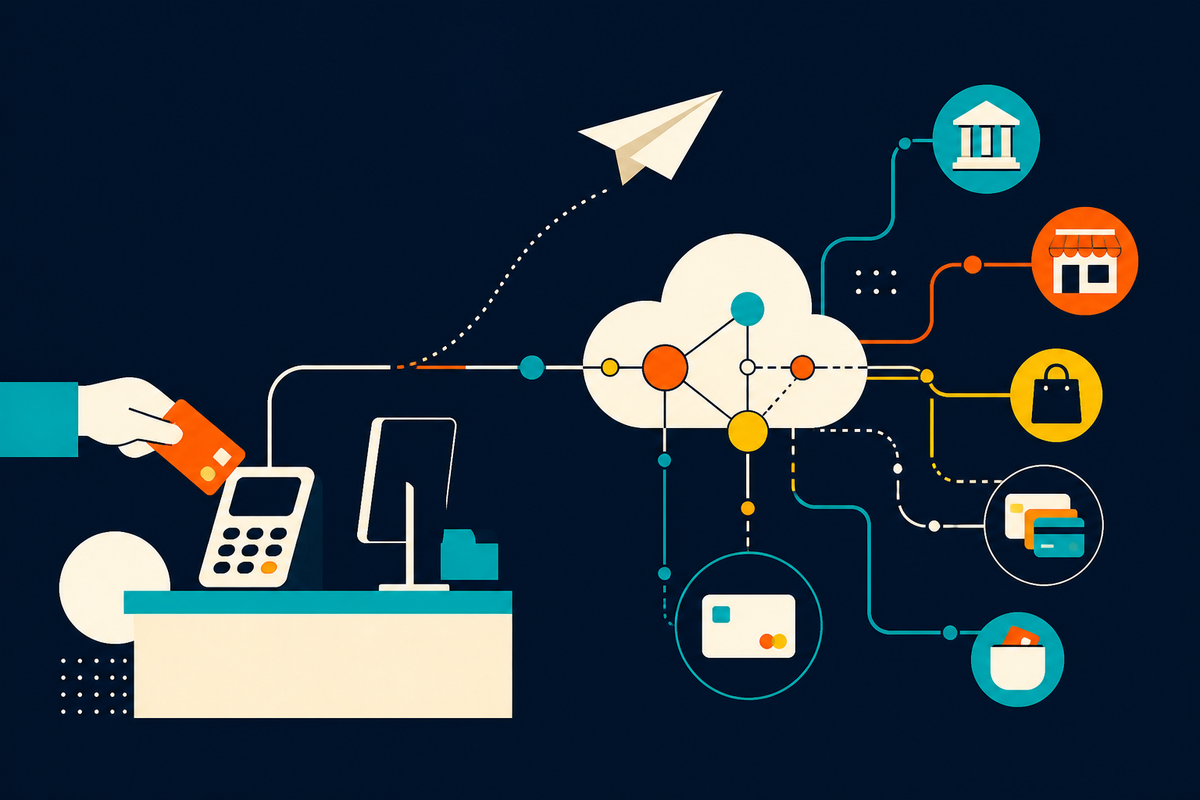
This is why calling Pine Labs a point-of-sale company is accurate in the way that calling a smartphone a telephone is accurate. The terminal remains important - roughly two million of them sat on its network in fiscal 2026 - but it is now one endpoint in a commerce system connecting more than 450 brands and 177 financial institutions.
A laboratory at the petrol pump
Pine Labs was incorporated in 1998. Its early work automated card-based payments and loyalty programs for fuel retailers, an environment where speed, reconciliation and reliability mattered long before “embedded finance” became a conference panel. Founders Lokvir Kapoor, Rajul Garg and Tarun Upadhyay had found a useful wedge: a narrow transaction workflow repeated at high frequency.
In 2005, the company launched Plutus, its credit- and debit-card acceptance platform. But Plutus did more than move money. It could carry equal monthly installments, loyalty benefits and promotions at the point of sale. That detail became the template for Pine Labs. Payment acceptance created distribution; distribution made it possible to place another product in the transaction.
PayLater followed in 2013, then PinePerks for rewards and gifting in 2014. Malaysia became the first international market in 2017. The acquisition of Qwikcilver in 2019 added a large prepaid and gift-card engine. Later purchases brought Fave's Southeast Asian loyalty and cashback network, Mosambee's payment acceptance, QFix's education payments and Setu's API-based financial infrastructure.
Inside the company, that appetite for adjacent moves is expressed in unusually brisk language. Pine Labs calls its culture “Every Day is Game Day.” Its published values include “Take the shot,” “Own tomorrow,” “Be the sherpa” and “Sign your work like an artist.” Read together, they ask employees to decide quickly, take responsibility, guide colleagues and care about craft. The sporting metaphor can sound intense, but it matches the operating problem: payments teams must move fast without being casual about money. A failed experiment in a social app may lose attention. A failed experiment at checkout can strand a customer and a merchant at the same time.
“We are not just processing payments. We are building the infrastructure layer that merchants, financial institutions, and brands will rely on to grow.”Amrish Rau, chief executive, May 202602 / What customers buy
One counter, several businesses
For a small merchant, Pine Labs can be the machine on the counter, the settlement view and a route to offer installments without becoming a lender. For a large retailer, it can join the billing system to payment acceptance, promotions and loyalty. An e-commerce company can use Pine Labs Online for cards, UPI, net banking, wallets, subscriptions or cross-border payments. A brand can issue gift cards or run cashback campaigns. A bank can use its software for merchant acquiring or card processing.
The customer is almost always a business, even when the consumer sees the result. Pine Labs sits between parties with different incentives. The shopper wants choice and certainty. The merchant wants conversion and fast settlement. The bank wants compliant processing and controlled credit. The brand wants a promotion that can be measured. The platform's job is to make those interests agree before the person at the counter becomes impatient.
That solves several stubborn problems at once: fragmented payment methods, difficult integrations, manual reconciliation, expensive customer acquisition and limited access to credit at the moment of purchase. It also lets financial institutions reach merchants without deploying every terminal and workflow themselves.
Payments are the road, not the tollbooth
Pine Labs makes money in several ways: transaction-linked and processing fees, software and platform charges, terminal deployment and related services, prepaid and issuing program fees, and value-added products such as affordability, loyalty and analytics. That variety matters because plain payment processing is competitive and often thin-margin. The more useful services that travel through the same connection, the more valuable the relationship can become.
Management calls the architecture a Commerce Operating System. The phrase is grander than a card reader, but the logic is practical. Distribution creates transaction volume. Volume produces data. Data can improve risk decisions, promotions and merchant tools. Better tools make the platform harder to replace and create more surfaces from which to earn revenue.
The fiscal 2026 numbers show both the promise and the work left to do. Gross transaction value grew 50 percent to $194 billion while revenue rose 19 percent to INR 2,711 crore. Adjusted EBITDA reached INR 559 crore. Pine Labs posted INR 113 crore in profit after tax, its first profitable full year, reversing a loss of INR 145 crore the year before.
Faster transaction growth than revenue growth can mean pricing pressure or mix shifts, but management frames it as unused monetization capacity. In plainer language: more traffic is moving down the road than Pine Labs is currently charging for. Turning that traffic into durable, higher-value services is the public company's central assignment.
Broad enough to be awkward to compare
Pine Labs meets different competitors on different floors. Razorpay, PayU, Cashfree and Paytm overlap in online checkout or merchant payments. Worldline, Fiserv and Network International overlap in acquiring and processing. Prepaid and expense platforms contest brand programs. Banks can build portions of the plumbing internally.
Its differentiation is the combination. Pine Labs has a substantial physical acceptance footprint, an online gateway, checkout affordability, prepaid issuing and bank-grade processing. A merchant can begin with acceptance, while a financial institution can begin with infrastructure. Both can meet in the services above the transaction.
That breadth also creates risk. A wide product map can become a collection of integrations rather than a coherent platform. Acquisitions have to share data, sales motion and engineering. International markets carry different payment habits and regulation. And the terminal network, while valuable, brings hardware and operating costs that a purely online gateway avoids.
Pine Labs is trying to make more of its international work asset-light. It points to technology-led acquiring arrangements with Emirates NBD in the Gulf, CIMB in Malaysia and GCash in the Philippines. International revenue passed INR 400 crore in FY2026 and represented about 15 percent of the total, up from 9 percent three years earlier.
05 / What comes nextThe checkout learns to act
The company's newest products move beyond the familiar tap. Credit+ gives financial institutions issuing and acquiring processing across cards and merchants. Setu adds identity, bill-pay and account-aggregation rails. The 2026 acquisition of Shopflo brings a direct-to-consumer checkout product closer to Pine Labs Online.
Then there is P3P, Pine Labs' protocol for payments initiated by AI agents. It uses standard web requests, pre-approved spending mandates and verifiable receipts. The current rails include UPI ReservePay and one-time mandates; cards and stablecoins are described as future scope. The immediate market is young, but the strategic idea is consistent with the company's history: get close to a new kind of checkout before it becomes ordinary.
Pine Labs reached public markets by a circuitous route. It confidentially filed for a US listing in 2022, reorganized its corporate structure back toward India, and finally listed on the NSE and BSE in November 2025. The IPO's roughly $2.9 billion pre-money valuation was well below the little-over-$5-billion value attached to its last private round. Public investors received a less romantic price and a clearer test.
The test is whether Pine Labs can turn its range into compounding advantage. Two million terminals are impressive; two million places to distribute the next useful service are more interesting. The company began by making a fuel payment behave. Its future depends on making a sprawling commerce network feel just as boring - quick, reliable and barely noticed by the person paying.
The terminal was the beachhead. The product is everything useful that can happen because the terminal is already there.Explore
See the machinery yourself
Pine Labs publishes product documentation for online payments and its newer agent-payment tools, plus company updates and investor filings. Its official channels also carry product walkthroughs and interviews.