Imagine the least dramatic moment in commerce. A customer pays an invoice. The card is approved. Somewhere, a balance has changed. Yet the person responsible for the accounts may still have to find the transaction, match it to the invoice, and tell another piece of software what just happened. The money has moved. The work has merely changed desks.
This is the territory occupied by EBizCharge. Its proposition is wonderfully unromantic: put payment processing inside the business software that already knows who owes what. If an invoice lives in an accounting system, why should collecting it require an expedition elsewhere?
- What it does: connects card and ACH/eCheck payments to existing business systems.
- Who cares: finance teams dealing with invoices, repeat customers, and manual payment entry.
- What to check: your exact software version, the complete processing quote, and where the payment posts.
The ledger has not heard the news
There are two questions hiding inside “Did we get paid?” One concerns the transaction. The other concerns the books. A successful authorization answers the first; it does not, by itself, settle the second. Cash application is the prosaic name for applying received money to the right customer and invoice. It is the sort of task that becomes visible chiefly when somebody gets it wrong.
EBizCharge sells payment acceptance and the connection around it. Its catalogue includes integrations for QuickBooks, NetSuite, Sage, Acumatica, Microsoft Dynamics, SAP, and Salesforce, alongside eCommerce systems. The company advertises more than 100 business-system integrations. The point is to let staff act on the invoice where it was created, with payment information flowing back into that system.
That makes its natural audience less a particular industry than a particular kind of office. Manufacturers, distributors, and service firms can all have the same difficulty: the sale, the payment, and the accounting record inhabit different places. EBizCharge’s named customer stories range from a technology reseller to a manufacturer. Their shared characteristic is an existing business system that needs to participate in collecting money.
The processor that hired developers
The company’s history begins with merchant services in 2004. In Century Business Solutions’ account of its evolution, customers kept encountering inefficiency between accepting credit cards and recording the result. The business hired software developers to connect those activities. The resulting integration was called EBizCharge.
It is an instructive origin because the observation came from an adjacent job. A processor could compete over rates and support. It could also notice the work its customers performed around each transaction. EBizCharge pursued the latter as well, becoming a software developer alongside a payment processor. A rebranding effort started in 2018 brought the product name to the front.
Today, its commercial identity still reflects both jobs. The pricing page describes payment processing as the core business, with features and integrations included in most merchant accounts. A prospective customer asks for a quote. The software is therefore also a reason to choose the processor that supplies it. This is a different buying conversation from selecting an isolated invoice app.
Five days, and fewer telephone calls
Queue Associates makes the mechanism tangible. In EBizCharge’s customer account, the technology reseller was waiting roughly 45 days for invoice payments and spending up to six hours a week on manual collection. It added a prebuilt payment module to Microsoft Dynamics SL. Staff could then run a transaction from an invoice or send an email payment link.
The published result was a reduction to about five days and the removal of manual phone follow-ups. Jeffrey Goldstein’s succinct assessment: “Now that average is down to 5 days.” It is a customer-reported outcome, rather than an experiment that predicts every buyer’s results.
Still, the intervention is worth examining. The invoice gained a convenient way to pay, and the team gained a way to collect inside its existing system. For anyone studying a sluggish collections process, that suggests a useful question: which delay comes from the customer’s unwillingness to pay, and which comes from the arrangements required to do it?
The card details leave the filing cabinet
Auburn Manufacturing’s problem was different. According to EBizCharge’s account, repeat customers did not produce an easy repeat-payment process. Staff had to locate manually stored payment details outside the payment system. EBizCharge’s Macola integration introduced saved cards connected to customer profiles, with data held off-site.
“We don’t have to store the credit card information ourselves.”
Joy Campbell / Auburn Manufacturing
That is a modest sentence with a great deal inside it. The employee can find the customer’s payment method without the old search. The business also changes where sensitive data resides. EBizCharge describes tokenization and encryption as parts of its security approach: a token stands in for the card details used in subsequent payment activity.
Security belongs in the workflow conversation because convenience can otherwise encourage bad habits. Saving a reusable payment method and circulating raw card details are very different arrangements. For a buyer, the useful demonstration is what an ordinary employee can see, retrieve, and use, and what remains in the provider’s storage.
An invoice gets a doorbell
The customer-facing tools extend the same idea. Payment Links and Email Pay put an action alongside the request for money. The customer opens a link and pays; supported integrations synchronize the payment with the outstanding invoice. The customer payment portal adds a place to view open invoices and history, manage payment methods, and pay without arranging a telephone conversation.
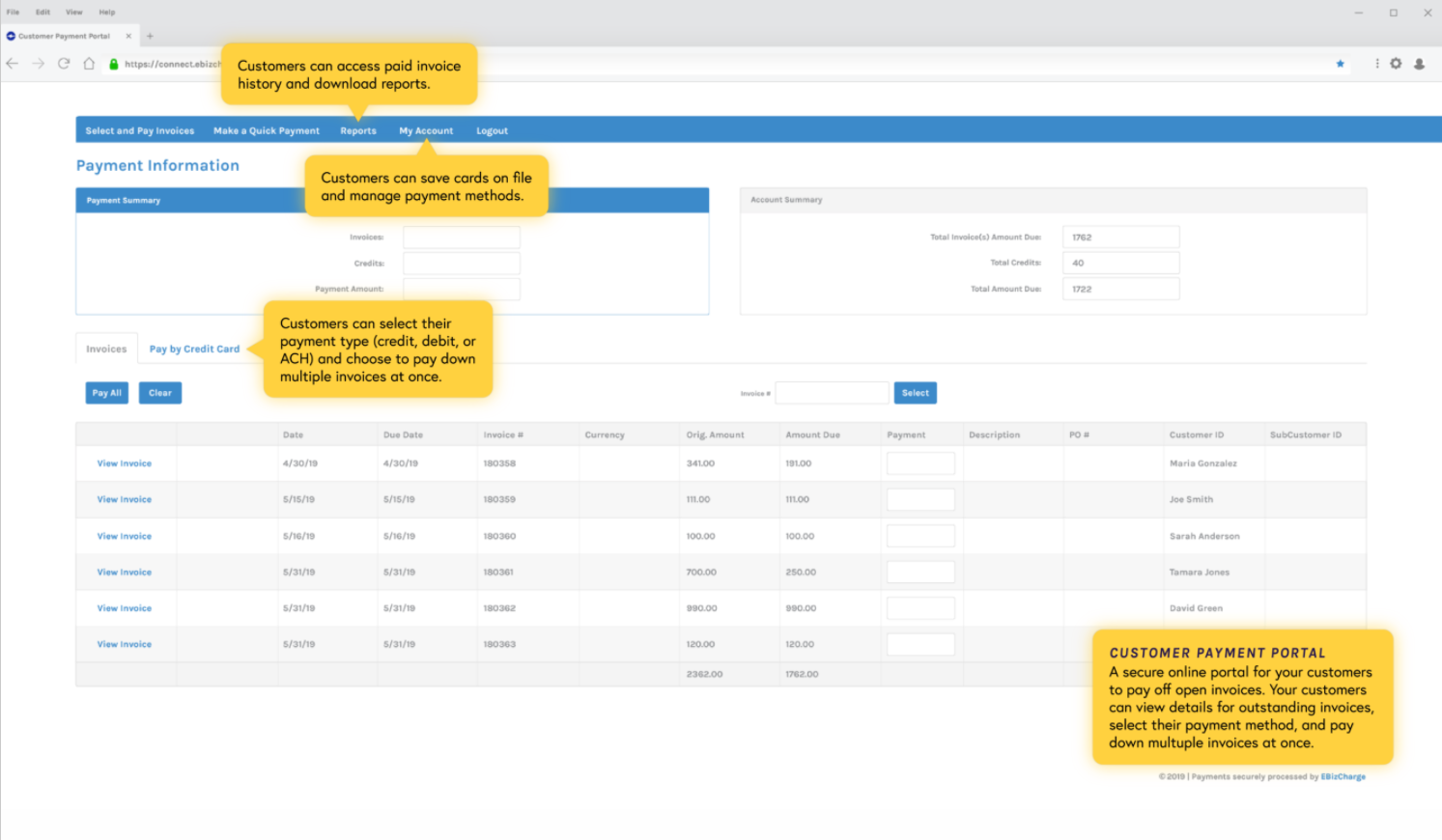
Billing tools handle repetition in two distinct ways. Recurring Billing schedules repeated charges, such as a subscription or installments. Auto Pay collects outstanding payments at the end of a payment cycle. One repeats an arrangement; the other deals with the balance that has accumulated. Choosing between them starts with how the business actually bills.
Virtual terminals, mobile payments, and EMV devices cover other places a transaction can originate. The underlying attraction is continuity: whichever channel collects the money should leave the accounting team with a usable record. A catalogue of ways to pay is helpful only if those ways connect to the work that follows.
The small print is part of the product
Cost has two ledgers of its own. There is the processing bill, and there is the staff time surrounding each payment. EBizCharge advertises flat-rate options and complimentary support. Its onboarding page advertises zero setup costs and qualifying integrations at no charge. The homepage’s zero-cancellation-cost offer explicitly excludes Canadian merchants.
A buyer can make the comparison concrete by asking for a quote against actual volume, transaction sizes, and payment methods. Then add the time spent requesting, entering, and matching payments. This is an evaluation method, not a promise of savings. A rate difference and a workflow improvement need to be measured together.
Compatibility deserves equal billing. Front of the House’s customer story describes a payment solution that did not keep pace with an upgraded SAP Business One system. That was the practical failure: the business software moved forward while the payment connection lagged. It turned to EBizCharge for a compatible integration and a different pricing arrangement.
Acumatica’s own marketplace lists EBizCharge as a native payment application maintained by in-house developers, with in-house support. This is relevant expertise: knowing the accounting system as well as the transaction. Yet “integrates with” should begin a buyer’s investigation. The exact version, required functions, and planned upgrades determine whether a connection is useful.
Stripe, Square, and PayPal are familiar payment alternatives; ERP-focused providers such as REPAY and Fortis also compete for connected workflows. EBizCharge’s case rests on the depth of the particular integration a business needs. If an existing processor already handles its invoices and accounting satisfactorily, the incremental benefit may be small. If customers pay late because they dispute the work or lack the money, a more convenient link does not resolve that problem.
Copy the handoff, then count the work
The useful lesson travels beyond the product. Take one real invoice and follow it until both the money and the books agree. Count the systems opened, the numbers typed twice, and the people contacted. Then ask a prospective provider to demonstrate that same journey, including the exceptions. The demonstration should end at the accounting record.

EBizCharge continues to add connections. It announced integrations for Infor CloudSuite Distribution and Industrial in January 2026. In August, it reported an eighth Inc. 5000 appearance and 58% revenue growth over 2022-2025. These are signs of an expanding business; the test for an individual customer remains narrower and more useful.
When a customer says “paid,” how much work is left? EBizCharge has chosen to sell an answer to that question. For an accounting team, a successful transaction is pleasant news. A transaction that arrives attached to the right invoice is news it can finally put away.