A card payment is a tiny stage trick. The customer taps plastic. A light turns green. Money travels through a thicket of software, banks, networks, rules and fees. When it works, nobody applauds. When it fails, everybody looks at the business whose name is on the screen. Basys has spent nearly a quarter-century building a company around that awkward fact.
The privately held payments company was founded in 2002 by Brad Oddo in the Kansas City area. Kenny Thompson, now an executive vice president, once described the early work with charming bluntness: the team was “slinging credit card processing machines.” Basys still supplies countertop and mobile hardware, but the center of gravity has shifted. It now offers merchant processing, an in-house gateway called iQ Pro+, embedded-payment APIs, bank programs, virtual terminals, invoicing, recurring billing, reporting and the humans required to keep those pieces talking.
That last item is the pitch hiding in plain sight. Basys says 99 percent of support calls are answered within three rings and 90 percent of problems are resolved on first contact. Those are company-reported figures, but they explain the strategy better than a feature list. In a market where processors can look interchangeable, the company has made “someone picks up” part of the product.
The product is the plumbing - and the plumber
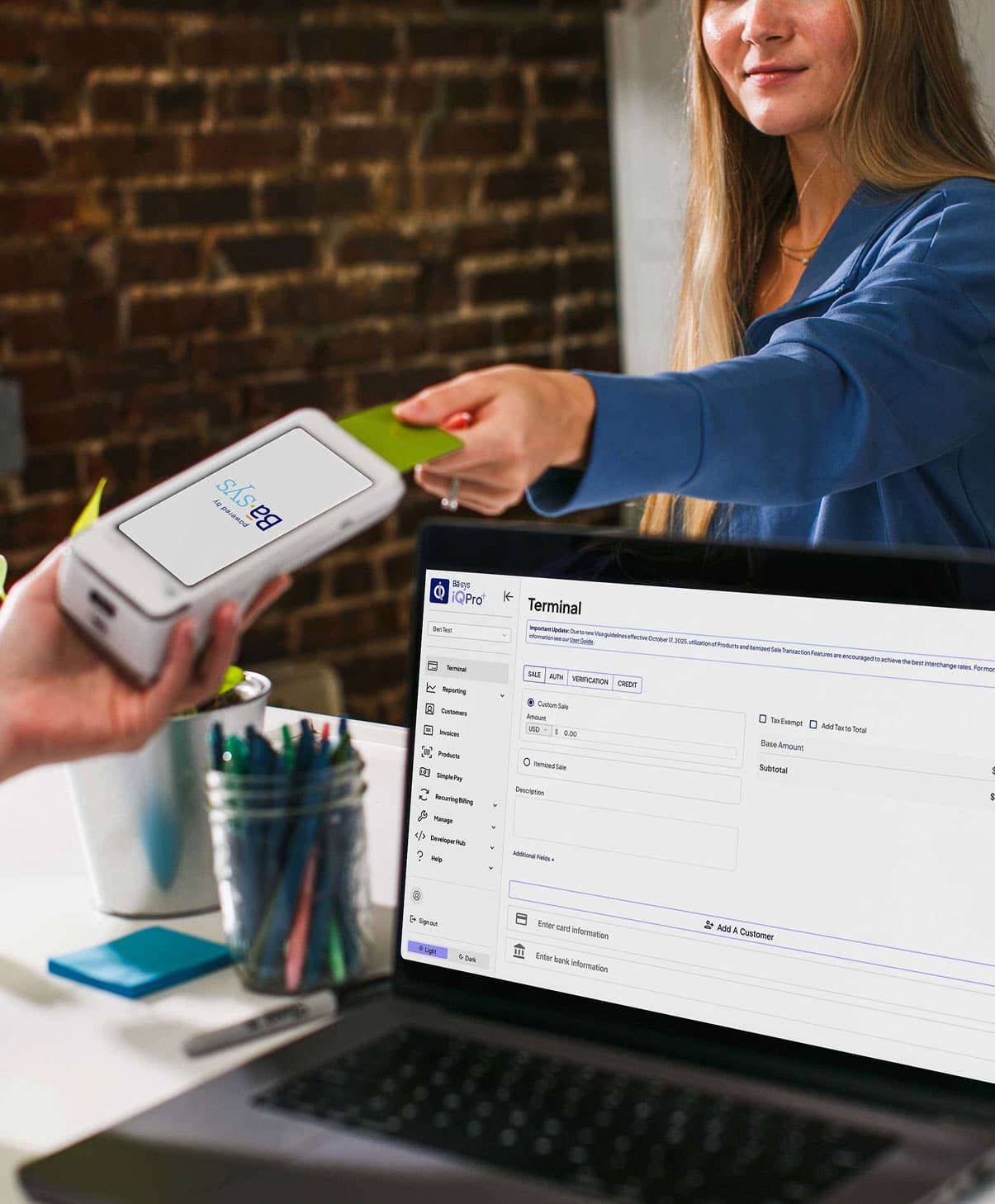
iQ Pro+ is the control room. A merchant can take payments in person, online or on a phone; send digital invoices; schedule recurring billing; save customer details; and track transactions, batches and funding. For software teams, Basys exposes tokenization, webhooks and transaction APIs. Hosted payment fields keep sensitive card data away from a partner’s own servers, reducing the amount of PCI work the partner must shoulder.
This is not merely a gateway with a logo pasted on it. Basys owns and supports iQ Pro+, which gives it room to alter a workflow when a vertical software company has peculiar needs. Construction billing does not behave like a dental office. A community bank cares about its business customer’s experience and the resulting non-interest income. A field-service technician needs to invoice at the job site. The infrastructure is shared; the last mile is not.
The 2026 product work makes that vertical bet visible. An Epic integration puts card, ACH and recurring patient payments inside healthcare workflows, then sends reconciliation data back without another portal. An enhanced mobile app lets service crews collect at the job site while the office sees the same transaction record. Neither feature reinvents money. Both remove the swivel-chair work of copying a payment from one system into another - exactly the sort of small administrative irritation that becomes expensive at scale.
Fit the workflow
Basys works with the software team on APIs, tokenization and the screens its users already inhabit.
Move the money
iQ Pro+ handles cards, ACH, invoices, recurring billing, transaction data and reconciliation.
Own the aftermath
The processor supports onboarding and end users, while the platform can share in transaction revenue.
The weak link changed their minds
The useful version of the Basys story appears in its partnerships. Foundation Software already had credibility with construction businesses. Payments were the loose floorboard. When a processor caused friction, contractors did not distinguish the vendor from Foundation’s platform. They simply saw software that did not quite understand their work.
A generic plug-in was unlikely to repair that perception. Basys worked with Foundation’s developers, adjusted the integration around contractor workflows and iterated from user feedback. Foundation executive Brian Cancian put the unusual part succinctly: “Not many processors want to jump through hoops to build custom integrations. Basys did - and they nailed it.”
“Payments should support growth, not generate support tickets.”The practical lesson in the Foundation case
The published outcome is unusually specific: a 40 percent reduction in service load, 155 percent more accounts onboarded, 48 percent faster access to funds and 92 percent account retention. Those figures come from a Basys case study, so they should be read as a successful customer example rather than a universal forecast. Still, they identify what failed first - not settlement technology in the abstract, but the relationship between the payment tool and the daily job.
What changed at Foundation
Different measures, normalized for display. Results reported in the Foundation Software case study.
BayCoast Bank faced a different version of the same embarrassment. Its merchant-services provider delivered inconsistent responses, opaque pricing and slow support. Because the merchants were also banking customers, every bad interaction landed on BayCoast’s reputation. The bank changed partners when payments stopped meeting the service standard of the rest of the institution.
After the Basys program moved beyond onboarding, BayCoast reported three times as many active merchant accounts, five times the processing volume, three times the revenue contribution and roughly 90 percent annual retention. The mechanism matters more than the victory lap: direct access to support gave bank employees enough confidence to discuss merchant services with customers. A neglected add-on became something they were willing to sell.
What it costs, without the teaser rate
Basys does not post one clean processing price, because card type, acceptance method, transaction size, equipment and interchange qualification alter the bill. It asks a prospect for current merchant statements, compares the programs line by line and estimates what the same month would have cost on Basys. That makes comparison slower than clicking “start” on a flat-rate account, but more honest for a business with enough volume and complexity.
The company says that among businesses processing at least $10,000 a month that switched from a range of providers, 80 percent saved money, with average savings of $182.39 a month. Its live pricing page also displays changing snapshot figures from recent account reviews, so buyers should insist on their own calculation. The price of an embedded partnership is likewise custom. Revenue share, implementation effort, devices, risk profile and support scope all move the economics.
Copy this, not the slogan
Ask for the ugly artifact before quoting the elegant solution. Basys uses the merchant statement. Your version might be a support log, reconciliation file or failed onboarding funnel. Price and design against observed behavior, not the buyer’s memory of it.
A quiet position in a loud market
Stripe and Square made payments accessible through self-service software. Adyen sells global scale. Fiserv, Worldpay and Global Payments bring enormous acquiring footprints. Basys occupies a narrower middle: U.S. businesses and platforms that are large or specialized enough to need a tailored setup, but still want a processor to behave like a reachable partner.
Its business model follows that position. Basys earns revenue as transactions move through merchant accounts and as customers use related payment services. Software companies, banks and associations can receive a share of processing revenue tied to the merchants they bring into the network. The bargain is straightforward: the partner gets an income stream and a more native product; Basys gets durable distribution and transaction volume.
Private ownership helps the company tell a long-horizon story. It has disclosed no institutional funding and says it has had consistent ownership for more than two decades. The tradeoff is that it cannot wave around the international coverage or developer mindshare of the largest platforms. Its evidence lives in retention, support and particular integrations rather than ubiquity.
Where it fits
- U.S.-focused software with a vertical workflow
- Banks protecting customer relationships
- Merchants with enough volume to analyze
- Teams that value guided onboarding
Where it may not
- A tiny seller wanting instant self-service
- A global platform needing broad local acquiring
- A team unwilling to maintain an integration
- A buyer choosing solely on one headline rate
The playbook worth stealing
First, find the customer’s reputational weak spot. Foundation’s users blamed the software for payment trouble; BayCoast’s customers blamed the bank. Second, own enough of the product to fix the weak spot. Basys can alter its gateway and APIs instead of filing a request with an anonymous vendor. Third, take responsibility after launch. The support call is not an unfortunate cost sitting beside the product. It is where the product proves itself.
Finally, align the money with continued use. Revenue share can make a software company care about adoption long after the integration announcement. But this only works when the payment flow is frequent, the partner has distribution and both sides are clear about onboarding, risk and support. A beautiful API cannot rescue thin volume. A generous split cannot rescue a confusing checkout. Custom work becomes an anchor if every new customer demands a different product.
Basys is not trying to make payments thrilling. That would be suspicious. It is trying to make them uneventful for the person paying, useful for the software or bank distributing them, and legible to the operator reconciling them. The amusing truth is that the company’s human touch depends on a great deal of machinery. The sharper truth is that all that machinery earns trust only when somebody answers the phone.