A shopper taps a phone at a market stall. A driver feeds a parking machine. A subscriber's card renews in the background. The visible names belong to the merchant, an app or a payment company. Somewhere underneath, NMI may be doing the quiet work of turning that gesture into an authorized transaction. The arrangement captures the company's unusual position in fintech: it is large enough to move close to $700 billion in annual transaction volume, yet designed to disappear.
NMI does not court shoppers, and it says it does not recruit the merchants served by its partners. Its direct customers are the companies one layer up - independent sales organizations, payment facilitators, banks and software platforms that want payments inside their own products. NMI supplies the gateway, connections, onboarding, risk controls and management tools. The partner supplies the brand and the merchant relationship. For a vertical-software company serving dentists, gyms or repair shops, this can turn checkout from a necessary integration into a recurring revenue line.
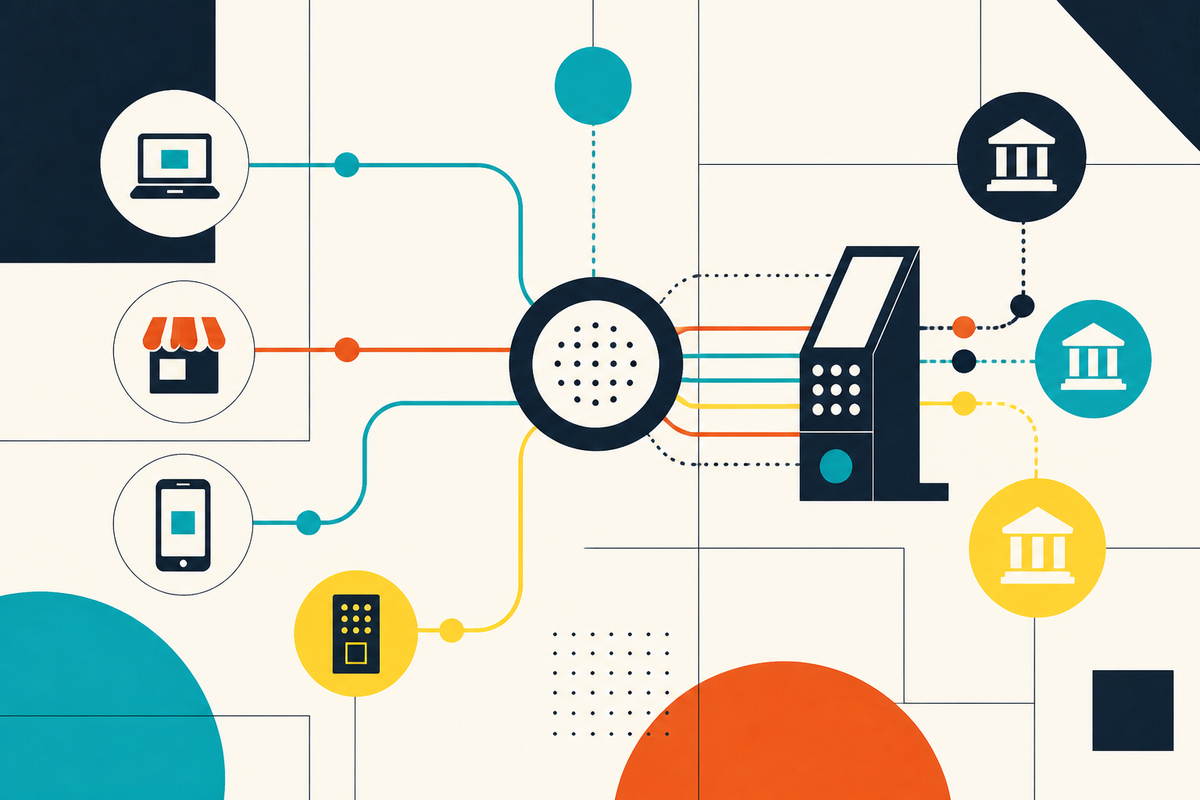
Invisibility, sold as a feature
Many payment companies want their name on the button. NMI's white-label model lets its customer put another name there. That distinction is more than cosmetic. An ISO can offer a branded gateway without maintaining processor integrations and security certifications itself. A SaaS company can embed a payment form, merchant application or reporting portal without making customers feel as if they have been handed to a third party. A bank can extend its merchant-services suite while keeping its institution at the center.
The problem NMI solves is not merely accepting a card. Modern payment acceptance is a chain of chores: qualify a merchant, collect documents, evaluate risk, connect an acquirer, secure card data, route a transaction, support a terminal, reconcile activity, calculate a sales agent's residuals and move funds. Each handoff can add another login, vendor and failure point. NMI has spent the past decade pulling more of those chores into one modular system.
Scale gives that backstage role weight. At the start of 2026, NMI said it had powered $502 billion in 2025 payment volume, 6.5 billion annual transactions, more than 1.2 million active merchants and roughly 235,000 connected devices. The May acquisition of account-to-account specialist Dwolla pushed the combined volume close to $700 billion. Those figures are company-reported, but they reveal the shape of the business: millions of small payment moments aggregated behind thousands of distributors.
“Every partner has a different roadmap.”NMI's explanation of its modular approach
A kit, not a concrete block
NMI's favorite nouns are “modularity,” “flexibility” and “choice.” In practice, that means a customer can begin with the gateway, use one of several integration styles and add other pieces as its payment strategy matures. Hosted checkout keeps sensitive data away from a small developer's servers. Embedded components allow more control over appearance. APIs and SDKs give a larger platform deeper command. On the acquiring side, NMI can support merchant decisioning, boarding and revenue sharing without requiring every partner to assume the full operational burden of becoming a payment facilitator.
The partner-branded payment journey
Gateway
Online, in-app, mobile, in-store and unattended acceptance, with tokenization, reporting and connections across processors, carts and devices.
Merchant Central
A payments-specific CRM for leads, boarding, support, portfolio reporting and the residual calculations that compensate sales channels.
Risk + onboarding
Automated underwriting, statement analysis, identity and compliance workflows help partners move a merchant from application to approval.
Tap to Pay
Apps and SDKs turn supported Android devices and iPhones into contactless acceptance points, reducing the need for a separate reader.
Business Capital
Parafin-powered financing appears inside the merchant portal, while partners can earn commission without underwriting or servicing loans.
A2A money movement
Dwolla adds ACH, real-time payments, FedNow, open-banking connections and programmable payouts to NMI's card-heavy foundation.
That breadth creates a different competitive argument from the all-in-one processor. Stripe Connect, Adyen, Finix, Stax Connect and Worldpay each cover parts of the platform-payments market; Authorize.net and Braintree are familiar gateway alternatives; Spreedly emphasizes orchestration. NMI's case rests on channel loyalty and optionality. A partner can keep its brand, connect to many processors and devices, and add modules without accepting one rigid configuration. Choice, however, is not free: more possible arrangements can mean more decisions, integration work and commercial negotiation than a standardized out-of-the-box stack.
The gateway that kept acquiring rooms
Founded as Network Merchants in the Chicago area in 2001, NMI began in ecommerce gateway software. Its present form was assembled through investment and acquisitions. Francisco Partners acquired the business in 2017. Creditcall arrived in 2018, adding EMV, contactless and unattended expertise. Great Hill Partners invested, followed by Insight Partners in 2021. That same year, NMI added USAePay's omnichannel gateway. In 2022, IRIS CRM and Agreement Express payment technology extended the company into merchant relationship management, automated underwriting and risk monitoring.
Annual volume, company reported
The purchases follow a clear workflow rather than a collection of fashionable features. The gateway sits in the middle. CRM and underwriting move earlier, toward merchant acquisition. Devices and Tap to Pay widen the acceptance edge. Reporting, residuals and support deepen merchant management. Dwolla moves later and sideways, into bank rails and payouts. Business Capital, launched in late 2025 with Parafin, uses payment history to place pre-approved financing inside the portal. NMI is gradually covering the path from “I want to take payments” to “I need to move and use the money.”
Hardware returns, wearing Android
The company's July 2026 AXIUM SmartPOS launch is a useful example of how physical commerce now behaves like software. Ingenico provides payment-grade Android hardware. NMI adds the gateway, SDK, remote fleet management, certifications and deployment architecture. Partners can put their own application on countertop, portable or field-service devices while retaining processor flexibility. A restaurant system might combine ordering and checkout; a service technician might invoice and tap a card at the customer's home; a kiosk operator can link a terminal to unattended workflows.
NMI had already been pushing in the opposite hardware direction: making the terminal vanish. Its Mastercard-powered Tap to Pay options let supported phones accept contactless cards and wallets. The Android app favors quick deployment; SDKs on Android and iPhone let software companies put acceptance inside their own apps. Both strategies serve the same principle. Whether the merchant needs a managed smart terminal or no extra device at all, the partner should control the experience.
“Today, every merchant has a payment terminal right there in their pocket.”Tiffany Johnson, NMI chief product officer
Who wins when the plumbing works?
For a software company, embedded payments can increase revenue per customer and make the product harder to replace. For an ISO, a modern gateway and merchant portal can refresh an offering without abandoning processor relationships. For a bank, NMI can fill gaps between merchant onboarding, acceptance and reporting. The end merchant gets fewer systems to reconcile and more ways to be paid: card, bank, token, wallet, online, at a counter, through a phone or at an unattended machine.
The risks are familiar to infrastructure businesses. NMI operates in a regulated, security-sensitive market where reliability is noticed mainly when it fails. Large processors can bundle aggressively. Developer-first challengers can simplify onboarding. Partners may want freedom but still demand a single accountable vendor. NMI must keep broad compatibility from turning into a maze, and acquisitions must become a coherent product rather than a row of logos.
Steve Pinado, who became chief executive in September 2025, inherited both the opportunity and the integration job. NMI's stated ambition is to deepen support for SaaS and embedded finance while investing in developer tools and partner enablement. The recent moves fit that brief: bank payments from Dwolla, merchant financing from Parafin, tokens for recurring commerce and Android terminals for in-person software.
The lesson behind the curtain
NMI fits between raw financial rails and the brands that sell payment experiences. It is not simply a gateway anymore, and it is not trying to become the consumer's wallet. Its market is the enabling layer: enough infrastructure to spare a partner years of certification and integration work, delivered with enough restraint that the partner still feels like the owner.
That restraint may be the company's sharpest product decision. White-label software is sometimes dismissed as generic machinery. Here, it becomes a pact: NMI will handle complexity without crowding the storefront. The result is a business that can appear in a parking meter, a subscription renewal and a smart terminal on the same afternoon, leaving almost no calling card. In payments, being forgettable to the shopper can be evidence that everything worked.
Keep exploring
See the platform in its own habitat: product documentation for builders, company updates for the newest rails and demonstrations for the machinery in motion.