A customer taps a card. A receipt appears. For a few seconds, the little machine on the counter looks like the whole payments business. Valor PayTech’s story begins with the people outside that frame: the reseller who supplied the terminal, the developer who connected it, and the person who must answer when it stops working.
- Valor sells payment technology through resellers and software partners, with white-label options.
- Its tools connect countertop, online, and mobile payments with merchant operations.
- Processor choice is central to the pitch; compatibility still needs checking.
- Its next chapter has institutional backing and a broader management team.
The business behind the counter
Consider the payment reseller’s predicament. A merchant wants card acceptance, but also wants invoices, reports, an online checkout, and someone to call. Selling a machine solves only the first conversation. Every additional request risks sending the merchant elsewhere. Valor’s proposition is to give that reseller more reasons to remain useful.
An independent sales organization, or ISO, distributes payment services. An independent software vendor, or ISV, builds business software that may need payments inside it. Valor courts both. The ISO can offer a collection of merchant tools; the ISV can connect its application through APIs and software development kits. Each already has a route to customers.
White labeling makes the arrangement more interesting. A partner can put its own brand on Valor’s products and services. The supplier accepts a quieter role; the partner keeps a more visible relationship. For anyone building a business through intermediaries, this is a useful idea to copy: give the intermediary something worth selling, and room to receive the credit.
Reported alongside nearly 300,000 merchants in the October 2025 investment announcement. A distribution network, not a count of employees.
That puts Valor in a recognizable corner of fintech. NMI also offers a white-label gateway, multiple merchant IDs, and remote device tools. Dejavoo’s iPOSpays offers an omni-commerce gateway. Processor flexibility and branding are therefore buying criteria, rather than inventions exclusive to Valor. Its case rests on the particular combination of terminals, merchant software, integrations, and partner support.
A cloud company goes shopping for chips
There is an agreeable absurdity in the origin story. A company selling cloud-connected payments found itself hunting for physical components. In a public account of the launch, co-founder Eric Bernstein recalled waking at 3 a.m. to bid for parts in Taiwan during the pandemic chip shortage. He described a resale market in which components were both difficult to find and overpriced.
The company’s own timeline places gateway, terminal, and risk-monitoring development in 2019. Bernstein dates the launch to 2020. By 2023, Valor says it had surpassed 100,000 connected devices. These milestones describe different stages: development, arrival in the market, and a growing installed base.
“The only way out is through.”Eric Bernstein, recalling Valor’s early years
His account suggests that access to components was an early constraint. A gateway can exist in the cloud; its countertop endpoint must exist on an actual counter. The transferable lesson is pleasantly concrete: a software promise involving hardware needs a supply plan. A brilliant integration cannot take a card through a terminal that never arrived.
Bernstein later reported more than 350,000 devices across America. Devices are not merchants, and neither figure is company revenue. Keeping those distinctions intact makes the growth story more useful. A merchant may operate several machines; the value passing through them is not the amount their technology supplier earns.
One sale, several ways to finish it
Valor’s gateway connects several ways of accepting money. A shop can use a terminal, a business can take a payment through a browser-based Virtual Terminal, and an online seller can use a shopping-cart integration. Valor advertises integrations for BigCommerce, WooCommerce, Magento, and OpenCart. The attraction is continuity between the channels a business actually uses.
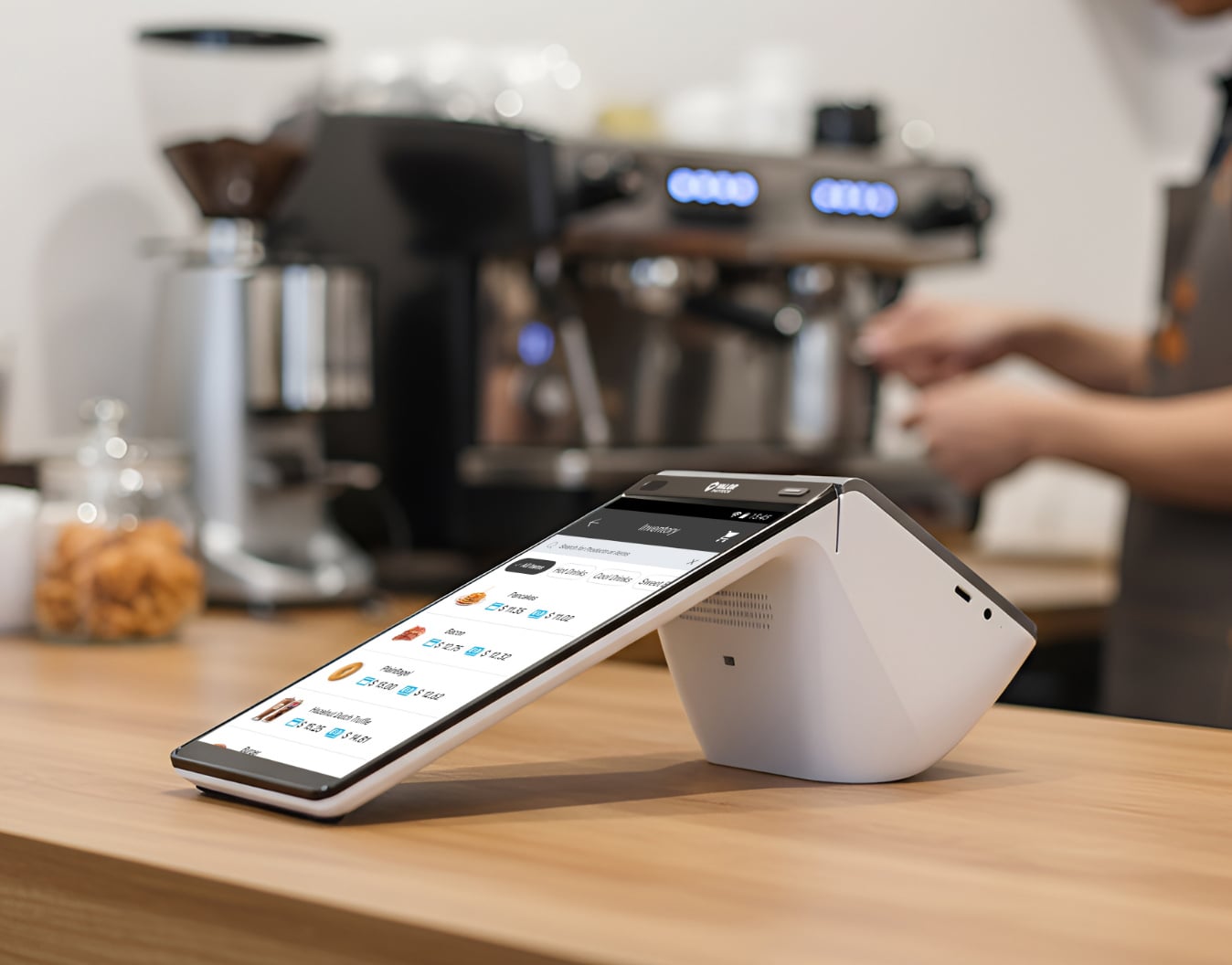
The VP800 makes that division physical. Its customer display supports electronic signatures; its merchant display handles the business side of the interaction. Elsewhere in the range, the pocket-sized RCKT supports mobile EMV acceptance with a PIN pad. Hardware choice follows the setting: a fixed counter and a roaming seller have different needs.
Now imagine a service business finishing a job away from its office. This is an illustrative workflow, rather than a named customer case. Its staff could send an invoice link by text or email through the Virtual Terminal, or present a QR payment code. A sale need not wait for the customer to return to a particular counter.
Web
Mobile
gateway
processor
Reporting and management connect back to merchant and partner tools. The gateway is one part of the route.
Some features address the sale after the first attempt. The Vault stores tokenized payment credentials. Valor Updater refreshes stored card information, useful when a recurring customer’s card details change. Engage My Customer adds email and text marketing based on filters such as visit frequency and spending. Acceptance, maintenance, and follow-up sit close together.
FlexFactor tackles a different interruption: an eligible payment decline. Valor’s published workflow detects supported decline codes and prompts a reroute. An approval produces a receipt; another decline produces a receipt showing both error codes. That last detail matters. The feature offers another attempt, with an explicit failure path.
Decline recovery would be a poor fit if someone expected it to override every rejection. Likewise, automatic card updates address changing credentials, not every reason a subscription payment might fail. The sensible purchasing question is specific: which interruptions does this feature handle in our actual transaction mix?
The price of convenience
Payment costs arrive in layers. A historical reseller sheet from April 2024 listed a VL100 terminal at $312, a VL500 at $516, and Virtual Terminal access at $11.99 a month plus six cents per authorization. Those are dated, channel-specific figures, useful for seeing the structure rather than predicting today’s bill.
Hardware, software access, and usage charges are separate items on that sheet. Processing terms and optional services also need to be understood in a buyer’s actual proposal. Valor’s commercial model combines devices and payment software sold through partners; the public material does not establish a single universal merchant price.
Dual Pricing addresses cost from another direction by displaying cash and card prices. It turns a merchant’s payment-cost decision into a choice visible at checkout. The design question is whether customers understand the two prices before paying. Two screens are useful here, though a screen alone cannot supply a clear pricing policy.
Processor choice deserves equally careful reading. Valor lists connections and certifications involving TSYS, Fiserv, Worldpay, Elavon, and others. Its comparison matrix separates terminals and features. A buyer should check the intended device, transaction type, and processor together. A processor-agnostic platform still operates through particular supported combinations.
The operational tools may be less photogenic than the devices, but they explain the partner pitch. Remote diagnostics, remote rebooting, and remote key injection give partners ways to configure and support deployed hardware. For a reseller managing a portfolio, the ability to resolve a problem from elsewhere can be as consequential as another payment button.
The next job is management
In October 2025, Valor announced its first institutional investment, from funds managed by Lovell Minnick Partners. Subsequent company communications described the transaction as a September 2025 acquisition. The announced purpose included expansion, innovation, and potential acquisitions. A business built through partners was adding a financial partner of its own.
By March 2026, the emphasis had shifted toward management capacity. Valor announced Daniel O’Connell as chief operating officer, Maxim Rokhline as chief product and technology officer, and former Verifone CEO Mike Pulli joining its Board of Managers. Bernstein was moving from daily operations toward strategic advisory work.

The company’s explanation for taking institutional backing was investment in talent, technology, and infrastructure. That is a more useful account of the decision than assuming capital itself solves growth. Supporting a large installed base creates work in product development, logistics, technical support, and coordination. Someone has to own each of those jobs.
There is a quieter glimpse of the organization in its video library: payment tutorials share space with office birthdays, Pongal celebrations, Onam festivities, and an India awards ceremony. These are company-selected scenes, but they reveal the human operations behind a platform whose customers may mostly see screens and receipts.
Valor’s most interesting proposition remains the one outside the photograph. It gives the person selling payments more to sell, and the person supporting them more to work with. The terminal gets its moment on the counter. The relationship has to survive all the moments between transactions.
Take a closer look
Explore Valor’s website, gateway updates, and developer documentation.
Watch the VP800 demonstration, Vault tutorial, or WooCommerce integration walkthrough. Follow LinkedIn, X, Instagram, Facebook, and YouTube.