The till knows something the proprietor may not: which products sell, when the queue arrives and how much money actually changes hands. Epos Now has built a business around putting that knowledge to work. What began as a response to a bar owner’s frustration now reaches beyond ringing up drinks into the financial life of the merchant behind the counter.
That journey has acquired a substantial borrowing facility. In June 2026, Epos Now secured a £55 million revolving credit line from HSBC UK, with a £35 million accordion providing room for additional facilities. The money is intended to support expansion in North America and Europe and investment in AI-powered business management. The headline figure is up to £90 million, combining committed and uncommitted facilities. It is not an equity round or a statement that £90 million has been spent. The deal’s structure matters.
A bar problem with a long receipt
Founder Jacyn Heavens had run a bar with friends and found that they lacked an effective way to monitor till payments. He established Epos Now in Norwich in 2011. His starting point was the shopkeeper’s predicament: useful information existed somewhere inside the business, but getting hold of it was difficult. A 2018 founder profile records that practical origin.
The proposition joined a touchscreen computer to dedicated software at a lower entry price than Heavens had encountered. By 2016, Epos Now appeared in Deloitte’s UK Technology Fast 50, ranked 30th with 597 percent growth. Its AppStore also earned recognition through the Queen’s Award for Enterprise: Innovation. A business that started with the frustrations of one operator was learning to accommodate the differing needs of many.
The company’s American foothold arrived in Orlando in 2015. The local economic partnership describes the attraction: technical graduates, multilingual talent and costs below New York or San Francisco. By its 2020 account, the office had grown from one employee to more than 100. That was a sales, implementation and support base as much as a software outpost. International expansion required people who could help an actual business start trading.
Fish are blue. Reptiles are green.
Today, Epos Now sells a cloud POS platform for retail and hospitality: sales, inventory, employee access, customer records and reporting connected to physical terminals and payment devices. Its customers include independent cafes and shops alongside multi-location operators. The company’s website advertises more than 80,000 business locations. Different company announcements use different counts and definitions; the useful point is its reach across everyday commerce.
Consider Pets Paradise in Fakenham, Norfolk. Owner-manager Siven Cook wanted technology to reduce the workload when he opened in 2021. His team uses a laptop to update stock while the till remains available for sales. Items without barcodes get on-screen buttons. Fish categories are blue; reptiles are green. It is a modest detail, and exactly the kind that makes software usable while someone is waiting with a bag of pet food.
In the company’s customer account, Cook also describes repeat ordering, minimum and maximum stock settings, and loyalty points. These are the mechanisms behind the promise of efficiency. They reduce repeated typing and help staff find the right item. The value depends on doing the initial work: suppliers, categories and stock rules need to be set up before the system can save anyone time.
Across the Atlantic, Cowpens Coffee and Creamery offers a different example. The South Carolina family business chose Epos Now before opening in 2022, after considering Square and Clover. Joyce Stauffer valued the price and round-the-clock support. Jenny used sales trends to help arrange training at quieter times, while reporting helped the family understand popular products and ordering needs. The shop also uses VoucherCart for gift vouchers.

“Just knowing there’s somebody there to help walk us through has really been a peace of mind.”Jenny Stauffer / Cowpens Coffee and Creamery
Jenny describes the reassurance in Epos Now’s published interview. It is a testimonial, not a service guarantee. Still, it explains why a support package can influence a purchasing decision as much as a screen full of features.
The hardware opens the door
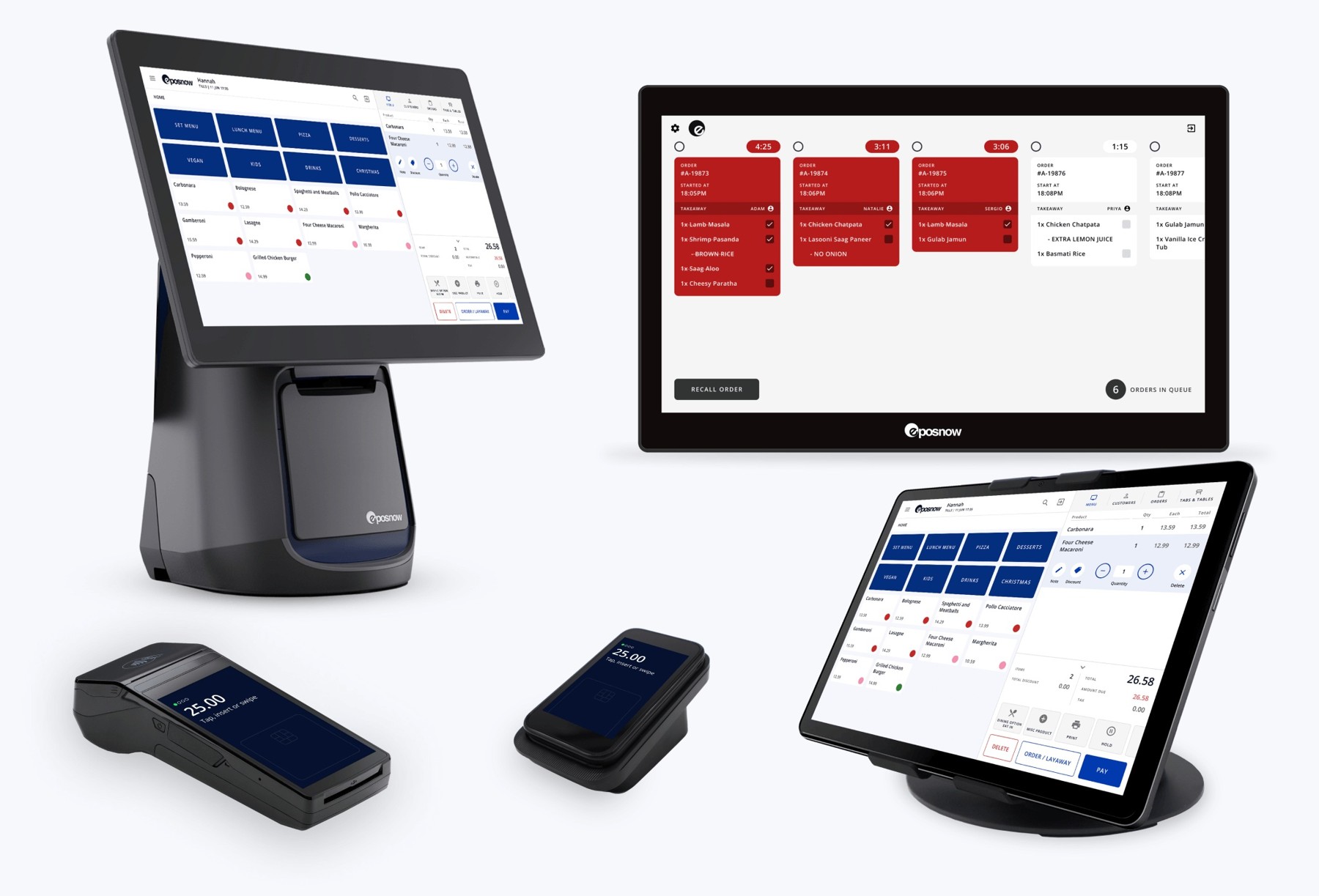
The product range covers countertop tills, printers, scanners and payment machines. Pro+ combines portable payment acceptance and POS functionality; Air is a smaller portable payment device; Link sits at the counter. Enterprise services add centralized oversight for multiple sites. The relevant question is where the transaction happens: at a checkout, beside a table or across several premises.
Software subscriptions, hardware purchases, support, optional apps and payment charges make up the commercial relationship. The US site’s advertised $349 starting hardware offer is therefore only one number in the decision. TechRadar’s reviewed configuration paired that price with subscriptions starting at $79 a month. That example reaches $1,297 across the first year before processing charges, tax or optional extras. Offers and contract terms vary; the signed package determines the bill.
A purchase price has company.
Adjust the assumed monthly fee. Hardware held at $349. Illustration, not a live quote; excludes processing, tax and add-ons.
Integrated payments bring the sale and its payment record together. Epos Now also offers remote payment links, allowing a customer to pay without standing at the counter. The operational appeal is fewer separate records to reconcile. Commercially, payment processing gives the supplier another way to earn revenue as its merchants trade. That helps explain why the terminal is an entry point to a longer relationship.
The financing pilot that changed the plan
The clearest account of a change in direction comes from financing partner YouLend. Epos Now already had a finance provider, but performance fell short of expectations. It considered finding a replacement or building a solution itself. It chose to test YouLend’s white-label offering, aiming to launch quickly without diverting the organization from its core product.
In YouLend’s historical case study, the pilot produced six times the application rate and twice the approval rate of the previous provider. Launch took three weeks. Epos Now then expanded the product across its UK merchant base. Although the page carries a January 2026 date, its account refers to activity in 2022. These are partner-reported pilot results, not a promise about today’s applicant.
The partner-reported change
The lesson is unusually copyable: identify the weak stage, test a different provider, then use measured uptake to decide whether to expand. Epos Now did not need to own the lending machinery to improve the product offered through its software.
Adyen provides another part of the financial infrastructure. Its account of the partnership describes payments, capital, business accounts and card issuing in a single platform, with the full suite operating in the UK. The attraction is distribution: the merchant already uses the software. Introducing a relevant financial service there can be easier than persuading the same owner to establish another provider relationship.
Epos Now Capital uses partners including Adyen and YouLend, with eligibility differing by provider. Repayments are linked to sales, and the company’s documentation distinguishes the funding received, the fee, the total repayment and the percentage withheld from payouts. A deduction that moves with sales can help match cash flow, but it still reduces the money reaching the merchant. Convenience does not remove the need to understand the agreement.
Buy the connection, keep the customer
In December 2024, Epos Now announced its acquisition of Yoello, extending a white-label relationship that began in 2021. Yoello brought mobile ordering and payment technology, including QR-based services and open-banking capabilities. The acquisition followed an existing working relationship with shared merchants. This was a connection the businesses had already tested in use.
Order & Pay shows the customer-facing result: a diner scans a code or follows a link, browses a menu and places an order without downloading an app. Orders for tables, collection or delivery feed into the POS workflow. The app marketplace handles other connections, including accounting and ecommerce. Epos Now’s developer portal offers a REST API for businesses that need custom integrations.
None of this makes cloud POS exclusive territory. Lightspeed also sells connected retail and restaurant systems, and Square and Clover appear in Cowpens’ own buying comparison. Epos Now’s case rests on its particular combination of hardware, integrations, assistance and financial services. A useful comparison needs the merchant’s actual workflow and a complete price, rather than a contest between feature counts.
The same breadth creates conditions for disappointment. A merchant who needs only occasional checkout may have little use for multiple paid connections. A business dependent on a particular app or processor needs that exact arrangement confirmed. Stock reports depend on accurate stock inputs. None of those requirements can be solved by adding another attractive box to a product diagram.
The Canadian launch of Capital in July 2025 shows how the financial offer travels. The company said eligible merchants could receive funding within 48 hours of accepting an offer, with repayments aligned to daily income and capped payback periods. That is a specific service proposition, subject to eligibility, rather than a reason to assume every Canadian customer gets funding. It also broadens what a local POS relationship can include.
For a merchant evaluating the system, a practical demonstration would follow one order through the whole process: sale, stock adjustment, payment record and accounting handoff. Repeat it with a refund and an out-of-stock item. Those ordinary exceptions reveal how much work remains between the connected products.

Epos Now’s published culture prizes speed, merchant results and AI adoption. Its practical challenge is preserving those priorities as the offer grows. The original customer wanted a clearer view of the takings. Every extra product still has to earn its place in that working day.
Take it to the shop floor
Explore Epos Now · Company news · Business guides · Developer tools
Watch: Jacyn Heavens in conversation with the London Stock Exchange · Epos Now videos and product walkthroughs