A search keyword can tell you something about a business. In Omie’s case, it told Marcelo Lombardo that the route to the customer was getting absurdly expensive. He later recalled one keyword rising 37-fold in four months. Imagine paying thirty-seven times as much to knock on the same door. Somewhere, there had to be another entrance.
- Cloud ERP for Brazilian businesses: sales, stock, invoices and money together.
- Accountants help distribute it because organized client records help them, too.
- Subscriptions, local franchises and financial services make up the business.
When the click got too expensive
Lombardo and Rafael Olmos founded Omie in 2013. By Lombardo’s account, more than 90 businesses were chasing similar management problems. Their advertising money met in Google’s auction. He called the phenomenon VC2G: venture capital flowing to Google. The joke contained an uncomfortable business model.
Then he noticed the referrals. Accountants were recommending Omie because the software reduced their own costs. Here was someone who understood the client’s problems, had an existing relationship and stood to gain from the purchase. Omie began speaking directly to accounting offices. The growth insight was hiding in the work the product removed.
“O custo de uma determinada palavra-chave subiu 37 vezes em quatro meses.”
Marcelo Lombardo, speaking to NeoFeed in 2024
That observation makes the company interesting beyond Brazil. A referral channel becomes more persuasive when the referrer receives a practical benefit. In Omie’s case, the same cleaner record can serve the business owner and the accountant. One purchase improves both ends of a recurring handoff.

One sale, fewer loose ends
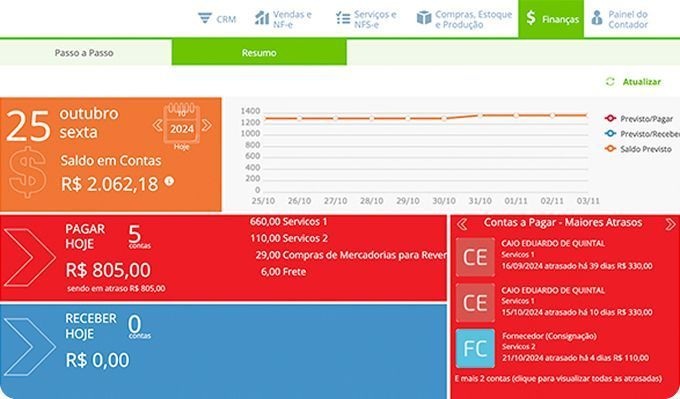
ERP means enterprise resource planning, a grand name for making different parts of a business agree. Omie connects sales, purchases, inventory, production, service contracts, finance and electronic invoices in the cloud. A Brazilian retailer or service company can use the same environment to follow an order, issue its invoice and see what remains to be collected.
The practical enemy is repeated work. A sale recorded in one place, stock adjusted in another and a payment checked elsewhere creates opportunities for disagreement. Connected records give the owner a way to inspect the chain. The accountant can work from organized information rather than reconstructing the month from scattered documents.
Each handoff is a chance to avoid entering the same information again.
The surrounding products extend that chain. Omie.Hub links online stores and marketplaces. Omie.PDV handles retail checkout. Omie.Cash places a business account and collections beside the financial records. Omie.Store supplies extensions; G-Click manages accounting-office tasks. These solve different jobs, so the package deserves a closer look than the word “integrated” alone.
On the pricing page checked in October 2026, ERP Padrão starts at R$309 a month; Multivarejo, which adds checkout and online-channel integration, starts at R$419. Both list unlimited users. Prices depend on the business’s revenue and package. Separate applications and financial-service usage can add charges. Count the workflow you need before counting the seats.
A cloud business with local people
Omie’s current company page reports more than 200,000 customers and more than 25,000 partner accounting offices. Those are company-reported totals, not evidence that every partnership produces the same result. They do show how far the accountant relationship has travelled.
The company also entered franchising in 2015. Software delivered through a browser still has a local sales problem: someone must explain it, help a customer begin and answer questions. A franchise gives that work a geographical address. The system lives in the cloud; the conversation can happen nearby.
Education supplies another piece. Omie Educação advertises more than 60 free courses with certificates. Its published culture emphasizes learning, ownership and execution. For customers, the useful distinction is between possessing a tool and knowing how to manage with it. Training has a job even after the subscription is signed.
In Brazil’s ERP market, Conta Azul also offers cloud management and accountant relationships; Bling connects selling, stock and finance; TOTVS spans broader business operations. Omie’s particular combination brings general business management, financial services, education and local distribution together. The buying question is how well that combination fits the actual business, especially its stock, service and accounting routines.
The customers changed. Then capital did.
In March 2020, the smaller-business sales pipeline weakened. Omie responded by pursuing larger companies, including businesses with annual revenue up to R$200 million. Exame reported adopters including Grupo Doria, Proibida and Sauer. The trade-off was a longer sales cycle. By July, medium and large businesses accounted for 35% of new contracts, against 3% early that year.
The next test came from expensive capital. Omie’s account of its return to breakeven describes a hoped-for expansion in financial services, education and larger clients. Credit operations disappointed as lending to small businesses tightened. The company leaned harder on accountants, franchises, Itaú and digital sales, while slowing acquisitions. The lesson is fairly plain: adjacency does not guarantee demand.
The money needs a footnote
SoftBank led Omie’s R$580 million Series C in 2021. A Partners Group-led transaction announced in September 2025 was reported at R$855 million. Much of the latter involved existing shares changing hands, giving earlier investors partial liquidity. A later closing report described US$160 million and a smaller, undisclosed primary component.
That distinction matters. The headline amount cannot all be treated as a development budget. At the December 2025 closing, reported annual recurring revenue was approximately US$112 million. ARR describes a recurring revenue run rate; it is not the same thing as audited revenue collected over a year.
Start with the handoff
The move to copy is straightforward: find the person who benefits when your customer uses the product well. Ask what repeated task disappears for that person. Omie’s accountant channel suggests a useful test for distribution: shared convenience can support a recommendation more convincingly than a sales pitch alone.
For a prospective user, test a real invoice, an inventory adjustment and a bank reconciliation with the accountant involved. Check the required add-ons and migration work. Specialized operations may need deeper industry functions. A business without reliable connectivity or clean starting records has preparation to do before a cloud ERP becomes useful.
Connections also depend on other companies. In June 2026, Omie announced a temporary pause in one automatic Itaú synchronization method following bank-system changes, pointing customers toward APIs or bank files. That is a practical reminder to check the fallback. The software earns its place when the next handoff still works.