Consider the two people standing on opposite sides of a corner-store checkout. The shopkeeper wants the scanner to recognize the barcode, the price to be right and the payment to clear. The shopper wants to get on with the day. Between them sits a screen. National Retail Solutions has made that small piece of counter space do work for a third participant: a brand hoping to influence what gets bought.
- For the merchant: checkout, payments, stock records and store-management tools.
- For the brand: ads near the purchase and data about independent-store sales.
- The bargain: advertising helps subsidize the merchant’s POS subscription.
- The catch: hardware, processing and extras still belong in the budget.
01A shopkeeper buys a tool. A brand buys a moment.
NRS is a supplier of point-of-sale systems and retailer services. Its home territory is the independent grocery, convenience store, bodega, liquor shop and tobacco seller. These businesses need many of the same capabilities as a chain, with fewer people available to administer them. A computer that rings up purchases can also keep the pricebook, record stock movements and report what sold while the owner was elsewhere.
The customer-facing display creates a second opportunity. It shows transactions and promotions; it can also carry advertising. A national advertiser gets access to shoppers in stores that do not belong to one large retail corporation. The merchant gets a useful machine whose economics have another contributor. NRS explicitly describes advertising as a subsidy for its monthly charges. The inexpensive subscription is part of a larger arrangement.
“customer-facing onscreen advertising to subsidize your costs”
NRS, explaining its subscription economics
02First, earn a place beside the cash drawer
Elie Y. Katz founded NRS in 2015. His company biography describes experience managing food businesses, including bakeries, restaurants and takeout establishments. It is a useful background for this particular problem. Retail software has to survive the indignities of retail: an interrupted transaction, a new cashier, a product without a scannable code. A beautiful dashboard can wait. The customer in the queue cannot.
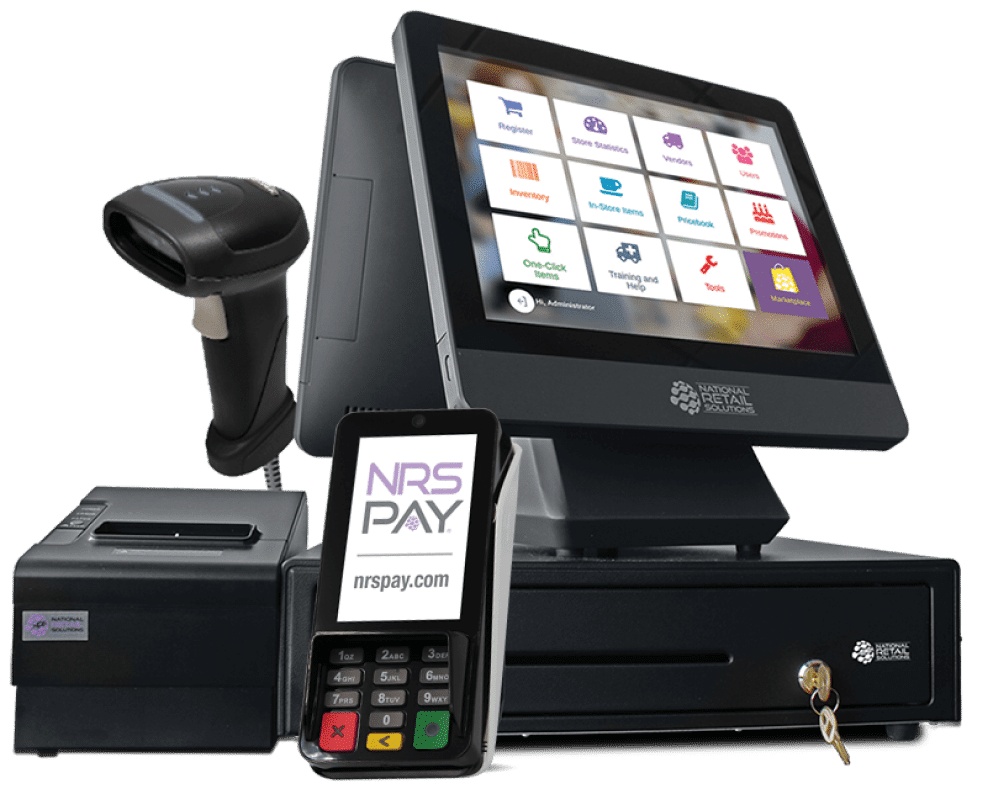
The hardware is familiar: touchscreen, scanner, receipt printer and cash drawer, with a customer display on relevant models. The useful differences emerge in the software. Merchants can set user permissions, create promotions and inspect sales by date. Stock alerts help identify items that need replenishing. Remote access through a portal and mobile app gives the owner a view of the store without requiring a permanent seat behind the register.
Some details tell you whom the product is built for. The FAQ advertises support in English, Spanish and Hindi, alongside training videos. Premium services include camera integration and a panic alarm activated by holding the ordinary No Sale button. The alarm requires connectivity and a monitoring agreement. These are features for a physical shop with people, cash and late hours, where operational inconvenience can become a more serious problem.
03The neighborhood becomes a network
Independent shops are difficult for a brand to approach one by one. NRS Digital Media gives advertisers a common route into them. Campaigns can be selected by geography, retail channel, audience or product-level criteria. Its creative specifications describe ten-second ads in a typical sixty-second loop. That is a very particular kind of media: a short message competing with the business of paying for groceries.
The data side makes the proposition more interesting. NRS Insights uses product-level and transaction-level information to examine sales and campaign performance. The company’s case-study library includes Gatorade, a bilingual laundry-brand campaign and a spirits brand whose national leadership did not translate into first place within the NRS network. A national ranking is a poor substitute for knowing what moves on a particular shelf.
Inventory & reports
Merchant services
Brand analytics
IDT’s fiscal 2026 figures make clear where the business now sits. NRS reported $159.4 million in annual revenue, up 24%, with $39.3 million of income from operations. Terminal sales supplied only $7.5 million. The machine opens the relationship; services account for most of the money. As of July 31, the network had 40,400 active terminals across 35,400 retailer locations, with 29,400 processing accounts. Those counts measure different things.
Hardware gets the smallest receipt.
Owning a network does not guarantee a smooth advertising business. In fiscal 2025, advertising and data revenue was roughly flat while merchant services expanded. The September 2026 report described a return to advertising growth in the fourth quarter, helped by an acquisition. The lesson is modest: more checkout counters do not automatically produce proportionately more advertising dollars.
04The $19.95 price has company
For a merchant, a second customer in the business model is useful only if the first customer’s bill makes sense. The US pricing page lists a Puma POS at $1,299 and Basic software at $19.95 a month with NRS Pay. Twelve months of that subscription plus the advertised hardware price comes to $1,538.40. This is an illustrative starting subtotal, before tax, payment processing, installation and optional services.
Without NRS Pay, Basic is listed at $29.95 monthly. The pricing terms say early cancellation of NRS Pay can require repayment of an equipment discount. Some services need separate hardware; some programs have third-party terms. A buyer should ask for the complete written quote and compare the cost for the store’s actual transaction mix. A cheap subscription can coexist quite comfortably with a consequential processing bill.
The company’s own financing has a similarly useful distinction. In September 2021, Alta Fox paid $10 million for a 2.5% fully diluted stake in NRS. That arithmetic implies about $400 million at the time. It describes a historical minority transaction, rather than a present-day appraisal. NRS operates as a subsidiary of IDT, which publishes its segment results.
05The next sale may arrive through the door - or an app
NRS extends the store beyond its counter with POS-synced ecommerce and the BOSS Local Shopping app. Customers can browse products and order pickup or delivery. DoorDash integration synchronizes the catalog and brings orders into the merchant’s tools. Grubhub is another connection; IDT reported an Uber Eats partnership in September 2026. For the owner, the point is to reduce the amount of retyping between places where customers shop.
Retention has its own tools: loyalty points, club rewards and customer transaction history. Product recommendations supply a different kind of help, suggesting merchandise and prices tailored to store type and location. Treat such advice as a candidate for a small buying experiment. A recommendation cannot know every local event, customer request or awkward supplier minimum. The merchant still has to decide what deserves the shelf space.
The catalog also reaches into gas-station POS through NRS Petro, payroll through NRS Purple and business cash advances through NRS Funding. These services make sense as adjacent chores a merchant may want help with. Each deserves its own evaluation. Buying the register is no reason to stop comparing terms on financing or payroll.
06Copy the chore, then build the network

Square, Clover and Lightspeed are alternatives in retail POS. The sensible comparison begins with the merchant’s work: stock complexity, payment costs, staff controls and online orders. NRS’s distinctive pitch combines that work with a network of independent-store screens and transaction data. It occupies the intersection of retail software, merchant services and retail media, where the same installed equipment supports several paying relationships.
My reading of the business is that its most portable idea comes before the advertising sale. Find an unavoidable daily task and make it easier. Then examine the relationships that task creates. NRS can offer brands a checkout audience because merchants have reasons to keep using the checkout equipment. The sequence matters. A media network that inconveniences its shopkeepers would have a rather expensive distribution problem.
The merchant version of that lesson is equally practical. Start with accurate item and stock records, learn the reports and add services when they answer a real need. The FAQ calls for hard-wired internet of at least 25 Mbps down and 5 Mbps up. Poor connectivity, untidy inventory data or extras that cost more than they earn can spoil the bargain. The corner store’s second business depends on the first one working.
See the NRS website, current pricing, product demo booking and merchant blog. Explore advertising case studies and company news.
Watch product and training videos on NRS’s YouTube channel or visit Camp NRS. Follow LinkedIn, X, Instagram and Facebook.