A restaurant computer occupies an unusually valuable patch of real estate. It stands between a customer who wants dinner and an owner who wants to be paid. Harbortouch’s wager was that this position mattered more than the selling price of the computer itself. Give the merchant a reason to put your machine on the counter, and you have a chance to earn from the business passing through it.
- The offer: remove the upfront POS equipment bill; bundle setup, software and support.
- The business: recurring service charges and integrated payment processing.
- The customer: merchants who need their orders, staff and payments to work together.
- The sequel: SkyTab launched in 2022 and became Shift4 Dine in May 2026.
That makes Harbortouch an interesting company to study even if you have never split a restaurant check. It asks a question every business eventually meets: which part of the customer’s problem should you charge for, and which part should you make easier to begin?
The machine was an invitation
Jared Isaacman established United Bank Card in 1999. Its early business was payments. A free credit-card terminal program followed in 2004; the Harbortouch POS product arrived in 2007. In January 2011, the company extended the no-upfront-cost proposition to a touchscreen system capable of doing considerably more than authorizing a card.
The move required patience. Harbortouch was paying to acquire a merchant, rather than collecting the entire equipment price at the start. “We have to make it back over time,” Isaacman told the payments trade publication The Green Sheet. That short sentence contains both the opportunity and the obligation. Future revenue must cover today’s installation.
“We have to make it back over time.”
Jared Isaacman, January 2011
The company put more than 7,000 touchscreen POS systems into merchants’ businesses during 2011, according to contemporary trade reporting. In January 2012, United Bank Card adopted the name of the product around which its business was gathering. The counter computer had become important enough to rename the company.
- 1999Payments business
- 2007POS product
- 2011Free-POS offer
- 2022SkyTab launch
- 2026Shift4 Dine
Free acquired some useful fine print
“Free” is a talented word. It gets invited into conversations that “five-year service agreement” has trouble entering. Harbortouch’s offer removed the initial equipment purchase, but merchants still entered a commercial relationship involving service and card processing.
In February 2012, the company announced two revealing changes. Hospitality software customers could try the system for 30 days and return it without penalty if dissatisfied. Merchants would also own the equipment after completing the initial five-year service agreement. Previously, Harbortouch retained ownership and required its return when an account was canceled. The new ownership policy applied retroactively.
Those revisions show where the company adjusted the bargain: the risk of trying it and the question of who eventually owned it. A smaller first bill did not remove the need to make the commitment attractive. The announcement documents the changes; it does not establish that a particular operational failure forced them.
Later legacy brochures made the monthly charge quite explicit: Onyx carried a $39 service fee, while Echo carried $29. They served different sizes and kinds of merchant. Those are historical product prices, useful for understanding the model rather than pricing a restaurant’s installation today.
A register with a longer job description
The original merchant base extended beyond dining rooms to retail and other service businesses. Harbortouch’s hospitality manual reads like a compressed operating guide: clocking in, opening tickets, managing tables, maintaining customer records, issuing refunds, creating discounts and adjusting menus. The checkout screen was becoming the place where a business kept track of itself.
There was a substantial human component. Harbortouch described onsite installation, preliminary training, subsequent remote instruction and in-house support available around the clock. For a restaurant owner, getting the menu programmed and the staff comfortable can matter as much as the processor inside the machine.
A historical technical-support recruiting page gives a glimpse of the work behind that promise. Representatives were expected to diagnose terminal problems, look for patterns in call logs and coordinate customer conversations across several channels. The same posting describes learning resources and shared outdoor patios. The patios are pleasant; a useful diagnosis during dinner service is the part the customer buys.
The name changed; the counter stayed valuable
Capital and acquisitions widened the business. Isaacman’s later account identifies Prospect Capital as its first outside investor in 2014. Searchlight announced a significant investment in June 2016, describing a company that had served more than 250,000 American small and medium businesses over its history and processed more than $10 billion in annual bankcard volume.
Those numbers deserve their proper labels. Merchants served over 17 years are not the same as merchants active on one afternoon. Bankcard volume is money processed for customers, not Harbortouch’s revenue. Confusing the two would make a very impressive chart and a very poor explanation.
Lighthouse Network formed in 2017 and acquired Shift4 Corporation that November. The January 2018 announcement put Shift4 Payments at the top of the organization, supplying processing for Harbortouch and other POS brands. Harbortouch became a chapter within a broader payments group.
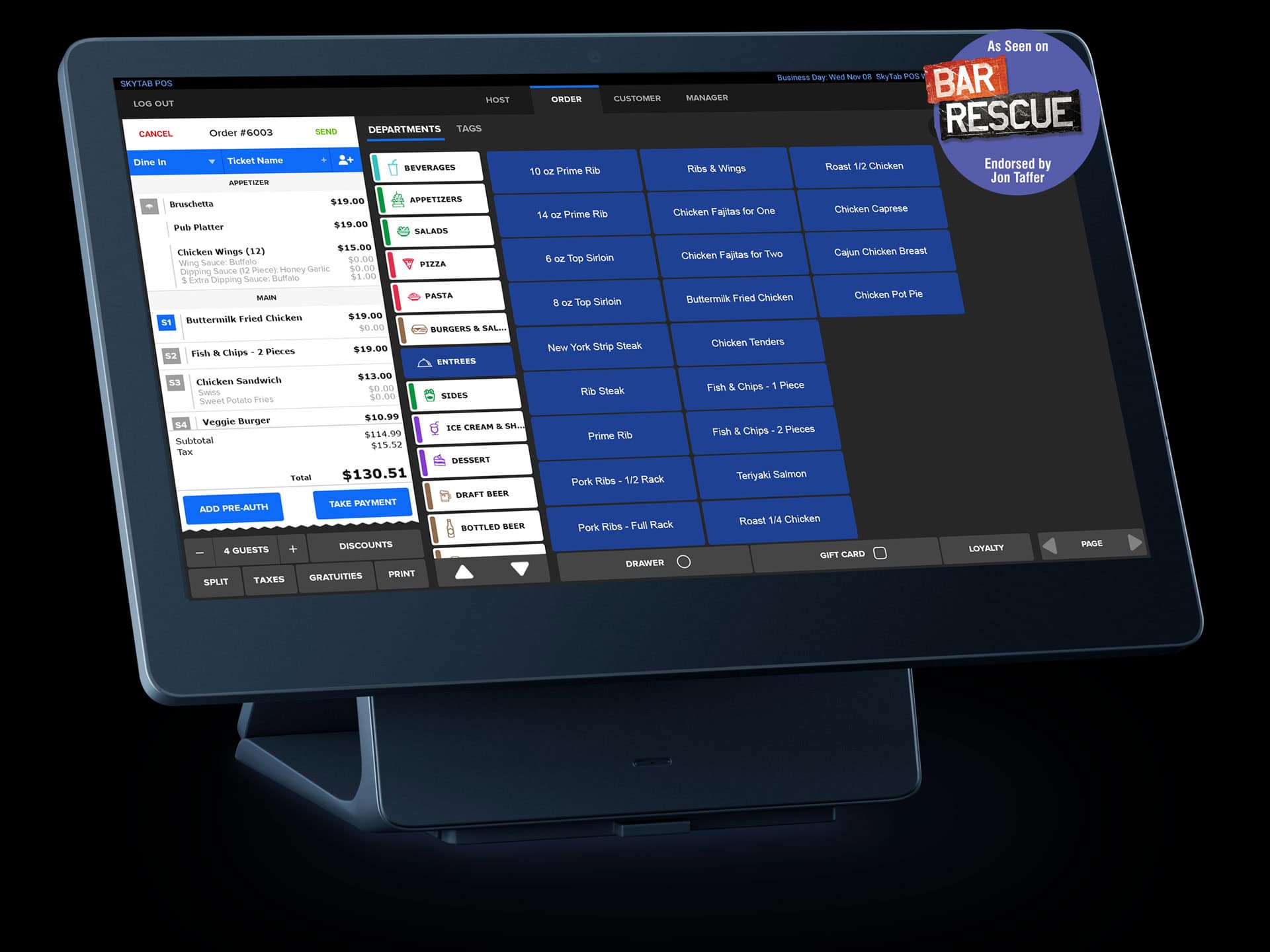
In September 2022, Shift4 launched SkyTab POS for general availability. Its Android-based restaurant platform included mobile ordering, kitchen displays and hybrid-cloud architecture intended to keep restaurants operating during an internet outage. This was a new restaurant platform carrying forward the integrated payments approach.
The shortest distance between hunger and a ticket
Consider the work an order creates. Someone takes it, communicates it, fulfills it, presents the bill and records payment. A restaurant adds complications with almost artistic dedication: substitutions, separate checks, tables that move, pickup orders that arrive while the dining room fills.
The successor platform connects several of those steps. Handhelds take orders and payments beside the guest. Kitchen displays relay tickets. Online ordering, reservations, loyalty tools and remote management extend the system beyond the register. The practical attraction is fewer places where somebody must repeat information.
Table, counter
or online
POS ticket
to kitchen
Payment
and reporting
Shoney’s provides a concrete example. In a July 2025 company-published case study, the chain described using reporting to watch activity across more than 50 restaurants remotely. Its staff also used mobile hardware for orders and payments at the table. Chairman and CEO David Davoudpour called SkyTab “a lifesaver in our business.” That is a customer endorsement, not an independently measured productivity gain.
For an owner, the useful test is specific: can this configuration handle your busiest service, your modifiers and your reporting needs? Toast, Clover, Square for Restaurants and TouchBistro also occupy this market. Harbortouch’s descendants compete through the equipment-and-service bundle and the payments relationship; a feature list alone will not settle the choice.
The arithmetic lives beyond $29.99
SkyTab’s online checkout advertises a workstation bundle at $29.99 a month, with $0 due upfront. Payment processing appears as a separate choice. The small subscription is therefore one line in the cost calculation. Transaction volume, average check size, additional hardware, integrations and the signed agreement determine more of the answer.
What does a small rate difference cost?
This isolates the percentage component: card sales × 0.0025. It excludes per-transaction charges, subscriptions and other fees. No provider rate is assumed.
The slider makes a simple point: a modest processing-rate difference can outweigh a modest software-price difference. An operator can copy this method using actual quotes and a recent statement. Run the same month through every proposal, then ask staff to perform the same awkward order on each demo.
The bundle suits businesses willing to combine POS and processing with one provider. It becomes less attractive when a required integration is unavailable, a preferred processor cannot be retained, or the service agreement does not fit the owner’s plans. Those are conditions to test before installation, while changing one’s mind is still inexpensive.
The next name on the receipt
On May 12, 2026, SkyTab POS officially became Shift4 Dine. Shift4 said the core operations, interface and functionality would remain the same. The company framed the change around a more connected platform drawing on its work in hospitality, venues and enterprise operations.
A July release offered a specific example: Deliverect connectivity for routing delivery orders into the POS and synchronizing menus. Availability covered seven named countries and required merchants with at least three locations. Even a broad platform has boundaries; “integrated” always deserves the follow-up question, “with what, and for whom?”
Harbortouch’s lasting idea is useful because it is so ordinary. A merchant needs equipment before the equipment can generate transactions. Financing that first step can open the door to a longer relationship. Whether the bargain pays for the operator depends on what happens after the machine arrives: the orders it handles, the costs it carries and the people who answer when it needs help.