Before payment terminals became small glowing rectangles asking for tips, they were instruments of suspicion. In 1981, a Honolulu entrepreneur named William "Bill" Melton built a device that let a shopkeeper check whether a paper check was likely to be good. It worked over telephone lines. The product was a verification phone, and the compressed name stuck: Verifone.
The original problem sounds quaint until you notice that the modern version is much the same. A person presents a promise to pay. A merchant wants a fast answer. Between those two moments sits a thicket of networks, banks, processors, fraud rules, credentials and local regulations. Verifone's job is to make the thicket disappear before the customer begins tapping a foot.
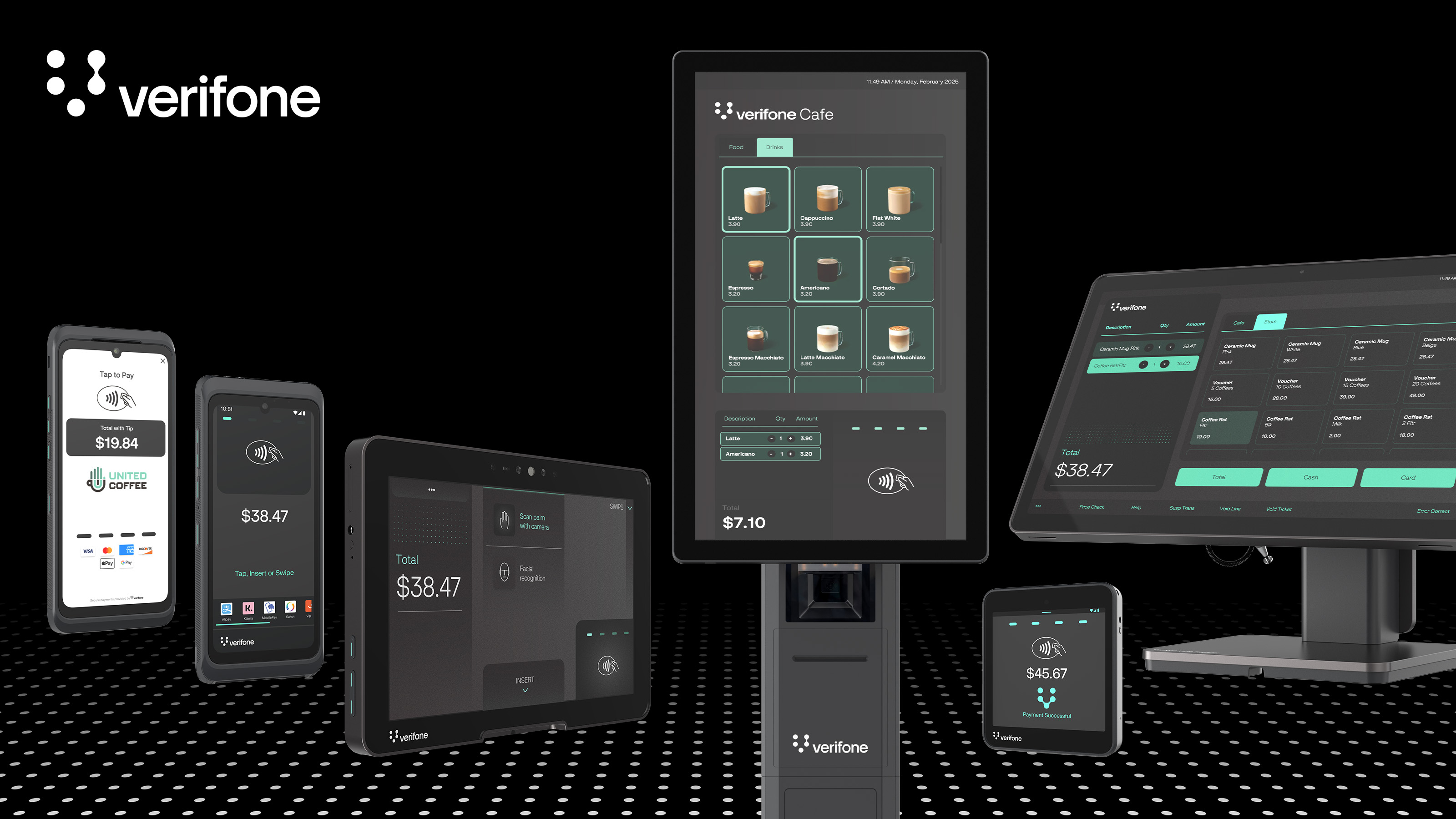
Today the company sells the object you can see and much of the machinery you cannot: handheld and countertop devices, multilane terminals, unattended readers, a payment gateway, acquiring and processing, reporting, remote fleet management, field installation and security services. Its newer Verifone Tap software can turn a compatible NFC phone into an acceptance device. Its Victa family runs Android. Its biometric work adds the possibility that a face or palm can retrieve identity, loyalty and payment credentials.
A Verifone terminal is no longer the whole product. It is the doorknob on a much larger building.The strategic shift, in one sentence
The numbers under the tap
Verifone says its technology touches more than $8 trillion in payment activity each year across more than 165 countries. The company reports more than 2,500 integrations, linking its platform to 160 acquirers and processors, 16 global and regional gateways, and more than 40 local or alternative payment methods. It also says three quarters of top retailers use its solutions. These are company figures, but together they explain the pitch more vividly than a product catalog: Verifone sells reach.
Its customers range from global retailers and grocery chains to restaurants, hotels, fuel stations, banks, payment companies, software vendors and small merchants. A supermarket needs a hardened lane device that can survive thousands of daily interactions. A waiter needs a portable terminal with a printer. A petrol station needs outdoor equipment, a site controller and specialized compliance. A growing boutique may need nothing beyond Tap on a phone. The unifying requirement is not merely taking a card. It is keeping acceptance consistent while everything around it changes.
One checkout, too many moving parts
Payments fail in boring, expensive ways. A device goes offline. A wallet works on the website but not in the store. An acquirer supports one country and not the next. A terminal certificate reaches retirement. Fraud rules reject good customers. A new app has to be installed across ten thousand locations. Reports from the shop, app and website refuse to reconcile. Large merchants often inherit several generations of this machinery at once.
Verifone's answer is a modular grid rather than a single closed lane. Its gateway is hardware-agnostic. Verifone Central provides a shared view of transactions and device operations. Estate-management tools can monitor hardware health, push updates and deploy applications without a technician visiting every store. Operational teams handle staging, installation, replacement and compliance. An enterprise can keep its chosen processor, add a wallet or connect a new commerce partner without treating each change as a complete renovation.
terminal · phone · web · kiosk
secure · route · manage · report
gateway · processor · acquirer · bank
That openness is the point of the recent partnership spree. Stripe services now run natively on selected Verifone devices. PayPal brings Braintree's online processing into an enterprise omnichannel offer. FreedomPay supplies orchestration. Shopify brings its point-of-sale software to selected Victa hardware. Bilt adds loyalty and recognition. Aevi contributes cloud orchestration. PopID supplies biometric software and sensors. In Europe, Unzer combines acquiring and software with Verifone devices for smaller retailers.
Some of these companies compete with Verifone in one layer and cooperate in another. That is not a contradiction. It is the architecture. Verifone is betting that merchants prefer a well-connected switchboard to a beautiful but locked room.
What Verifone can sell around one transaction
The business behind the box
Verifone is privately held, so it does not publish the tidy quarterly breakdown that would reveal exactly how fast each line is growing. The model, however, is legible. Hardware can be sold or leased. Gateway, device-management and analytics products create recurring software fees. Processing and acquiring produce transaction-linked economics. Support, deployment and field operations add service revenue. A merchant that begins with devices can buy more of the stack; a payment platform that begins with software can use Verifone as its physical edge.
This blend also explains the company's durability. Hardware is difficult. It must be secure, certified, available in local configurations and reliable under coffee spills, cold forecourts and impatient fingers. Global support is difficult too. A sleek software dashboard does little good if checkout lane seven is dark on a Saturday afternoon. Verifone's distribution, certification history and technicians are assets that a software-first newcomer cannot download from a repository.
The physical edge can also become a software sensor. In July 2026, Verifone announced a U.S. patent for wireless tamper detection. The technique watches for changes in the radio environment inside a terminal, allowing compatible devices to notice a hidden skimmer or another physical alteration without adding a mechanical component. It is a neat inversion: the box once built to interrogate a payment can now interrogate itself.
Every checkout is a tiny systems-integration project wearing the costume of a tap.Why payment infrastructure stays complicated
Where the moat meets the market
The competitive field is crowded. Ingenico and PAX contest the global terminal market. Fiserv's Clover and Block's Square wrap hardware, software and merchant services in tighter ecosystems. Adyen extends a single payments platform across online and in-person commerce. Global Payments, NCR Voyix, Newland and Castles occupy adjacent territory. Toast and other vertical specialists begin with the workflow of a particular industry and make payment one feature of a broader operating system.
The closed-stack appeal
One vendor, one interface and fewer initial choices. Strong for merchants that fit the standard package and value speed over configurability.
The Verifone wager
Many devices, processors, gateways and partners joined through one global layer. Strong for complex estates that need choice across regions and channels.
Verifone's difference is not that it alone can accept a contactless card. It is the combination of enterprise device breadth, local payment knowledge, security work, fleet operations and partner choice. Its North American gateway business says it serves 74 of the top 100 retailers, seven of the ten largest quick-service restaurants and 18 of the top 20 grocery chains. Those customers do not replace infrastructure lightly. The installed base is an advantage, provided Verifone can modernize it without turning familiarity into inertia.
That caveat matters. SoftPOS makes the generic terminal optional for some merchants. Consumer hardware improves every year. Competitors with vertically integrated software can iterate quickly and subsidize devices with other revenue. Enterprise customers, meanwhile, expect the polish of consumer apps without surrendering control over routing, data or vendors. Verifone must make openness feel simple, not merely possible.
From verification phone to palm wave
The Victa launch in 2025 gave this second act a physical form. The line arrived ready for Android 14 and designed toward the PCI 7 security generation, with large screens and form factors for mobile, portable and multilane use. Tap addressed the opposite end of the spectrum by letting ordinary smart devices accept contactless payment. Biometric modules, developed alongside PopID, proposed a checkout where recognition, loyalty and tender can be retrieved with a smile or palm wave.
The practical opportunity is broader than futuristic identity. A restaurant can add pay-at-table without replacing its core point-of-sale system. A retailer can deploy interactive screens for tips, loyalty, receipts or signatures. A chain can see device health and push software remotely. A brand moving into a new country can connect local tender types and acquiring relationships through existing integrations. A fuel operator can manage the peculiar marriage of pumps, stores and site controllers. The benefit is less visible technology at the moment a customer wants to leave.
A company built for the unremarkable moment
Verifone's public culture language emphasizes partnership, trust, excellence and a single global company informed by local teams. The company operates with employees in more than 40 countries and promotes flexible career paths, professional development and employee well-being. It is sensible language for a business whose products must work across wildly different retail habits and regulatory regimes. Payments may be global, but checkout is stubbornly local.
The preferred outcome for Verifone is almost comically modest: nothing happens. The card works. The wallet appears. The correct currency is offered. The loyalty account is recognized. The receipt lands where requested. The device remains online. The merchant sees one clean record. Bill Melton's first machine offered a fast answer to a nervous shopkeeper. The network is vastly larger now, but the promise remains recognizable: trust this transaction and get on with the day.