For most people, PayPal appears at the least romantic moment on the internet: after the wanting, the browsing and the comparison shopping, just before the money leaves. Its famous blue button once solved a basic web problem. A shopper did not want to hand card details to every unfamiliar store, and a small merchant could not build a global payments department. PayPal stood between them, remembered the funding source and made both sides a little less nervous.
A quarter-century later, the moment still lasts only seconds, but the machinery around it has multiplied. A PayPal payment can be branded or invisible. It can arrive through Venmo, run through Braintree, become four installments, earn a reward, cross a border, trigger a fraud model or settle partly through a dollar-backed token. The company is no longer one button. It is a switchboard for commerce - and it is trying to make all those wires feel like a single product.
01 / The machineWhat PayPal actually does
At its center, PayPal moves payment instructions among shoppers, merchants, banks, card networks and local payment systems. It authenticates users, chooses a funding route, screens for risk, converts currencies when necessary, tells the seller whether to release the goods and keeps a record in case somebody disputes the result. The easy interface is the final inch of a long industrial process.
The customers come in layers. Consumers use PayPal and Venmo to shop, send money and manage selected financial chores. A sole proprietor can send an invoice, create a payment link or take a card over the phone. A retailer can install checkout, offer installments, accept local methods and use Seller Protection on eligible sales. A large platform can call Braintree APIs, split payouts and manage payments in the background. At year-end 2025, that network covered approximately 200 markets.
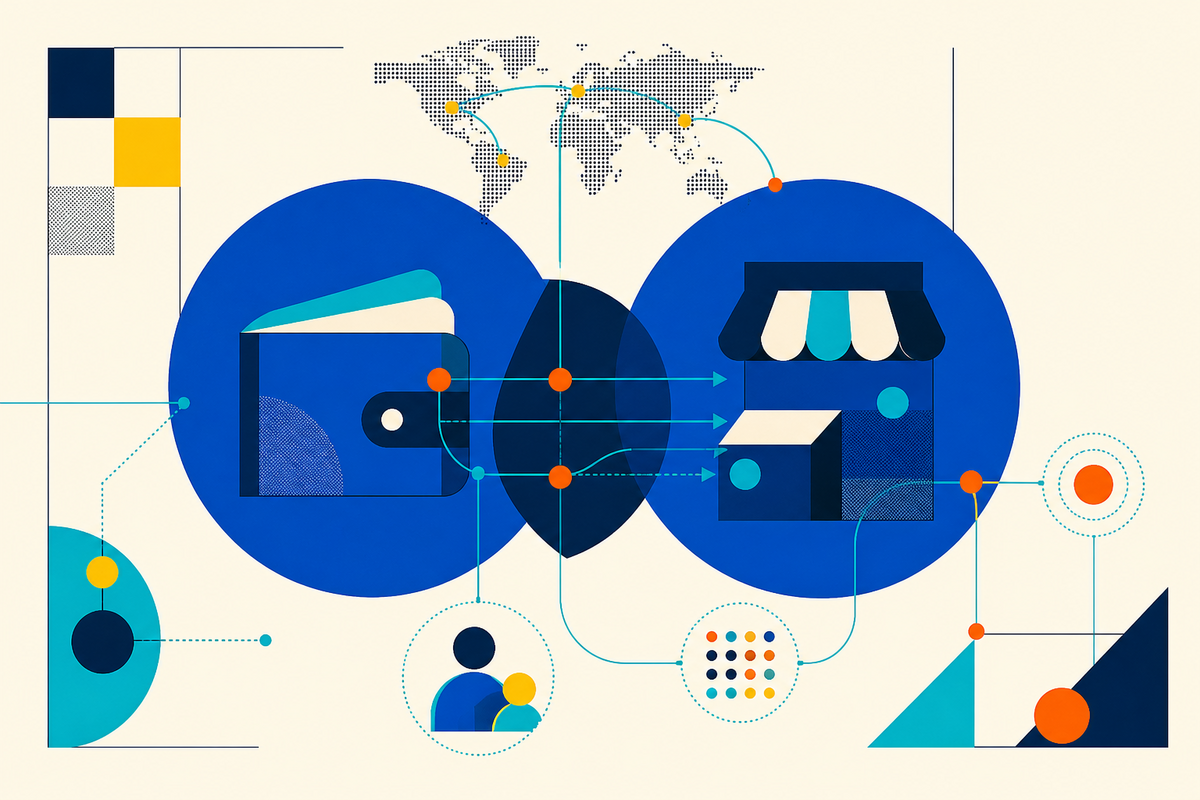
The problem being solved is larger than “move this dollar.” Online commerce is a confidence problem. Buyers worry about exposing financial details or receiving the wrong thing. Sellers worry about fraud, chargebacks, abandoned carts and a tangle of regional methods. Platforms worry about uptime, compliance and developers spending months on plumbing. PayPal's offer is a bundle of trust, conversion and orchestration. The company makes money when that bundle helps a transaction happen.
PayPal's real product is not the button. It is the promise that strangers can transact without learning too much about one another.YesPress analysis
02 / The shelvesOne logo, several businesses
The portfolio can look like a kitchen drawer, but each tool attacks a recognizable source of friction. The important distinction is visibility: sometimes PayPal wants shoppers to choose its name; sometimes it is content to be the engine beneath another brand.
PayPal Checkout
The branded wallet and payment button, with cards, balances, bank funding, Venmo and Pay Later options where available.
Braintree
Enterprise processing and gateway infrastructure. It may handle the payment even when the PayPal logo never appears.
Venmo
A U.S. social-payments network becoming a place to spend through merchant checkout, a debit card and rewards.
Credit and Pay Later
Consumer installments, cards and merchant financing that can raise purchasing flexibility and deepen account use.
Xoom and Zettle
International remittances on one side; point-of-sale tools for smaller physical merchants on the other.
PYUSD, Fastlane and Ads
A stablecoin, recognized guest checkout and a young advertising business built from commerce signals.
Fastlane is especially revealing. It pursues the shopper who does not want to log into PayPal at all. A participating merchant can recognize a returning guest and retrieve saved details, reducing form-filling without forcing the blue-button ritual. PayPal gets a larger addressable checkout, the merchant gets fewer abandoned carts, and the consumer gets speed. That is PayPal competing with one-click wallets on their own terms.
03 / The tillHow the economics work
PayPal generated $33.172 billion in net revenue in 2025. Roughly $29.8 billion came from transaction revenue: fees charged to merchants and consumers based on activity, plus revenue associated with currency conversion, cross-border payments, instant transfers and crypto transactions. Another $3.37 billion came from value-added services such as partnerships, referrals, subscriptions, gateways, credit interest and fees, and interest earned on certain assets underlying customer balances.
Where $33.2 billion came from
Fiscal 2025 net revenue. Bars show each category as a share of the total; rounded figures.
Not every dollar moved is equally valuable. Branded checkout generally brings richer margins because PayPal contributes consumer demand, identity and acceptance. Braintree can process enormous enterprise volume at slimmer economics. Peer-to-peer transfers may be free, but they keep users inside Venmo, where cards and merchant payments can earn revenue. This is why payment volume can rise faster than revenue, and why management talks about mix as often as scale.
04 / The crowded counterDifferent, but not alone
PayPal's distinction is breadth joined to a two-sided network. It knows consumers and merchants, sees both ends of many transactions and can apply that history to identity and risk. A small seller can borrow against PayPal activity; an enterprise can process through Braintree; a shopper can pay with a stored card; the same company can handle the dispute. Few rivals span the whole chain.
Apple Pay and Google Pay
Own privileged positions on devices and browsers. Their biometric convenience attacks the reason shoppers once needed a separate PayPal login.
Stripe and Adyen
Lead with developer tools and unified merchant infrastructure. They can feel more focused than PayPal's sprawling consumer-and-merchant portfolio.
Block, Cash App and Zelle
Compete for small businesses and person-to-person money movement, where local network effects and bank integration matter.
Klarna and Affirm
Made installment payments their identity. PayPal offers similar flexibility but must earn preference inside a much broader wallet.
Breadth can also blur the story. Apple owns the screen. Stripe built affection among developers. Adyen offers global merchants a clean platform pitch. PayPal can sound like six companies sharing an account system. Its strategic job is to make those pieces compound: Venmo users spend at PayPal merchants, Braintree merchants add Fastlane, transaction history improves risk, and checkout behavior informs ads. When the pieces do not connect, breadth becomes overhead.
The pressure is visible. PayPal's branded checkout - its prized, higher-margin franchise - grew only 2 percent in the first quarter of 2026. Enrique Lores, who became chief executive in March, reorganized the company around three business units and promised a more focused plan. The issue is not whether PayPal still works. It is whether consumers actively choose it when a phone, browser or commerce platform already remembers how they pay.
05 / From PalmPilot to agentA company that keeps changing costumes
PayPal's first costume was not a web button. Confinity, founded in 1998, worked on security software and payments for PalmPilots. Email payments found demand; Confinity merged with Elon Musk's X.com in 2000; the combined company took the PayPal name. After a 2002 public offering, eBay bought it for approximately $1.5 billion. Auction sellers had already made PayPal a habit.
Email beats PalmPilot payments; PayPal merges, lists and is acquired.
The portfolio broadens before PayPal separates from eBay and buys Xoom.
iZettle adds point of sale; Pay Later expands credit; PYUSD adds a stablecoin rail.
Fastlane reaches beyond logged-in users as partnerships prepare payments for AI-led shopping.
The next costume may be invisible again. PayPal is working with Google on agentic checkout and the Universal Commerce Protocol, while its planned acquisition of Cymbio is meant to make merchant catalogs discoverable through AI platforms. Travel partnerships with Sabre and Mindtrip envision a conversation that can search, assemble and pay for a trip. In that world, software may become the shopper, but somebody still has to verify authority, route funds, manage fraud and let a human contest a mistake.
PayPal World, announced in 2025, attacks a different fragmentation: local wallets that dominate at home but do not travel well. The plan is to connect major payment systems with PayPal and Venmo, turning separate networks into interoperable endpoints. PYUSD offers another route for value, especially across borders and programmable systems. These are infrastructure bets, less photogenic than a new app tab and potentially more consequential.
06 / What it is useful forThe practical PayPal
What people and businesses can do
- Check out without exposing full card details to each seller
- Send, request, split or pool money with eligible accounts
- Invoice clients or collect through links, buttons and QR codes
- Accept cards, wallets and local payment methods online
- Offer installments and apply for selected merchant financing
- Build marketplaces and payouts with APIs and SDKs
- Move money internationally through PayPal and Xoom
- Use eligible savings, debit, rewards and crypto features
Availability and fees change by country, and PayPal is not a bank. Products such as U.S. savings are supplied by partners; cryptocurrency custody and PYUSD issuance rely on regulated providers including Paxos. That arrangement is typical of modern fintech: the interface belongs to the technology company, while licensed institutions hold important parts of the balance sheet and regulatory duty.
07 / The organizationCulture under a new operating test
PayPal ended 2025 with approximately 23,800 employees representing 142 nationalities in 28 countries. It names Inclusion, Innovation, Collaboration and Wellness as core values, and translates them into three leadership principles: Put People First, Work Customer Back and Win Together. The phrases are conventional; the reorganization makes them measurable. A portfolio this broad needs teams to share identity, risk, data and distribution instead of protecting separate products.
That is the market position in one sentence: PayPal sits between a familiar consumer brand and industrial payment infrastructure. It is larger and more diversified than a single wallet, but less naturally integrated than a device owner. It has more consumer reach than a pure processor, but a more complicated product surface. Its 439 million active accounts provide an audience that a startup cannot quickly copy. They do not guarantee attention.
The next PayPal checkout may have no checkout page - only a permission, a risk decision and a receipt.On the rise of agentic commerce
The original PayPal made online strangers comfortable enough to exchange money. The present company must perform a subtler trick: persuade shoppers, merchants and software agents that its network is useful even when nobody thinks to call it PayPal. If it succeeds, the blue button will remain important, but it will be only the visible key on a much larger cash register.