At a Piggly Wiggly in South Carolina, sometime in the middle of the 2000s, a shopper could leave her purse in the car and still take home dinner. She placed a finger on a reader, typed a short search code and chose a payment account. The register received its answer. Fourteen seconds, Pay By Touch claimed. No card. No cash. No phone, because the phone had not yet swallowed the wallet.
This is the odd thing about Pay By Touch: the future it advertised no longer sounds futuristic. A body part unlocks a payment credential; identity and loyalty follow along; the checkout line moves. Yet the San Francisco company that made this work in 2002 was gone six years later. Investors had put in roughly $340 million. Its biometric network ended at 11:59 p.m. Pacific on March 19, 2008.
The business case fit on a receipt
Pay By Touch, the trading name of Solidus Networks, was founded by John P. Rogers and John Franks. Its basic bargain was unusually legible. A credit-card transaction could cost a grocer 60 or 70 cents. Debit might cost 45 cents. Pay By Touch said its fingerprint-linked ACH payments could cost 12 to 14 cents; in Piggly Wiggly's pilot, the reported company fee was 5 to 10 cents. The consumer paid nothing.
Enrollment turned a print into a mathematical template based on distinctive points. That encrypted template was matched in an IBM-run data center. It was not supposed to be a stored photograph of a finger, and a remembered code added a second check. A shopper could attach a checking account, debit card or credit card, then call up the wallet at any participating lane.
For a supermarket, the attraction was not merely speed. Pay By Touch could steer a check writer toward a cheaper electronic debit, identify a loyalty member without another card, reduce check fraud and remember offers. The company added biometric check cashing and age verification. Then it bought its way deeper into the stack: rival BioPay for $82 million, the troubled processor CardSystems, and the modern heir to S&H Green Stamps for more than $100 million.
The clever unit was not the fingerprint. It was the bundle: identity, payment and loyalty in one gesture.
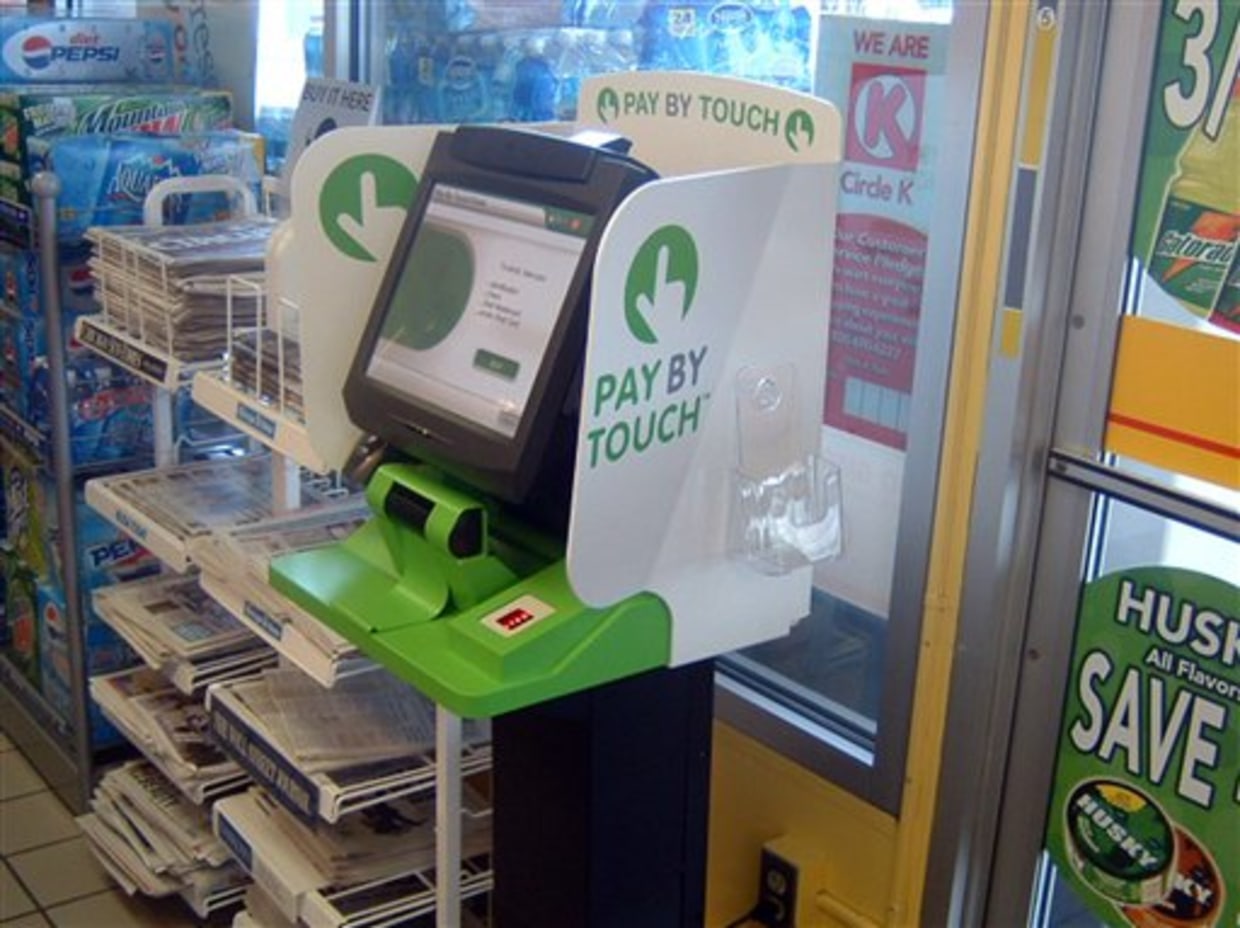
The pilot said yes. The shoppers whispered maybe.
The best part of the Pay By Touch story happened early and small. Piggly Wiggly Carolina tested the system in four Charleston stores for six months. The chain expected the fee math to be a slight loss. Enough check writers moved to electronic debits that the economics came out modestly positive. Customer interest helped persuade the grocer to extend the system across roughly 85 company-owned stores.
That is a respectable way to introduce a strange payment behavior: contained hardware, real lanes, real receipts. Other retailers followed. By late 2005, the combined network was said to include more than two million consumers. By 2006, Pay By Touch was reported in more than 2,200 US retail locations. Jewel-Osco became its largest biometric customer. There were trials in Oxford, England, about 100 sites in Singapore, and a late rollout at 10 Shell stations around Chicago. NCR worked on point-of-sale integration. IBM supplied infrastructure.
But registration is not repetition. After the service reached all 85 corporate Piggly Wiggly stores, the chain said fewer than 1% of shoppers had signed up. Pay By Touch could report 3.5 million registered users while still facing a more awkward question: how many people changed their default way to pay?
What worked
- Cheap reader hardware
- Fast, visible checkout benefit
- Lower-cost ACH routing
- Useful loyalty integration
What resisted
- Enrollment before first use
- A new habit at every register
- Trust in a central biometric vault
- Value dependent on store coverage
Payroll failed before the scanner did
Pay By Touch financed its acceleration with unusual enthusiasm. A 2005 package brought in $130 million from hedge funds including Farallon, Och-Ziff and Plainfield. Another $60 million arrived in early 2006. The money funded acquisitions and selling, while the company stretched from a clean authentication proposition into processing, check cashing, loyalty marketing and online payments.
The first public crack was not a broken reader. It was an organization unable to meet ordinary obligations. Employees were being paid intermittently in 2007. Four employees filed an involuntary bankruptcy petition over back wages. Institutional investors fought Rogers for control. A court-appointed custodian stepped in. Solidus filed for Chapter 11 on December 14.
Creditors briefly kept the core running while non-core pieces were auctioned. Then their judgment changed. The company said the enterprise could no longer support biometric authentication because of funding and market conditions. A person close to the process told the trade press that creditors doubted the technology's near-term prospects. A lender group later acquired the core assets for $4.4 million in cash and a $50 million credit bid.
A product can be early in two directions at once: technically ready and socially premature.
What is worth stealing
Pay By Touch is tempting as a morality play about hubris, but that lets the useful decisions escape. Its early operators understood several things modern fintech teams still miss.
- Price the merchant's pain. Seconds in a checkout line and cents in interchange are better sales tools than a vague promise of innovation.
- Pilot where behavior is observable. Four stores produced evidence about both costs and customer interest. That evidence was more valuable than a national announcement.
- Combine jobs that share an identity. Payment, loyalty and fraud control belonged together. Each made the same scan more useful.
- Measure repeat use, not enrollment. A large registration number can hide a tiny change in routine.
- Keep trust portable. A central network creates a frightening failure mode: if the operator disappears, who controls the biometric template and who keeps the checkout working?
The approach works best when a merchant has frequent customers, expensive legacy payments and enough lane volume to make seconds matter. It weakens when shoppers visit rarely, enrollment feels disproportionate, coverage is patchy, or a cheaper familiar gesture - a tap of a card or phone - already solves the wait. The modern winners in biometric payment usually keep the biometric on a device the customer already trusts. Pay By Touch asked the retailer's network to become that trusted device.
There is one final afterimage. The bankruptcy alarmed Illinois legislators because a failed company appeared to possess templates tied to financial identities. Pay By Touch's privacy policy reportedly constrained a sale, but the mere possibility helped move biometric privacy from seminar-room worry to legislative problem. Illinois enacted its Biometric Information Privacy Act in 2008.
So Pay By Touch left two inheritances. One was the checkout it predicted: body, identity and payment compressed into a gesture. The other was a warning that biometric convenience creates a debt of stewardship. The scanner may cost $50. The trust behind it is the expensive part.