A used car can be photographed, priced and sold online, yet the deal can still stall on a driveway. The buyer is ready. The seller has the keys. Somewhere between them, a payment needs to arrive. Motorway found that this final exchange was happening outside its marketplace, leaving delays at the doorstep and a blind spot in an otherwise digital sale.
Modulr helped bring that exchange inside. With Motorway Pay, dealers fund an online wallet and release money to sellers. If a car has outstanding finance, the workflow also handles payment to the finance company. Notifications tell the participants when money arrives. The useful innovation is almost comically ordinary: everybody can finish the transaction and get on with their day.
That is a good introduction to Modulr, a London-based payments company whose territory includes salary runs, supplier bills, travel bookings and loan disbursements. Its customers have plenty of software. Their problem is getting that software to move money without an employee shuttling information between systems.
Annualised payment value reported by Modulr in 2026. This is money processed, not company revenue.
The expensive gap after “approved”
A payroll calculation is not a salary payment. An approved invoice is not a paid supplier. Between the two can sit a bank-file export, an upload, another approval and a reconciliation exercise. Each handoff is an opportunity to waste time or introduce an error. Modulr sells accounts, payment connections and automation that join those steps to the software already running a business.
There are two ways in. A smaller employer or accounting practice can use packaged payroll and accounts-payable products, including integrations. A software platform can connect through an application programming interface, or API, and build payment features into its own service. Customers can issue accounts, collect money, schedule payouts and receive transaction updates. The interface visible to the end user may belong to someone else entirely.
Simply Lunch illustrates the first route. The sandwich supplier had grown to more than 260 employees when, according to Modulr’s customer film, its banking process became too time-consuming and costly. The finance team adopted Sage Salary and Supplier Payments, powered by Modulr. Financial controller Rebecca Byrne described the discovery with the delight usually reserved for finding a missing house key.
“It was an a-ha moment. Like someone had gone into my brain and built exactly what we needed.”Rebecca Byrne, financial controller, Simply Lunch
The film describes hours saved, without establishing a universal saving for other employers. Its more portable lesson is where the team looked: the repeated work around payroll. Motorway’s equivalent discovery was at the other end of a car sale. Both businesses changed the payment process because it was obstructing something their customers or employees already expected to work.
Closer to the machinery of money
Modulr’s argument for doing this work rests partly on how deeply it connects to payment systems. It built direct access to Faster Payments and Bacs. In August 2026, it announced direct participation in CHAPS, settling at the Bank of England. The company says that makes it the only non-bank payment service provider directly connected to all three major UK schemes.
The distinction has practical value. Fewer intermediaries can give a provider more control over execution and reduce dependencies. It also means taking on the work of operating those connections. In his account of Modulr’s first decade, founder and chief executive Myles Stephenson describes an early decision to invest in this infrastructure rather than assemble a service over multiple intermediaries.
Illustrative flow. Timing depends on the payment method and required checks.
This places Modulr in the market for embedded payments and finance operations. ClearBank is an alternative for businesses seeking banking and payment infrastructure, with a banking licence and a different account proposition. OpenPayd also operates in API-based accounts and payments. Currencycloud overlaps in cross-border infrastructure and supplies international-payment services for Modulr’s accounts-payable offering. The market contains partnerships as well as rivals.
A buyer’s useful comparison is therefore specific: supported currencies, scheme access, approval controls, integration effort and the kind of account required. Modulr’s combination of payment infrastructure and ready-made finance workflows is its pitch. Direct access alone does not settle every purchasing decision.
The invoice came with the acquisition
In November 2024, Modulr bought Nook, an accounts-payable automation company. The move brought more of the work preceding a payment into its product range: capturing an invoice, obtaining approval and keeping accounting records aligned. Modulr announced the combined AP product for early 2025.
The logic is easy to see. Moving money faster cannot repair a bill stuck in someone’s inbox. By connecting the invoice process to execution and reconciliation, Modulr can address a larger part of the finance team’s day. The product material describes accounting-system connections, configurable approvals and international payments alongside the domestic payment infrastructure.
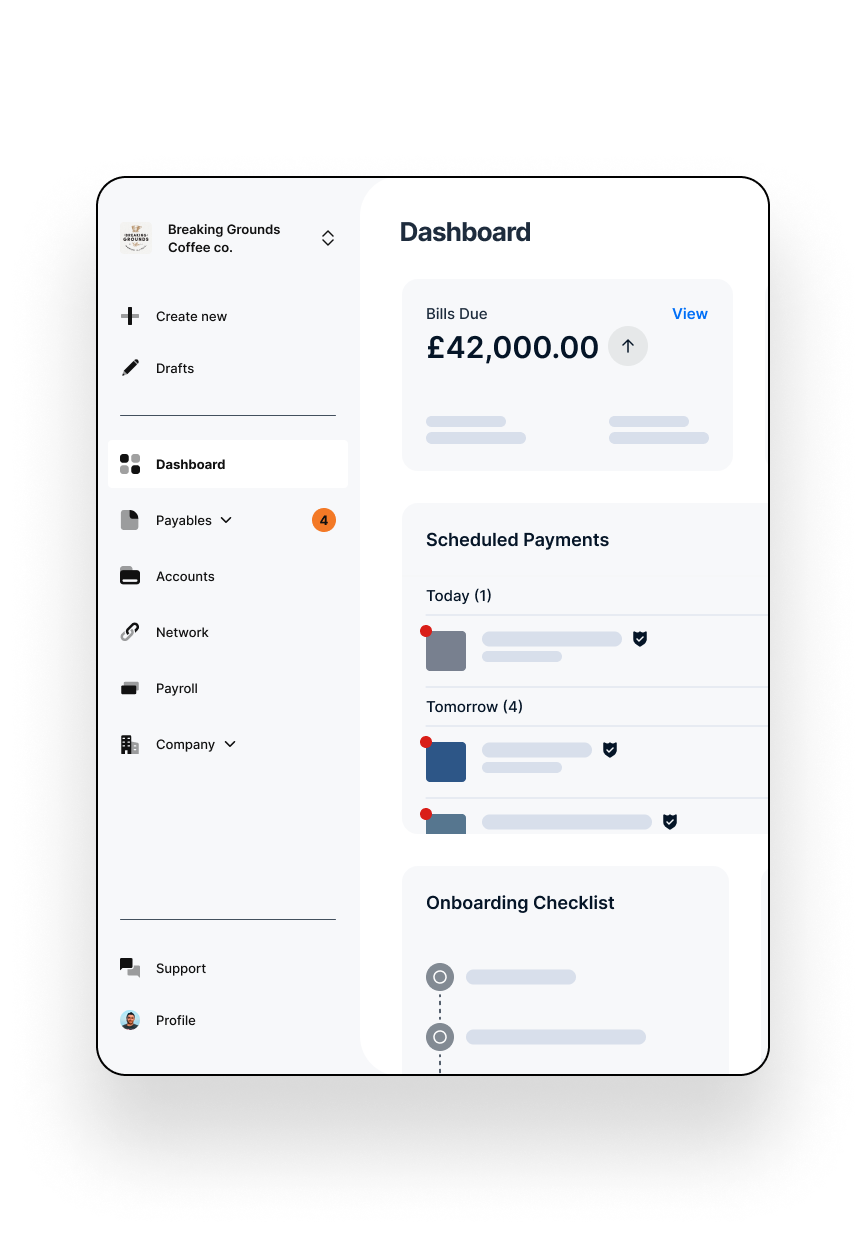
Other products follow the needs of particular industries. Travel intermediaries can use virtual cards and supplier payments; the December 2025 Conferma partnership extends Modulr’s reach into travel and hotel payments. Lenders need to disburse funds and collect repayments. The Collections Hub brings together Direct Debit and open banking, with commercial variable recurring payments added in June 2026.
Cards add another set of controls, including spending limits and restrictions on where or when a card can be used. These are different jobs with a common requirement: someone must know what the payment is for, who authorised it and whether it completed.
A £16.25 entry point; a $108 million build
For a business considering a small start, Modulr publishes prices. Its GBP Payroll Payments Bronze plan lists £16.25 a month for 35 payments, then £0.80 for each extra payment. Silver lists £67.20 for 200 payments, then £0.40 each. Those are the advertised figures checked in September 2026; other products and payment methods have their own terms and charges.
For example, 100 payments on Bronze would mean £16.25 plus 65 extra payments at 80p, or £68.25, before any other applicable charges. The arithmetic matters because the cheapest subscription is not automatically the cheapest plan at a given volume. Enterprise customers design packages with Modulr around the products they need.
Published GBP plan arithmetic, checked 7 September 2026. Excludes other applicable charges.
Building the supplier of those services required a different order of capital. In May 2022, Modulr raised $108 million, or £83 million, in a Series C led by General Atlantic. Existing investors including Blenheim Chalcot, Frog Capital, Highland Europe and PayPal Ventures participated. Geographic expansion and deeper product coverage were central to the stated plan.
In February 2026, Modulr announced full-year net profitability for 2025. It also reported more than 400 employees. Staff are called “Modulites”, and the company’s careers material stresses collaboration and problem-solving. The revealing cultural demand of this business is operational: a clever release still has to coexist with a payroll run that must happen on time.

The pause that belongs in the story
Growth brought a regulatory interruption. In October 2023, Modulr agreed it would not onboard new UK agents or distributors without prior written FCA consent. These partners extend payment services to their own users. The restriction concerned a particular distribution model, rather than a blanket stop on all customer activity.
By July 2024, reporting described the restart of that onboarding, subject to at least 10 business days’ advance notification. Modulr said it had enhanced partner onboarding and oversight, followed by internal and external testing and assurance. It is a concrete example of controls needing attention as a payment business expands.
The lesson for a customer is to examine the operating relationship as closely as the API. Modulr’s UK payment entity is an electronic money institution. E-money safeguarding differs from FSCS protection for bank deposits. Integration also requires clear approval rights, reliable customer data and a process for exceptions. Faster execution cannot compensate for an incorrectly authorised instruction.
Next stop: the bank behind the bank
Modulr entered the US in January 2026 through FIS, supplying payment-execution technology for its Money Movement Hub. The partnership offers a route to banks through an established financial-technology provider. It extends a business already accustomed to working behind another company’s customer interface.
September brought a smaller, developer-facing launch: an MCP connector that lets AI coding tools find API information and make requests in Modulr’s sandbox. The company claims working prototypes can be built up to three times faster. That is a claim about early integration work, not a guarantee about production deployment or payment speed.
For readers considering the same approach, the useful starting point is a single troublesome handoff. Count the uploads, approvals and reconciliation tasks. Establish the payment volume. Then test whether an existing integration removes enough work to justify its cost. A business with occasional straightforward transfers may have little reason to commission a bespoke payment connection; a marketplace repeatedly stranding buyers at the final step has a clearer case.
Modulr’s opportunity lives in that difference. A successful payment rarely gets applause. A delayed salary or an unfinished car sale gets immediate attention. There is a substantial business in making the quiet outcome happen more often.